
baby hornets: 5 Powerful Warning Signs to Avoid in 2025
Understanding Baby Hornets: The Complete Lifecycle Guide
If you’re searching for information about baby hornets, here’s what you need to know:
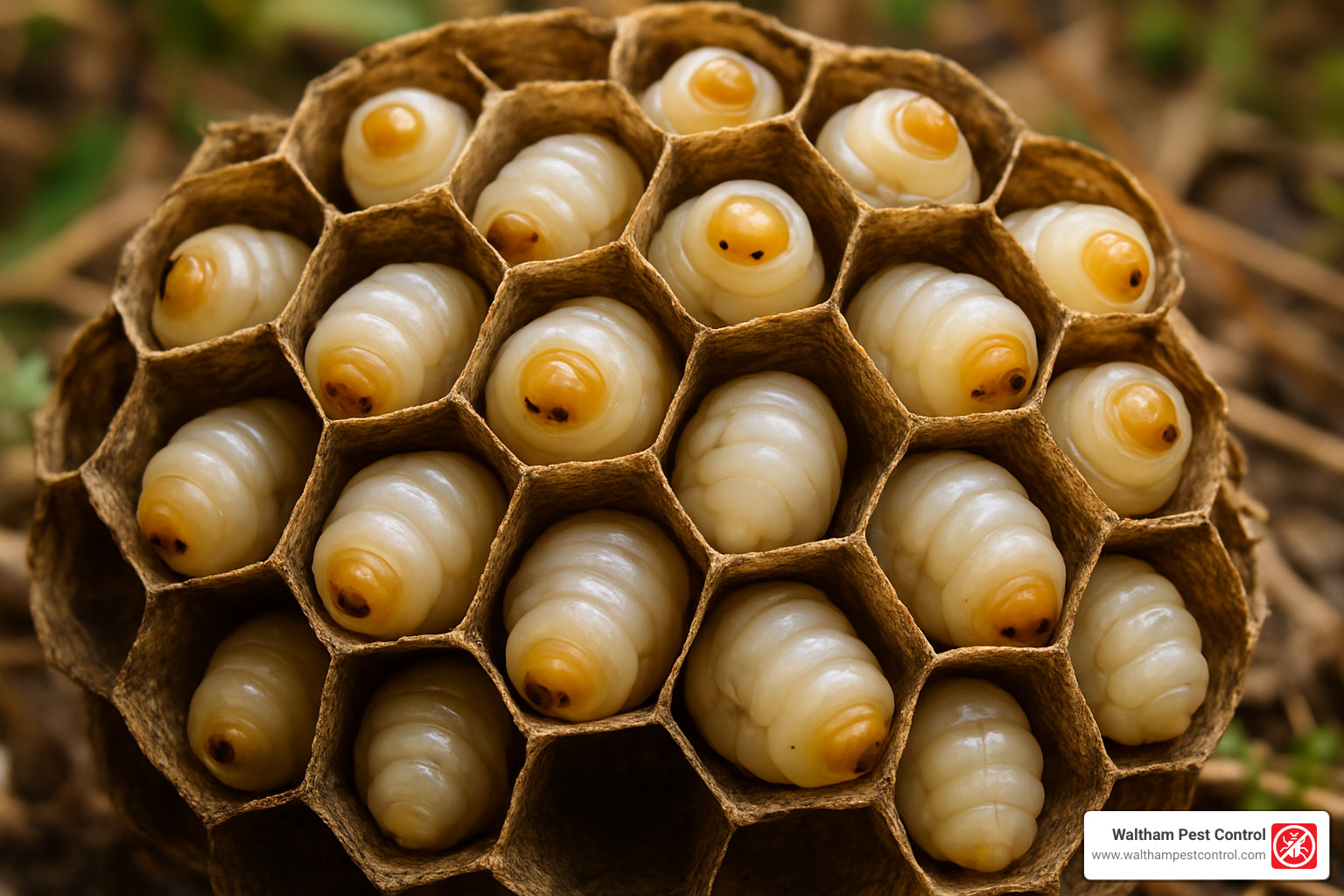
- Baby hornets are properly called larvae
- They are creamy-white, legless, and maggot-like in appearance
- They develop inside hexagonal cells within the nest
- They cannot sting and are completely dependent on adult workers
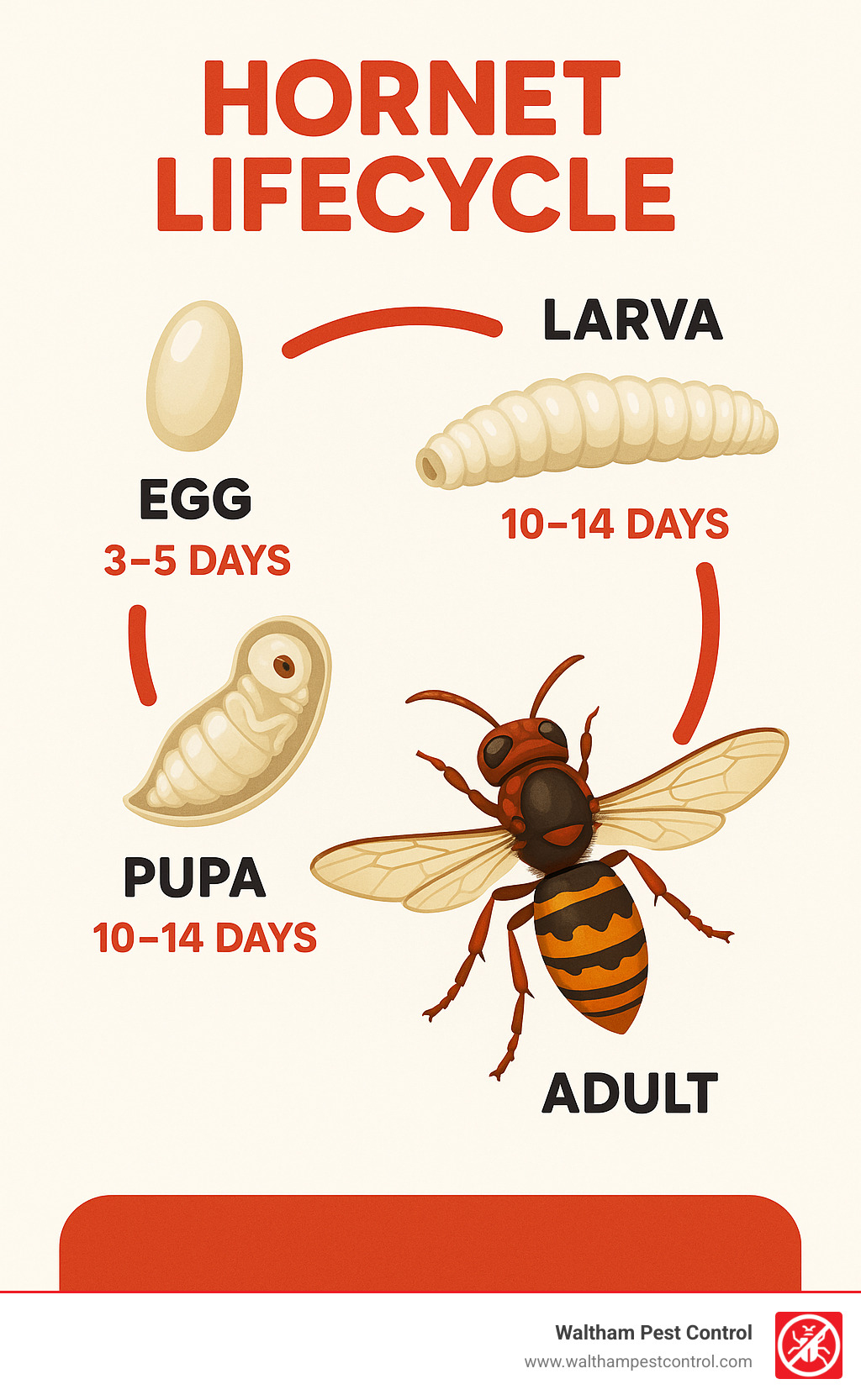
- The complete lifecycle: egg (3-5 days) → larva (10-14 days) → pupa (10-14 days) → adult
Baby hornets are a fascinating yet often misunderstood stage in the hornet lifecycle. Unlike their intimidating adult counterparts, hornet larvae are helpless, pale creatures that remain confined to their cells within the nest, where they’re fed and cared for by worker hornets. Understanding these early life stages can help you identify a developing hornet problem before it becomes a serious concern for your property.
Hornets begin their lives as tiny eggs laid by the queen in spring, hatching into larvae (the actual “baby hornets”) that require constant feeding and care. These larvae develop inside paper nests that grow throughout the season, eventually housing hundreds of individual hornets at various life stages.
I’m Waltham Pest Control, President of Waltham Pest Control, with over 40 years of experience identifying and safely managing hornet infestations, including the proper treatment of nests containing baby hornets at various developmental stages. My team specializes in effective hornet control that protects both your property and local ecosystems.
Easy baby hornets glossary:
– are ground hornets aggressive
– are hornets active at night
– how to remove a bald faced hornet nest
1. Egg Stage: The Invisible Beginning
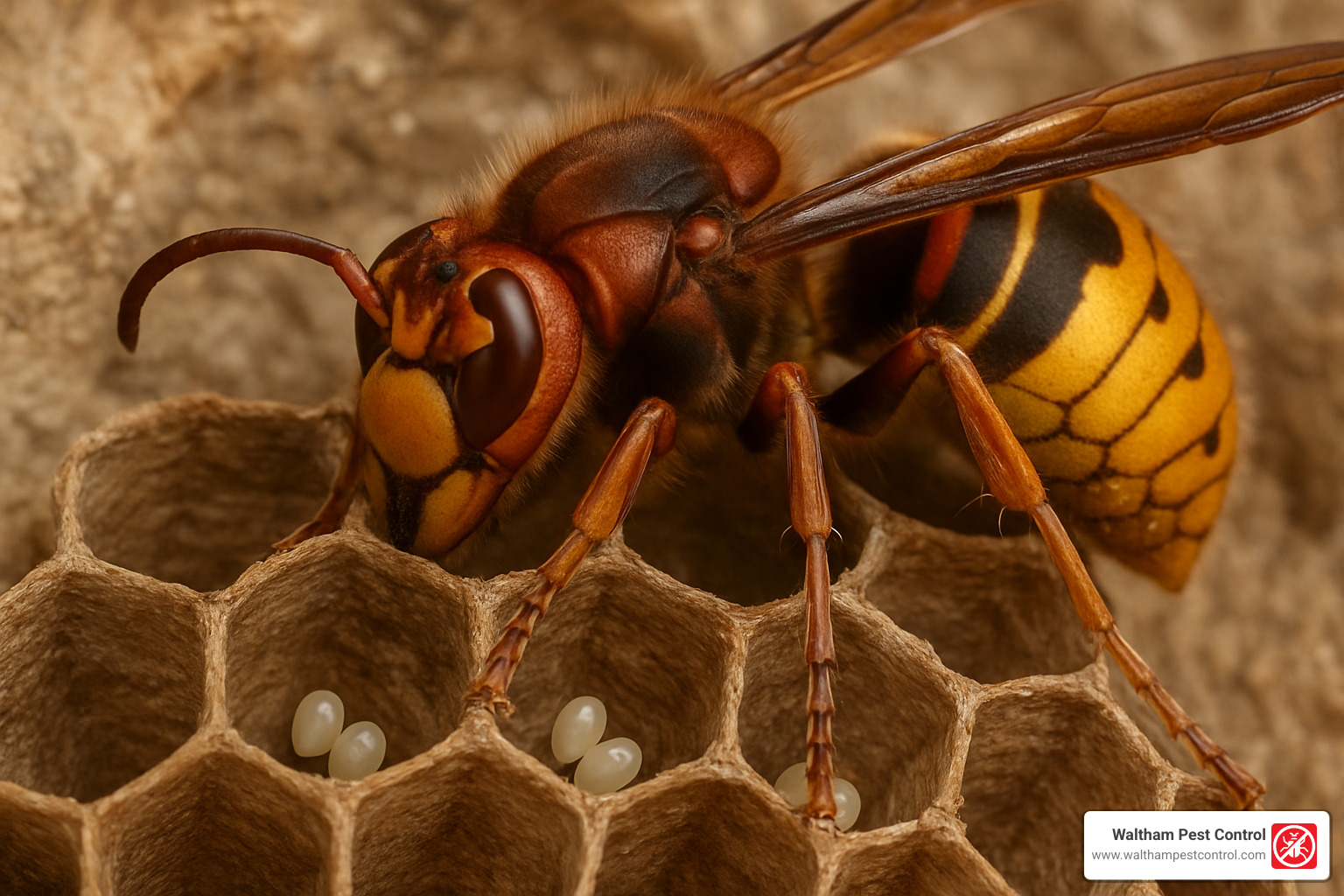
The journey of a hornet begins with a tiny, oval-shaped egg that most of us will never see with the naked eye. These minuscule eggs mark the start of the colony cycle, carefully laid by the queen hornet who emerges from winter hibernation ready to build her empire from scratch.
“A single hornet queen can lay thousands of eggs throughout the warm season,” explains our senior entomologist at Waltham Pest Control. “What’s remarkable is that she begins this enormous task entirely alone in spring, before she has any worker hornets to assist her.”
The queen carefully deposits each egg into individual hexagonal cells within the nest. These protective chambers aren’t just randomly constructed—they’re engineering marvels crafted from a paper-like material that the queen creates herself by mixing wood fibers with her saliva. These cells provide both physical protection and maintain the perfect microclimate for her precious eggs.
Here in Eastern Massachusetts, hornet eggs typically appear between April and May as temperatures begin to warm consistently. This timing isn’t random—it’s critical for colony survival. If eggs are laid too early, cold snaps could kill the developing brood. Too late, and the colony won’t have enough time to reach full strength before winter arrives.
At this vulnerable egg stage, threats abound. Predatory insects like ants may raid the developing nest. Fungal infections can take hold if humidity rises too high. Temperature fluctuations can disrupt development, and resources are stretched thin as the lone queen must hunt for food while simultaneously building and defending her nest.
The queen maintains remarkably precise humidity levels around 50-60% within the nest—essential for proper egg development. She guards these eggs with fierce determination, knowing they represent her colony’s future.
How Eggs Become Baby Hornets
The change from egg to larva is nothing short of miraculous, occurring over just 3-5 days. During this brief period, the embryo inside each egg undergoes rapid cell division and differentiation, preparing to emerge as a baby hornet larva.
The queen nourishes her eggs with royal jelly, a protein-rich secretion produced from specialized glands in her head. This nutritious substance isn’t just food—it’s the biochemical kickstarter for the entire development process, providing essential nutrients for the growing embryo.
Temperature control is absolutely crucial during this phase. The queen works tirelessly to maintain a consistent temperature of approximately 86-89°F (30-32°C) around her eggs. If you’ve ever noticed hornets rapidly beating their wings while seemingly hovering in place at the nest, they’re actually performing an important climate-control function—ventilating to regulate both temperature and humidity for the developing brood.
As each embryo develops, it gradually consumes the nutrients within its egg. Just before hatching, you might notice a subtle change in appearance—the egg becomes slightly more translucent as the developing larva prepares for its grand entrance into the world.
When hatching finally occurs, the egg casing splits open, and a tiny, C-shaped larva emerges into its cell. This moment marks the transition to the larval stage—the true “baby hornet” phase that will require constant care and feeding from the queen and, eventually, her growing workforce of daughters.
2. Larva Stage: Identifying Baby Hornets
When people talk about baby hornets, they’re usually referring to the larval stage—the tiny creatures that emerge after hatching. These freshly hatched larvae look nothing like the intimidating adults they’ll eventually become.
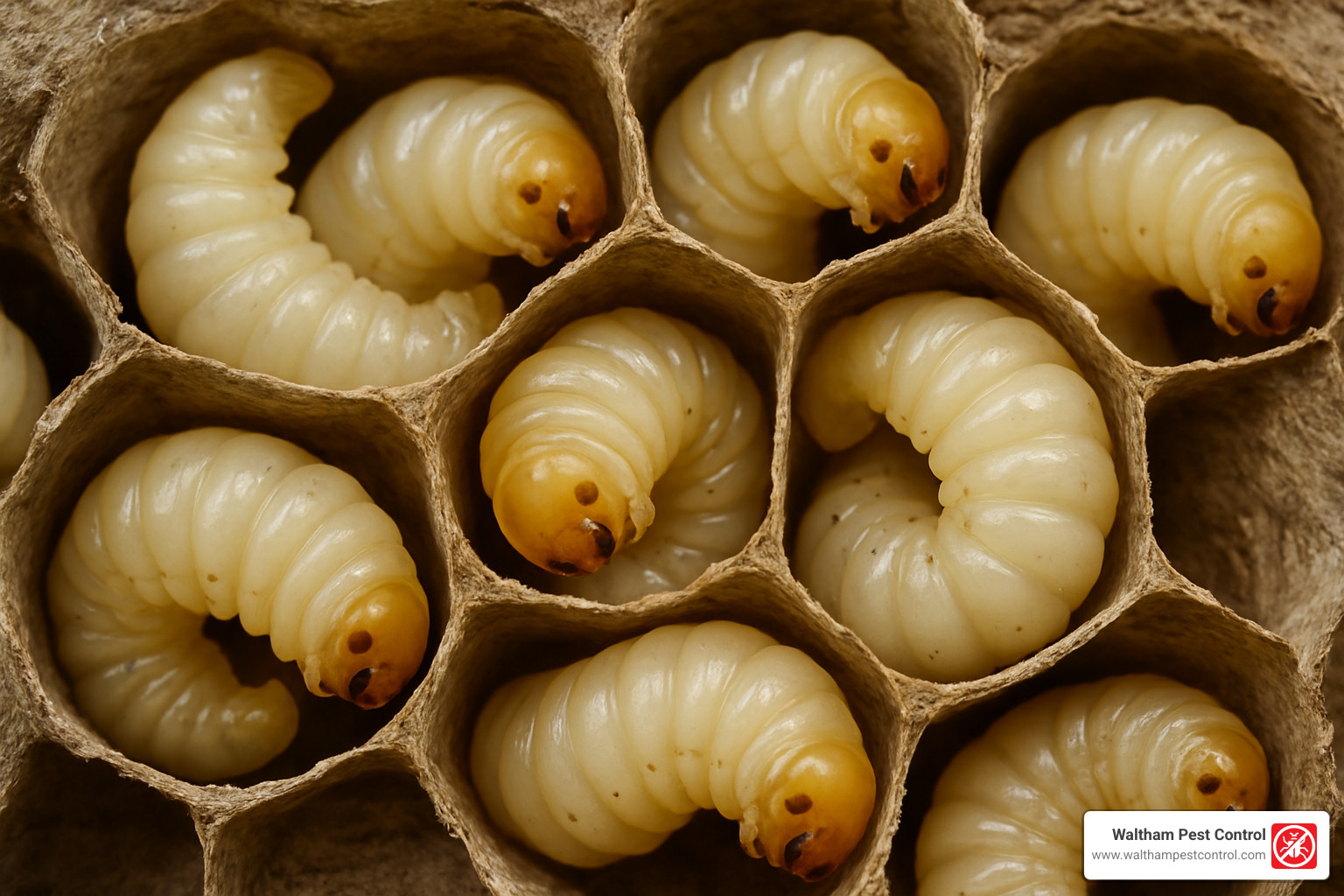
If you’ve ever peeked inside a hornet nest (though we don’t recommend it!), you’d see these baby hornets as small, creamy-white beings curled up in their hexagonal nursery cells. They have a distinctly segmented, maggot-like appearance that might remind you of small grains of rice. With no legs, wings, or even visible eyes, these helpless creatures rely completely on adult workers for their survival.
“Hornet larvae are essentially eating machines,” explains one of our field technicians who regularly handles nest removals in Burlington. “Their whole existence at this stage revolves around eating and growing—preparing for the dramatic change that awaits them.”
These baby hornets remain fixed in their individual cells, positioned with their heads pointing upward toward the cell opening. This posture allows adult workers to easily deliver food directly to their waiting mouthparts. Unlike some insects whose young can crawl about, hornet larvae are completely immobile and dependent.
As they grow, these baby hornets will molt several times, shedding their outer covering to accommodate their rapidly increasing size. By the end of the larval stage, they can reach up to half an inch long—quite a growth spurt from their tiny beginning! For more detailed information about hornet biology and behavior, you can check out National Geographic’s hornet facts page.
What Do Baby Hornets Eat?
Baby hornets enjoy a menu quite different from their adult counterparts. While adult hornets can feed on nectar and fruit juices, the larvae need protein—and lots of it—to fuel their rapid growth.
Worker hornets serve as dedicated caretakers, hunting insects like flies, bees, caterpillars, and spiders, which they chew into a fine paste before feeding to the hungry larvae. This protein slurry delivers all the nutrients needed for proper development. The feeding process, known as trophallaxis, is quite intimate—adult workers actually regurgitate this partially digested food directly into the mouths of waiting larvae.
Interestingly, this relationship benefits both parties. While the baby hornets receive their nutritional needs, they also secrete a sweet liquid that adult hornets consume as an energy source. This sugary reward motivates the workers to continue their caregiving duties.
“This exchange between larvae and adults creates an efficient nutrition cycle within the nest,” our entomologist points out. “It’s one of the key reasons hornet colonies can expand so rapidly once the first workers emerge—everyone literally feeds everyone else.”
When Do Baby Hornets Appear?
Here in Eastern Massachusetts, baby hornets begin making their appearance in late spring, typically from May to early June. As temperatures warm and food sources become more plentiful, the conditions become just right for raising the next generation.
The queen’s very first brood cycle is particularly important, as it produces the initial workforce for the colony. These first larvae develop into female workers who will take over most colony duties—building the nest, foraging for food, and caring for subsequent broods. This division of labor allows the queen to focus exclusively on her egg-laying responsibilities.
As summer progresses, the colony expands rapidly. By midsummer, a healthy hornet nest contains larvae at various developmental stages, with multiple overlapping brood cycles occurring simultaneously. The nest becomes a busy nursery with hundreds of developing hornets.
The colony reaches peak size in late summer to early fall, with bald-faced hornet nests potentially housing up to 700 hornets and European hornet colonies reaching between 300-1,000 individuals. By mid-September, nests can contain between 1,500-3,000 cells—quite the expansion from the queen’s humble spring beginning!
3. Pupa Stage: Cocoon Clues in the Nest
After feasting and growing for 10-14 days, baby hornets reach a pivotal moment in their development—the pupal stage. This third phase of metamorphosis begins when a larva has filled its cell completely and stored enough nutrients to power its remarkable change.
The transition is marked by a distinctive sign: the larva spins a silken cap over its cell opening, essentially tucking itself in for its dramatic makeover. These caps appear as slightly domed, whitish coverings that stand out from the paper-like material of the surrounding nest.
“When I’m inspecting a property, those silk caps tell me immediately that we’re dealing with a maturing colony,” shares our Burlington-based technician. “A nest with numerous capped cells isn’t just established—it’s actively producing new adult hornets that will soon join the workforce.”
Behind these silken doors, extraordinary changes unfold over the next 10-14 days. The developing hornet’s body completely reorganizes itself—compound eyes form where none existed before, wings develop and fold neatly against the body, legs and antennae take shape, and the distinctive coloration of the species gradually appears. European hornets develop their characteristic brown bodies with yellow stripes, while bald-faced hornets form their bold black and white patterns.
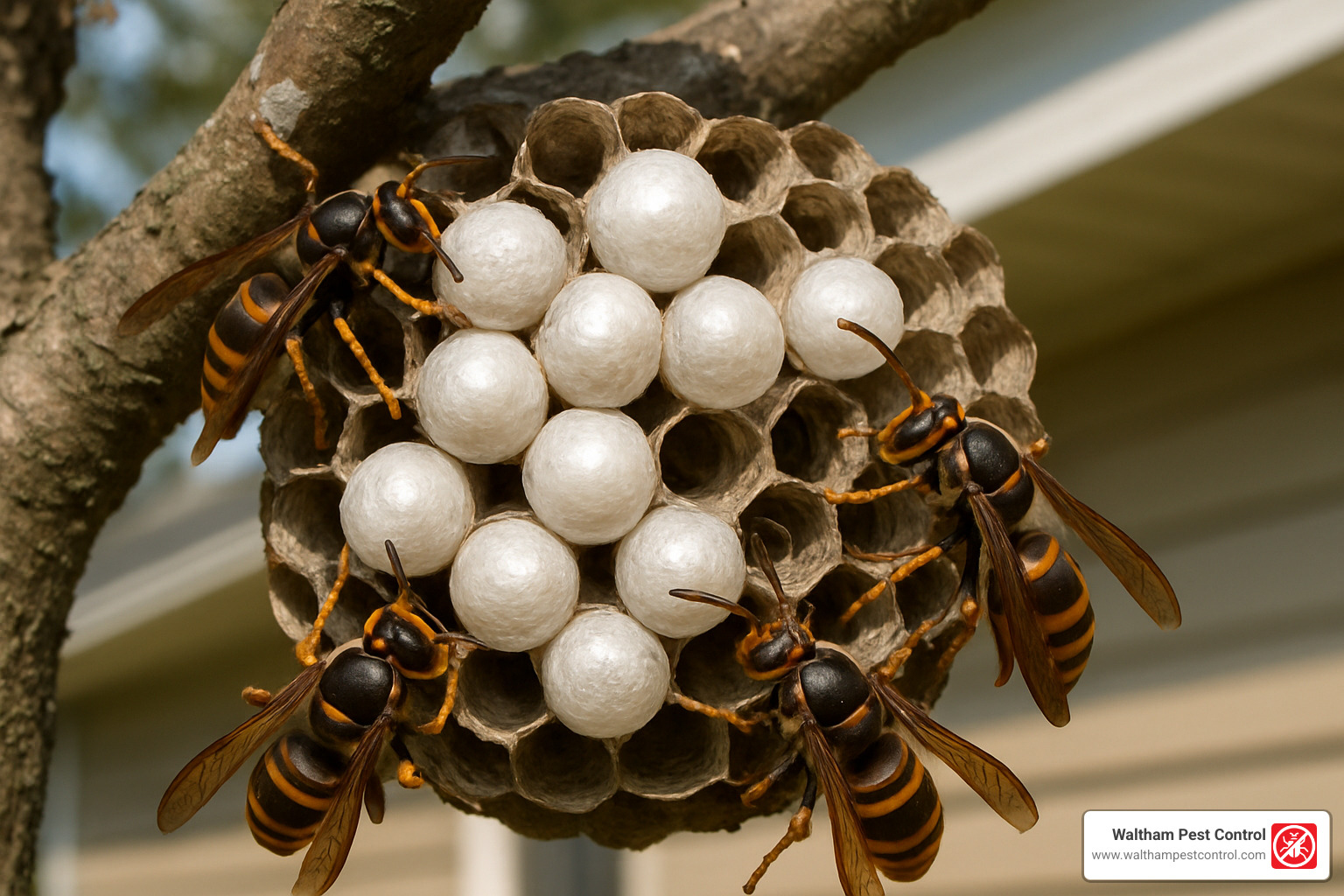
This is perhaps the most vulnerable period in a hornet’s life. Sealed in their cells, the pupae can’t move or defend themselves. Their survival depends entirely on the protective structure of the nest and the vigilant defense provided by worker hornets, who become increasingly aggressive when the nest contains developing pupae.
As you observe a hornet nest from a safe distance, several visual clues can help you identify the pupal stage:
Key pupal indicators include a patchwork of both open and capped cells, slight color variations visible through thinner caps as development progresses, and worker hornets frequently checking and attending to the capped cells. You might even notice that cells that have been capped for several days look slightly different than freshly capped ones.
The presence of these pupae signals that the colony is well-established and will soon experience a population boom as these developing hornets emerge to join the workforce. This is valuable information if you’re concerned about a nest on your property, as it helps predict how quickly the colony might grow in the coming weeks.
4. First-Day Adults: Spotting Freshly Emerged Hornets
When a young hornet finally completes its hidden change, it chews through its silken cap and steps into the busy world of the nest for the first time. These newcomers—sometimes called “callow” hornets by entomologists—stand out quite clearly from their seasoned siblings if you know what to look for.
“The first 24 hours of a hornet’s adult life are surprisingly vulnerable,” explains our Waltham Pest Control entomologist. “Their exoskeletons haven’t fully hardened yet, which is why they tend to stay safely within the nest during this critical period.”
You can easily identify these freshly emerged hornets by their noticeably softer appearance. Their bodies have a lighter, almost pastel version of the typical hornet coloration, with stripes or markings that appear washed-out compared to mature adults. They often look slightly damp or fuzzy, and their movements lack the confident coordination of their older nestmates.
One of the most fascinating behaviors to witness is the wing-pumping process. Baby hornets emerge with crumpled, folded wings that aren’t yet ready for flight. They must actively pump their hemolymph (insect blood) through the wing veins, gradually expanding them to their full size and strength—almost like inflating a tiny, intricate balloon.
As their bodies harden throughout that first day, these young hornets begin taking short practice flights near the nest. These “orientation flights” serve as flying lessons while also helping them memorize landmarks around their home. You might spot these training sessions during daylight hours, with hornets making brief, tentative journeys away from the nest before quickly returning.
Within about 48 hours, the change is complete. The young hornet’s exoskeleton fully hardens, its colors deepen to match the rich hues of the colony, and it begins contributing to nest life. These newly minted adults typically start with interior duties like nest construction and caring for the next generation of baby hornets before eventually graduating to more dangerous tasks like foraging and colony defense.
If you notice hornets with these telltale “new adult” characteristics around your property, it’s a strong indicator of an active, productive nest nearby—one that’s successfully raising new generations and likely to continue growing throughout the season.
5. Nest Clues: Where Baby Hornets Grow Up
If you’re wondering where baby hornets spend their early days, the answer lies in their remarkable nests—architectural wonders designed specifically to nurture the next generation of the colony.
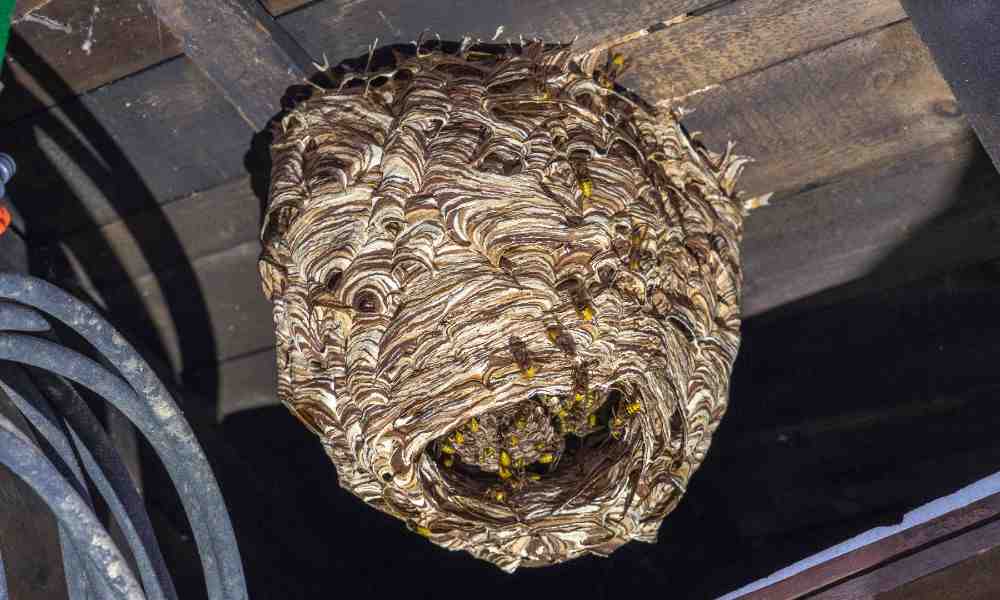
Hornet nests are truly fascinating structures, built with incredible precision and purpose. Each nest features multiple horizontal combs filled with hexagonal cells where eggs are laid and baby hornets develop. Surrounding these combs is a protective outer envelope made of several layers of paper-like material, with typically just a single entrance hole at the bottom. This design isn’t random—it creates the perfect microclimate for developing hornets, maintaining optimal temperature and humidity year-round.
“What I find most remarkable about hornet nests is that they’re essentially made from recycled wood,” shares our technician who specializes in nest removal in Tewksbury. “Workers actually chew wood fibers from trees, fences, or even your home’s siding, mix it with their saliva, and craft this natural paper-mâché building material. It’s ingenious when you think about it.”
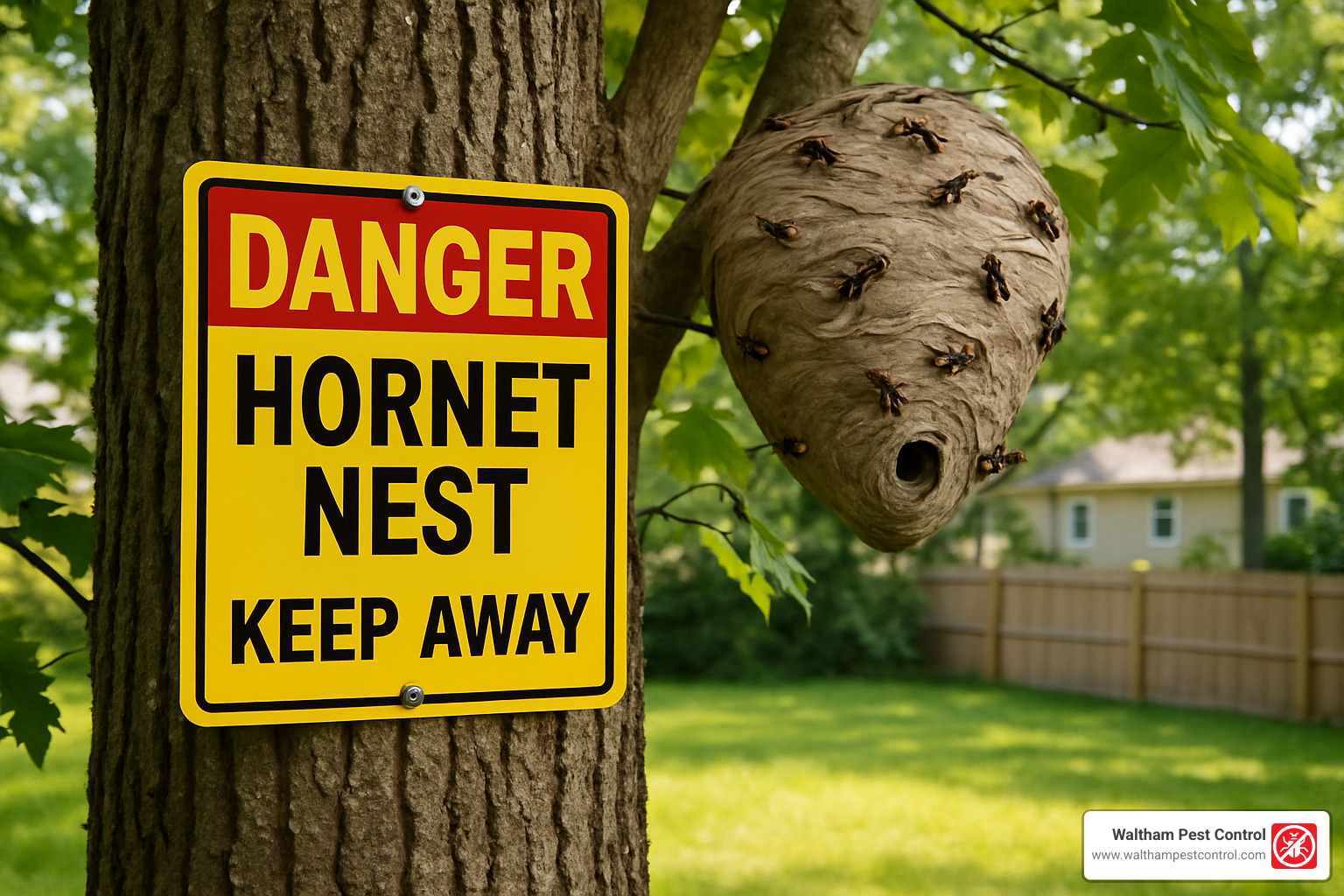
When searching for baby hornets, you’ll typically find their nests in several common locations. Tree hollows and cavities are particularly popular spots, especially for European hornets who prefer enclosed spaces. The underside of eaves and overhangs offer perfect attachment points, while attics and wall voids provide both protection and insulation. Many species, especially bald-faced hornets, build their distinctive football-shaped nests hanging from tree branches, while some may take advantage of abandoned structures for additional protection.
You can often gauge a colony’s age and population by the size of its nest. In early spring, a new queen’s nest might be no larger than a golf ball, housing just her and her first brood of baby hornets. By late summer, however, that same nest could expand to basketball size or larger, potentially containing hundreds of individuals in various life stages.
“Last August, we removed a nest from a property in Lexington that housed over 700 hornets,” our senior technician recalls with a shake of his head. “Inside that single structure was the entire lifecycle—fresh eggs, developing baby hornets at various stages, pupae, and adults. It was like a small city with different neighborhoods, all built for one purpose: raising the next generation.”
If you spot what appears to be a hornet nest on your property, we strongly recommend professional hornet nest removal. Attempting DIY removal can be dangerous, especially with larger, established nests. Our trained technicians at Waltham Pest Control have both the expertise and specialized equipment to safely remove these nests while minimizing risks to you and your family.

Frequently Asked Questions about Baby Hornets
What is a baby hornet called?
When people talk about baby hornets, they’re actually referring to larvae—the scientific name for this developmental stage. While “baby hornet” works fine in everyday conversation, entomologists use more specific terminology to describe these fascinating creatures.
“I often have homeowners call about ‘baby hornets’ when they spot larvae in a nest,” shares our senior technician. “It’s a perfectly natural way to describe them, even if it’s not the technical term we use in the field.”
The complete life cycle uses these specific terms:
1. Egg – The tiny, oval beginning
2. Larva – The feeding and growing stage (our baby hornet)
3. Pupa – The change stage inside the sealed cell
4. Adult – The fully formed, flying hornet
What makes hornets fascinating is that they undergo complete metamorphosis. Unlike some insects that simply grow larger versions of their juvenile form, baby hornets look nothing like their adult counterparts—they essentially rebuild their entire bodies during the pupal stage!
How long does it take for a baby hornet to become an adult?
The journey from egg to adult happens surprisingly quickly, though the exact timeline varies slightly based on species, temperature, and food availability. In general, you can expect:
- Egg stage: A brief 3-5 days
- Larval stage: About 10-14 days of intensive feeding
- Pupal stage: Another 10-14 days of change
- Total development: Approximately 23-33 days from start to finish
“Weather plays a huge role in how quickly baby hornets develop,” explains our Burlington-based technician. “During those hot July weeks, we see development times at the shorter end of the range, while spring broods might take a bit longer.”
Bald-faced hornets typically complete their development in 20-25 days under ideal conditions. European hornets, being slightly larger, may need a few extra days, especially when temperatures are cooler.
The queen’s first batch of offspring often develops more slowly due to spring’s cooler temperatures and the fact that she’s handling everything alone. Once worker hornets take over nest maintenance and foraging duties, development becomes more consistent and efficient throughout the summer.
Are baby hornets dangerous to humans?
Good news—baby hornets (larvae) pose absolutely no direct danger to humans. These soft-bodied creatures:
- Can’t sting (they lack stingers completely)
- Are physically unable to leave their cells in the nest
- Have no effective way to bite or defend themselves
- Rely entirely on adult workers for survival
“The larvae themselves are completely harmless,” our Waltham entomologist explains, “but that doesn’t mean you should approach a nest containing them. In fact, quite the opposite.”
The real danger comes from the adult hornets guarding the nest. Adult hornets are programmed with powerful protective instincts toward their developing brood. A nest filled with baby hornets will be aggressively defended by workers who perceive any nearby movement as a potential threat.
If you find a hornet nest with larvae inside, remember these safety tips:
– Maintain a distance of at least 10 feet—more if possible
– Never poke, throw objects at, or otherwise disturb the nest
– Keep children, pets, and curious neighbors away from the area
– Call professional pest control rather than attempting DIY removal
Even people without known allergies can experience significant pain, swelling, and potentially dangerous reactions from multiple hornet stings. For those with allergies, even a single sting could trigger a life-threatening situation requiring immediate medical attention.
Conclusion: Protecting Your Property from Hornet Colonies
The journey from egg to adult hornet is a fascinating biological process, but one that can create genuine safety concerns for homeowners. By understanding how baby hornets develop into aggressive adults, you can better protect your property and family from potential dangers.
Hornet colonies follow a predictable annual cycle that begins anew each spring. A single queen emerges from hibernation, builds a small starter nest, and lays the first eggs of the season. From these humble beginnings, colonies can explode in size by late summer, housing hundreds of hornets at various life stages.
“What many homeowners don’t realize is that timing is everything when dealing with hornets,” says our lead technician. “A nest spotted in May might have just a handful of hornets, but that same nest in August could contain an entire army ready to defend their home.”
Remember these critical points about baby hornets and their colonies:
The presence of larvae in a nest means adult workers are actively patrolling and will aggressively defend their developing brood. Nests with baby hornets inside are significantly more dangerous than empty or abandoned structures. As summer progresses into fall, colonies reach peak size and aggression levels, making professional intervention increasingly important.
While hornets won’t return to the same physical nest next year (nests are abandoned in winter), they often rebuild in locations that previously proved successful. This is why comprehensive treatment and prevention are so important.
At Waltham Pest Control, we bring over four decades of experience to every hornet situation we handle. Our technicians are trained to safely assess, treat, and remove hornet nests while minimizing risks to your family and property.
“Safety is always our primary concern,” explains our senior specialist. “We use specialized equipment and techniques that allow us to effectively eliminate the colony without putting anyone at risk. This isn’t something homeowners should attempt themselves, especially when baby hornets are present and adults are in full protection mode.”
Beyond immediate nest removal, we also help identify conditions that might make your property attractive to future hornet queens. Simple adjustments to landscaping, lighting, and structural maintenance can significantly reduce your chances of dealing with hornets next season.
If you’ve spotted hornets around your Eastern Massachusetts property, don’t wait for the colony to grow larger and more dangerous. Our licensed and insured professionals serve Burlington, Tewksbury, and surrounding communities with prompt, effective hornet control solutions.
For more detailed information about our services in specific locations, visit our guide on hornet nest removal in Tewksbury or contact us to schedule a professional inspection.
When it comes to hornets, professional help isn’t just convenient—it’s the safest choice you can make for your family and home.