
What do pest control companies use for ants: 4 Best Tips
Why Professional Ant Control Methods Are Essential
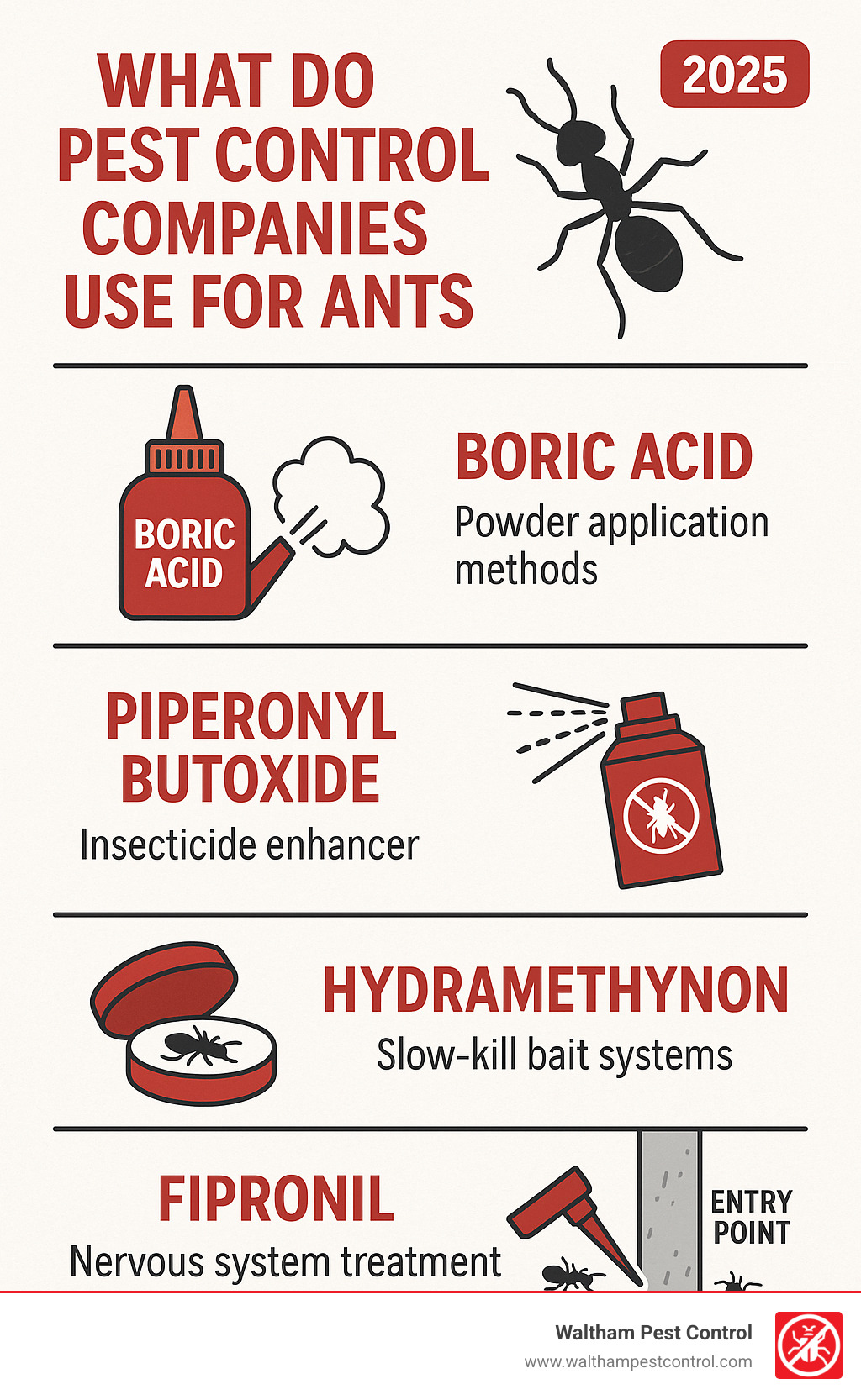
What do pest control companies use for ants is a common question for homeowners and business owners dealing with persistent ant problems. Professional exterminators typically use four main types of treatments:
- Boric acid – A powder-based poison that targets ant digestive systems
- Piperonyl butoxide – An additive that increases the potency of other insecticides
- Hydramethylnon – A slow-acting ingredient that allows ants to carry poison back to colonies
- Fipronil – A nervous system disruptor applied at entry points
Ant infestations can quickly spiral out of control without proper treatment. These tiny invaders don’t just appear in kitchens – they can damage property, contaminate food supplies, and create serious problems for businesses in food service, healthcare, and hospitality industries.
Understanding the science behind professional ant control helps property owners make informed decisions about treatment options. While DIY methods might provide temporary relief, professional-grade solutions target entire colonies and prevent future infestations.
Different ant species require different approaches. What works for carpenter ants won’t necessarily eliminate pavement ants or pharaoh ants. Professional pest control companies have access to specialized products and application methods that aren’t available to consumers.
As Waltham Pest Control, President & CEO of Waltham Pest Control with over 40 years of experience in Eastern Massachusetts, I’ve seen what do pest control companies use for ants and how these methods have evolved to become more effective and environmentally friendly. My team handles ant infestations across residential and commercial properties using integrated pest management solutions that deliver lasting results.
Quick what do pest control companies use for ants terms:
What Do Pest Control Companies Use for Ants?
When you call in professional exterminators, you’re getting access to specialized knowledge and tools that go far beyond what’s available at your local hardware store. We don’t just spray and hope for the best – we understand ant biology and behavior, which lets us choose the right weapons for the job.
The answer to “what do pest control companies use for ants” centers around four key active ingredients that form the backbone of professional ant control. Each one works differently, but they all share one important trait: they’re designed to eliminate entire colonies, not just the ants you see marching across your counter.
Boric Acid
Boric acid has been a pest control staple for decades, and there’s a good reason it’s still in our toolkit. This naturally occurring mineral compound acts as a stomach poison that’s particularly effective when mixed with sweet attractants.
Here’s what makes boric acid so clever: it has a mild sweetness that draws ants in, but once they eat it, it disrupts their digestive system. The real magic happens because boric acid works slowly enough that foraging ants can carry it back to the nest and share it with their colony mates through a process called trophallaxis.
When we use boric acid, we’re not just targeting the scouts you see in your kitchen. We’re reaching the queen, the larvae, and the workers deep in the nest. The powder formulation mixes easily with attractants, creating baits that entire colonies will consume before they realize what’s happening.
Piperonyl Butoxide
Piperonyl butoxide might sound complicated, but think of it as a performance improver for other insecticides. This additive doesn’t kill ants on its own – instead, it makes other active ingredients work harder and longer.
When ants encounter insecticides, their bodies naturally try to break down and eliminate the toxic compounds through enzyme activity. Piperonyl butoxide blocks this metabolism process, essentially preventing ants from detoxifying themselves. This dramatically increases the potency of pyrethrins and pyrethroids, making treatments more effective with smaller amounts of active ingredient.
It’s like putting a turbo charger on your car’s engine – the same fuel goes much further and delivers more power.
Hydramethylnon
Hydramethylnon is the patient assassin of the ant control world. This metabolic inhibitor works against multiple pest species, but its slow kill approach makes it particularly devastating to ant colonies.
The gradual effect is exactly what makes hydramethylnon so effective. Ants consume baits containing this ingredient and feel fine for days. They go about their normal business, sharing food with nestmates and caring for young, all while carrying a lethal dose that hasn’t activated yet.
When the effects finally kick in, the entire colony has been exposed. We often see complete colony collapse weeks after the initial treatment, as the poison works its way through every level of the ant hierarchy.
Fipronil
Fipronil attacks the ant’s nervous system, but what makes it special is that ants can’t detect it. Unlike repellent sprays that ants will avoid, fipronil is completely invisible to them, so they walk right through treated areas without realizing they’ve picked up a deadly dose.
We typically apply fipronil at key entry points where ants are most likely to encounter it. The slow-acting formula gives ants time to transfer the active ingredient to their nestmates through contact and food sharing.
While some formulations might have a slight moldy smell, professional-grade fipronil products are usually odorless, making them perfect for indoor applications where discretion matters.
Understanding what do pest control companies use for ants helps explain why professional treatments are so much more effective than DIY approaches. These four ingredients work together in various combinations to create comprehensive solutions that eliminate entire colonies, not just the ants you can see.
How Exterminators Eliminate Ant Infestations
When you call in professional exterminators, you’re getting more than just someone with a spray bottle. What do pest control companies use for ants goes far beyond the chemicals – it’s about having a systematic, science-based approach that gets to the root of the problem.
Think of it like being a detective. We don’t just show up and start spraying randomly. Every ant infestation tells a story, and our job is to read the clues and solve the mystery. The methodical process we follow ensures that we’re not just treating the symptoms, but eliminating the entire colony for good.
Identifying the Ant Species
Here’s where things get interesting – not all ants are created equal. What works brilliantly for one species might be completely useless against another. Species identification is like having the right key for the right lock.
Carpenter ants are the big guys who love to tunnel through wood, so we need treatments that can reach deep into their galleries. Pavement ants prefer to set up shop under concrete and asphalt, which means we’re often working outdoors around foundations and walkways.
Then you have odorous house ants – yes, that’s their actual name! These little troublemakers smell like rotten coconut when you crush them (not that we recommend the crushing method). They’re sneaky because they love to create multiple satellite nests, making them trickier to eliminate completely.
Pharaoh ants are probably the most challenging. These tiny yellow invaders have a survival trick called “budding” – when they feel threatened, they split into multiple colonies. It’s like trying to stop a zombie apocalypse if you don’t handle them correctly.
Our team knows how to spot the differences in size, color, behavior, and nesting habits. This identification step is crucial because it determines everything that comes next in our custom treatment methods.
Assessing the Infestation
Once we know what we’re dealing with, it’s time to play detective and assess the full scope of the problem. This isn’t just about counting ants – we’re looking at severity levels, tracking down nest locations, and estimating colony size.
We follow the ant highways (their trails) like breadcrumbs leading us back to their home base. We inspect every potential entry point – those tiny cracks in foundations, gaps around windows, and anywhere else these persistent little invaders might be sneaking in.
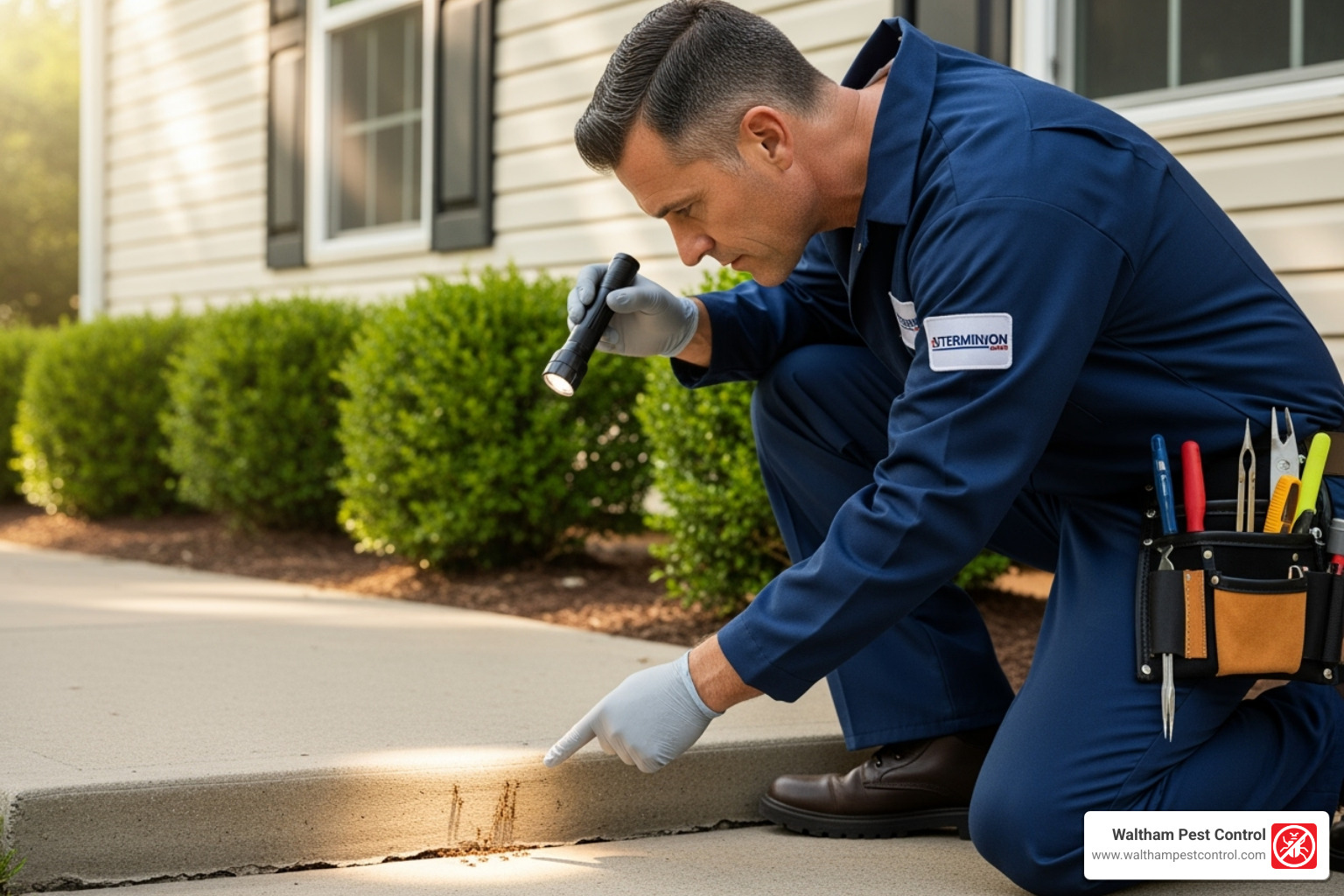
For carpenter ants, we actually listen to the walls. Seriously! You can sometimes hear them rustling around inside wood structures. With pavement ants, we’re down on our hands and knees examining cracks in sidewalks and driveways.
This thorough assessment tells us exactly where to focus our efforts and helps us choose the most effective treatment approach. There’s no point in treating the kitchen if the real problem is a colony living under your front porch.
Applying Treatments
Now comes the action part – but it’s still strategic, not random. We use different tools for different situations, always with the goal of eliminating the entire colony, not just the ants you can see.
Baits are often our weapon of choice, especially for species that love to share food. We strategically place baits containing hydramethylnon or boric acid right where the ants are actively foraging. The beauty is that the worker ants become our delivery system, carrying the poisoned food back to feed the queen and larvae.
Non-repellent liquid treatments create an invisible barrier around your property. Unlike those DIY sprays that ants learn to avoid, these treatments are completely undetectable. Ants walk right through them, pick up the active ingredient like fipronil, and unknowingly carry it back to the nest.
For hard-to-reach spots, we use ant dusts – typically boric acid-based products that we apply to voids, cracks, and crevices. These provide long-lasting control in areas where liquid treatments or baits might not be practical.
Sometimes we need immediate knockdown of visible ant populations with targeted sprays, but these are always part of a bigger strategy focused on colony elimination. After all, killing the ants you can see is just the beginning – the real victory comes when we eliminate the source.
Common Methods for DIY Ant Control
I get it – when you first spot ants marching across your kitchen counter, your instinct is to grab whatever’s handy and start fighting back. While I always recommend calling in the professionals for persistent problems (especially after seeing what do pest control companies use for ants compared to store-bought options), I understand that many homeowners want to try tackling the issue themselves first.
The truth is, DIY ant control can provide temporary relief, but it rarely addresses the root of the problem. Most home remedies focus on the worker ants you can see, while the real issue – the colony with its queen and larvae – remains safely hidden and continues to thrive.
Search for the Ant Nest
Your first mission, should you choose to accept it, is playing detective. Start by following ant trails to see where they’re coming from and where they’re headed. Check those damp places like under kitchen sinks, behind water heaters, or in basement corners where moisture collects.
Outside, look for small anthills in your lawn or cracks in sidewalks and driveways where ants might be setting up shop. You might notice tiny piles of soil or sand – dead giveaways that ants are excavating nearby.
Here’s the challenge though: ant colonies are master architects. They often build their nests deep within wall voids, under concrete slabs, or even maintain multiple satellite nests. What looks like the main highway might just be a side road to their underground empire.
Spray with Insecticides
The spray-and-pray approach is probably the most common DIY response. You’ll find plenty of certified products at your local hardware store, most containing pyrethrins or similar active ingredients. These can definitely kill the ants they hit directly – very satisfying in the moment, I’ll admit.
But here’s where timing matters. Application times are crucial because you’re essentially just treating the symptoms. Those worker ants you’re spraying? They’re replaceable. The colony will simply send out more workers while the queen continues laying eggs safely in her hidden chamber.
Always follow safety guidelines on the label. Even over-the-counter products can be harmful if misused, especially around children and pets.
Trap the Ants
Making your own ant traps can feel like a science experiment. The classic recipe involves mixing boric acid with sugar or honey, then placing the mixture in small containers where ants can access it but kids and pets cannot.
The theory is sound – it’s similar to what professionals do with baits. Ants take the poisoned treat back to share with their colony mates. The tricky part is getting the concentration just right. Too much boric acid and ants die before they can share the wealth. Too little and it’s about as effective as offering them a healthy snack.
Use Diatomaceous Earth
This cost-effective option has gained popularity among homeowners looking for natural solutions. Food-grade diatomaceous earth works against multiple pests by physically damaging their exoskeletons, causing them to dehydrate.
The application method is straightforward – dust it lightly in areas where you’ve seen ant activity. It’s safe around family and pets when you use food-grade DE. Just remember that it becomes ineffective when wet, so you’ll need to reapply after cleaning or rain.
Remove Ant Trails
Here’s a simple trick that can provide immediate (though temporary) satisfaction. Mix up a vinegar solution or use soapy water to wipe down ant trails. This helps disrupt scent trails that ants use as their GPS system.
The goal is to create confusion in their ranks. Without those chemical breadcrumbs to follow, worker ants have to start from scratch to find food sources. You might see them wandering around looking lost for a while – which honestly feels like a small victory.
Get an Ant Barrier
Creating pest barriers around your home sounds like a solid strategy. This might involve caulking cracks, applying granular insecticides around your foundation, or using natural deterrents like cinnamon or coffee grounds.
The effectiveness varies widely depending on the product and application. Professional barriers use advanced formulations that ants can’t detect, while many DIY options are either easily breached or lose their punch quickly.
Safety is always a concern with barrier treatments, especially if you have children or pets who spend time in treated areas.
The bottom line? DIY methods can buy you some time and peace of mind, but they rarely solve the underlying problem. When you’re ready for a permanent solution, that’s when understanding what do pest control companies use for ants becomes really valuable.
Frequently Asked Questions about Ant Control
After four decades in the pest control business across Burlington, Acton, Cambridge, and throughout Eastern Massachusetts, I’ve noticed the same questions come up time and again. Here are the answers to what homeowners and business owners want to know most about professional ant control.
What do professionals use for ant control?
What do pest control companies use for ants goes far beyond the basic chemicals you might find at the hardware store. We use advanced liquid treatments that create invisible, non-repellent barriers around your property. These formulations are specifically designed so ants can’t detect them, meaning they walk right through and carry the active ingredient back to their colonies.
Professional gel baits are another crucial tool in our arsenal. These aren’t your typical DIY ant traps – they’re precisely formulated for different ant species and contain the slow-acting ingredients we discussed earlier. We also use insecticidal foams that can penetrate deep into wall voids and hard-to-reach areas where ant nests might be hiding.
The real difference is in the quality and concentration of these products. Professional-grade formulations are highly effective and designed for targeted application by trained technicians who understand ant behavior and biology.
How does an exterminator get rid of ants?
An exterminator’s approach is like solving a puzzle – every piece has to fit perfectly. We start by identifying the exact ant species you’re dealing with, then assess how extensive the infestation really is. You might only see a few ants in your kitchen, but there could be thousands more in the walls.
Our process involves creating an integrated pest management plan that combines multiple strategies. We’ll use slow-acting baits to eliminate the entire colony, apply non-repellent liquid treatments around your home’s perimeter, and address any conditions that attracted the ants in the first place – like moisture problems or food sources.
The goal isn’t just to kill the ants you can see. We’re after a long-term solution that wipes out the current problem and prevents future invasions. This comprehensive approach is what separates professional treatment from temporary DIY fixes.
What chemical do most pest control companies use?
While the specific product depends on the situation and ant species, many pest control companies frequently rely on active ingredients from the pyrethrin and pyrethroid families. Permethrin is particularly common for perimeter treatments and direct applications. These are synthetic versions of natural insecticides found in chrysanthemum flowers, so they’re effective yet relatively safe when applied properly.
However, for true colony elimination, we often prefer slow-acting baits containing ingredients like hydramethylnon or fipronil. These allow worker ants to carry the active ingredient throughout the entire colony, providing much more thorough control than contact sprays alone.
The choice always comes down to the specific ant species and the nature of your infestation. What works perfectly for carpenter ants might be useless against pharaoh ants. That’s why professional identification and treatment selection makes such a difference in getting lasting results.
Conclusion
Dealing with ant infestations can feel overwhelming, especially when those tiny invaders keep coming back no matter what you try. The truth is, what do pest control companies use for ants makes all the difference between temporary fixes and lasting solutions.
While grabbing a can of spray from the hardware store might seem like the easy answer, it’s rarely the complete one. Professional exterminators bring science-backed strategies to the table – from identifying the exact ant species marching through your kitchen to deploying targeted treatments like boric acid baits, hydramethylnon, and fipronil that actually eliminate entire colonies.
The key difference lies in understanding ant behavior. When we use slow-acting treatments, we’re not just killing the ants you can see. We’re targeting the queen, the larvae, and the entire colony structure that’s hidden from view. That’s why professional treatments deliver results that last.
At Waltham Pest Control, we’ve been protecting Eastern Massachusetts homes and businesses for over 40 years. Our team understands the unique challenges of ant control in Burlington, Cambridge, Acton, and throughout our region. We’re licensed, insured, and committed to providing cost-effective solutions that actually work.
Don’t let ant problems take over your peace of mind. When DIY methods fall short and those unwelcome guests keep returning, it’s time to call in the experts. Contact us today, and let’s put an end to your ant troubles once and for all.