

Carpenter Bees: 1 Ultimate Guide to Protection
What’s That Big Black Bee?
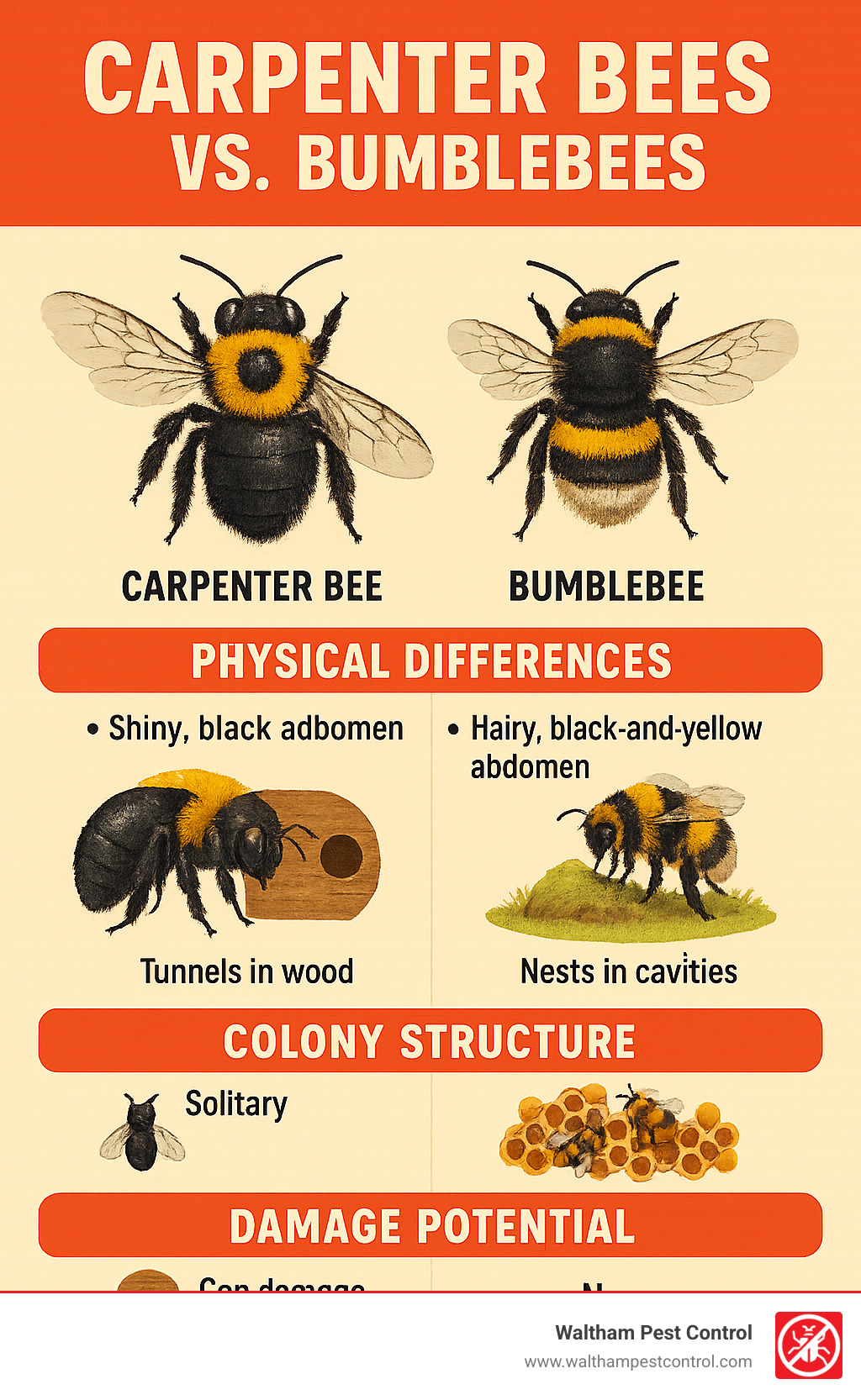
Carpenter bees are large, shiny black bees that drill perfectly round holes into wood to create their nests. These solitary insects are often mistaken for bumblebees but can be identified by their smooth, hairless abdomens and their wood-boring behavior.
Quick Facts About Carpenter Bees:
- Size: Up to 1 inch long, among the largest native bees in North America
- Appearance: Shiny black abdomen with fuzzy yellow thorax
- Behavior: Males hover aggressively but cannot sting; females sting only when provoked
- Damage: Create ½-inch round holes in wood, preferring unpainted softwoods like pine, cedar, and redwood
- Season: Most active in spring and early summer in Massachusetts
- Nesting: Solitary bees that tunnel into wood rather than forming colonies
If you’ve noticed large black bees buzzing around your deck, porch, or wooden structures during spring, you’re likely dealing with carpenter bees. While they play an important role as pollinators, these wood-boring insects can cause significant structural damage when left unchecked.
The main concern for homeowners is their relentless drilling behavior. Unlike termites that eat wood, carpenter bees excavate tunnels for nesting, creating galleries that can extend 6-12 inches initially but grow to several feet over multiple generations. The perfectly circular entrance holes and piles of coarse sawdust below are telltale signs of their presence.
With our 40+ years managing Carpenter Bees and other wood-destroying pests throughout Eastern Massachusetts, we’ve seen how these impressive insects can transform from beneficial pollinators into serious structural threats. Understanding their behavior and taking early action is key to protecting your property while respecting their ecological value.
Carpenter Bees terms to know:
- carpenter bees and pressure treated wood
- carpenter bees sting treatment
- home treatment for carpenter bees
Identifying Carpenter Bees and Their Look-alikes
Picture this: you’re enjoying your morning coffee on the deck when a large, dark bee starts buzzing around your head with what seems like attitude. Your first instinct might be to think “bumblebee!” but hold on – there’s a good chance you’re actually face-to-face with a carpenter bee.
These impressive insects belong to the genus Xylocopa, a massive group with over 500 species worldwide. While telling them apart can be tricky since many are primarily black with touches of yellow or white fuzz, there are some reliable ways to identify what you’re dealing with.
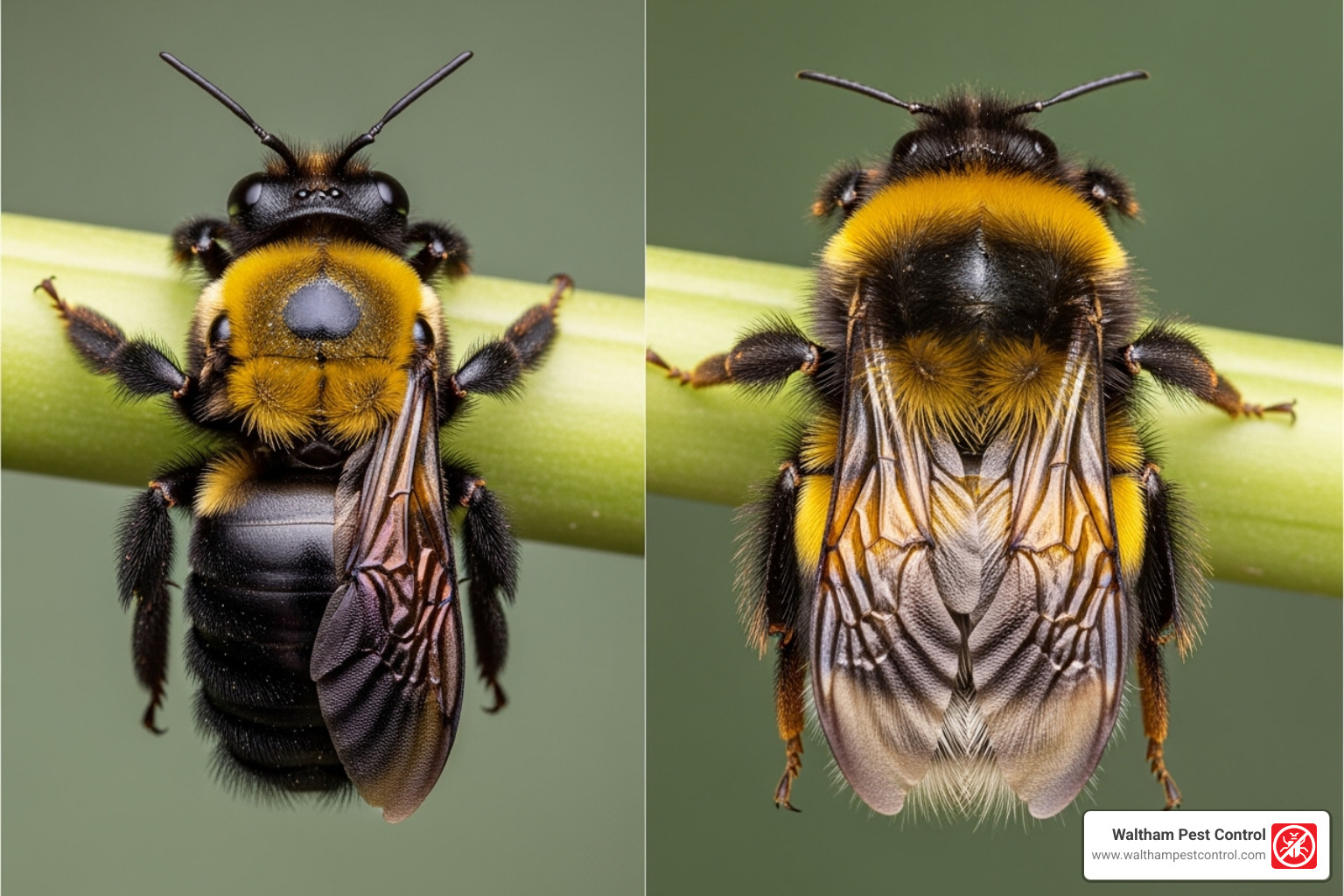
The golden rule for identifying carpenter bees is to look at their rear end – and yes, I’m being serious! Carpenter bees have shiny, completely hairless abdomens that look like polished black plastic. Bumblebees, on the other hand, are fuzzy all over, covered in dense hair from nose to tail with those familiar black and yellow stripes we all recognize.
Here’s another helpful trick: check out the face. Male carpenter bees often sport a distinctive ivory or yellow patch on their faces, while females have solid black heads. This isn’t just nature showing off – it’s actually your clue about whether that bee can sting you (spoiler alert: the flashy males can’t!).
The physical differences between these bees tell a story about their lifestyles too. Carpenter bees have that fuzzy thorax (chest area) because they need the hair to collect pollen, but their smooth abdomens help them maneuver through the tight wooden tunnels they excavate. Bumblebees keep their fuzz everywhere because they’re constantly in and out of flowers and need maximum pollen-collecting surface area.
| Feature | Carpenter Bees | Bumblebees |
|---|---|---|
| Appearance | Shiny, hairless black abdomen; fuzzy thorax. Males often have yellow/ivory facial spots | Entire body covered in dense hair with black and yellow stripes |
| Nesting Habits | Tunnel into wood creating perfectly round entrance holes | Nest in cavities like old rodent burrows or dense vegetation |
| Social Structure | Solitary nesters (each female builds her own nest) | Social colonies with queens and workers |
| Damage Potential | Can cause significant structural damage to wooden structures | No structural damage; purely beneficial pollinators |
How to Identify Carpenter Bees in Massachusetts
In our corner of New England, you’re most likely dealing with the Eastern Carpenter Bee (Xylocopa virginica). These substantial bees measure about three-quarters to a full inch long – impressive by any standard – and they’re particularly fond of our region’s wooden structures.
What makes Eastern Carpenter Bees especially noticeable is their hovering behavior. Unlike other bees that tend to move with purpose from flower to flower, these guys will hover in one spot, almost like tiny helicopters surveying their territory. If you see this behavior near wooden structures in spring, you’ve likely spotted your culprit.
The size alone can be startling if you’re not expecting it. These are among the largest native bees in North America, and their buzzing flight creates quite a presence. That shiny black abdomen remains your best identification feature – once you see it, you can’t unsee it.
If you’re still uncertain about what you’re seeing around your property, a professional inspection can provide definitive answers. We offer comprehensive pest inspections to help identify exactly what insects you’re dealing with. For those who enjoy diving deeper into the science, there’s fascinating scientific research on Eastern Carpenter Bees available through university extension programs.
Are They Dangerous? The Truth About Stings
Let’s address the elephant in the room – or should I say, the bee in the backyard. Most people’s first concern about carpenter bees is whether they’re going to get stung, and I have some surprisingly good news for you.
Male carpenter bees are all bark and no bite – literally. Despite putting on quite the intimidating show with their aggressive hovering and dive-bombing behavior, male carpenter bees cannot sting at all. They don’t even have stingers! All that territorial posturing you’re witnessing is pure theater designed to protect their nesting area and impress potential mates.
So if you see a large bee with that telltale ivory face patch acting tough around your deck, just remember: he’s harmless. Think of him as the neighborhood’s most dramatic security guard – lots of noise and bluster, but no actual enforcement power.
Female carpenter bees do have stingers, and unlike honeybees, their stingers aren’t barbed, meaning they can sting multiple times. However, here’s the reassuring part: female carpenter bees are remarkably docile creatures. They’re focused on their work – excavating tunnels, laying eggs, and collecting pollen – not on bothering humans.
The only time you’re likely to get stung is if you accidentally grab one, step on one, or somehow trap her against your skin. Even then, many females will try to escape rather than sting. The sting itself, while painful, is similar to other bee stings and rarely causes serious problems unless you have an allergy.
If you’re dealing with more aggressive stinging insects around your property, we also provide specialized hornet and wasp control services for those situations that require immediate attention.
Behavior, Life Cycle, and Wood Damage
The name “carpenter bee” isn’t just poetic – these remarkable insects are nature’s woodworkers, using their powerful jaws to excavate perfectly engineered tunnels in wood. This wood-boring behavior is what makes them both fascinating and frustrating for homeowners across Eastern Massachusetts.
Unlike social bees that live in crowded hives, carpenter bees are solitary architects. Each female creates her own private nest, preferring unpainted, weathered wood that’s easy to excavate. They have excellent taste in real estate – soft woods like pine, cedar, cypress, and redwood are their favorites, though they’ll tackle harder woods when necessary.
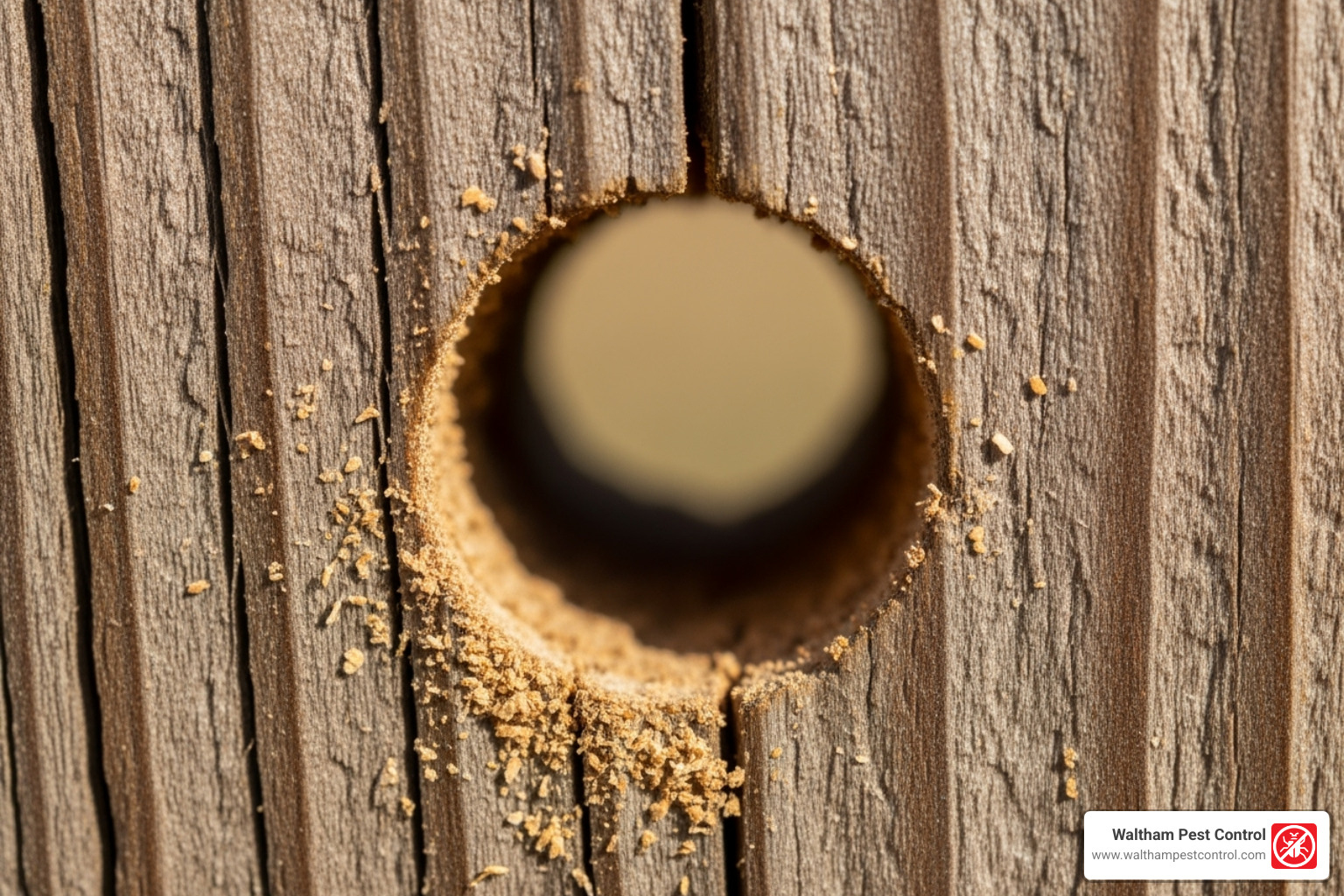
The female uses her strong mandibles like tiny chisels to chew perfectly round entrance holes about 16mm wide (roughly the size of your little finger). Once she breaks through the surface, she makes a sharp turn and excavates galleries parallel to the wood grain. It’s precision engineering that would make any carpenter proud.
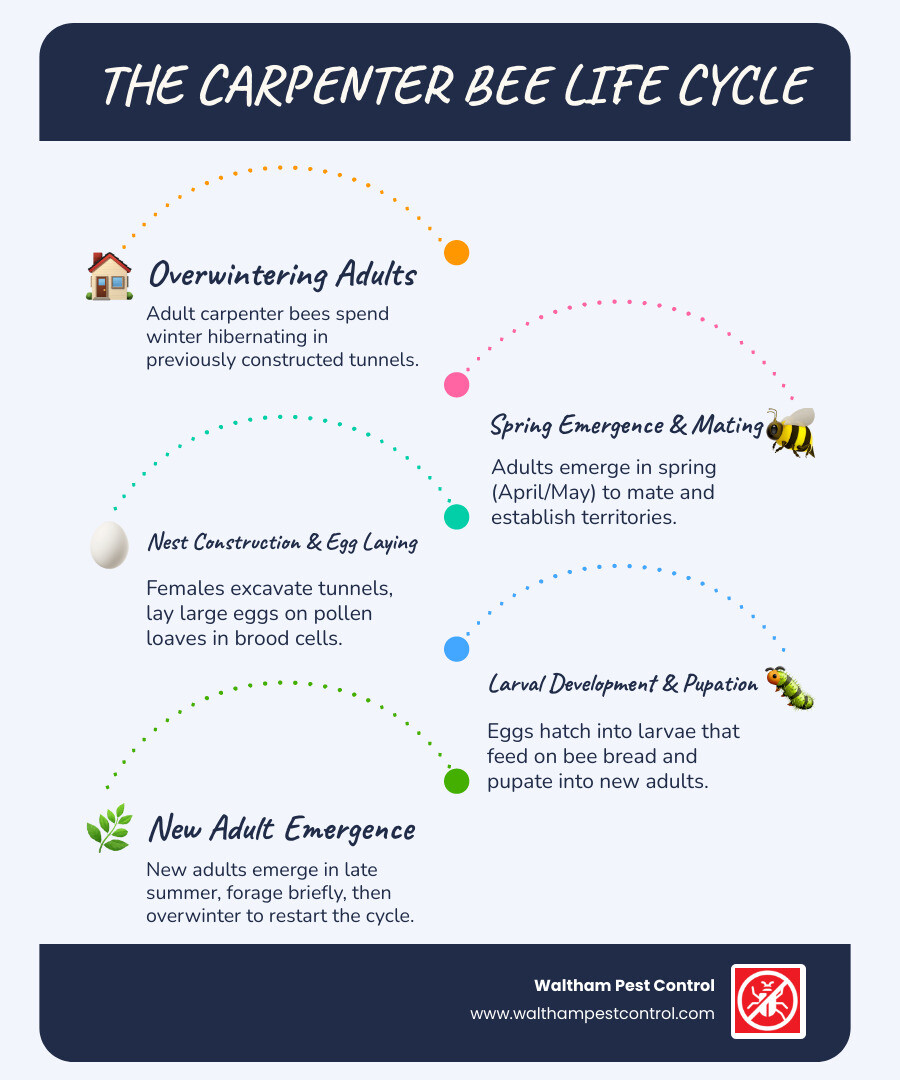
Carpenter bees follow a predictable yearly routine in our New England climate. As winter loosens its grip in April and May, adults emerge from their cozy tunnels where they’ve been overwintering. The males typically wake up first, immediately claiming territories and putting on impressive aerial displays to attract females. Think of it as nature’s version of showing off your dance moves.
After mating, the real work begins. The female carpenter bee becomes a devoted mother, collecting pollen and nectar to create protein-rich “bee bread.” She lays a single, remarkably large egg (proportionally one of the biggest in the insect world) on top of this nutritious ball. Each egg gets its own private room, sealed off with a partition wall made from chewed wood particles mixed with her saliva – basically, natural particle board.
A typical tunnel contains five to six of these brood cells. The eggs hatch into larvae that feast on their bee bread provisions, then pupate before emerging as adults in late summer. Here’s where it gets interesting: the first egg laid is at the back of the tunnel, so that bee is the last to emerge – like being stuck at the back of a very long driveway.
The Damage Carpenter Bees Cause
In our four decades of pest control experience throughout Eastern Massachusetts, we’ve learned that carpenter bee damage often starts small but compounds dramatically over time. What begins as a few innocent-looking holes can evolve into a serious structural concern.
The warning signs are usually obvious once you know what to look for. Perfectly round holes about half an inch wide are the calling cards of carpenter bee activity. Below these holes, you’ll typically find piles of coarse sawdust (called frass) – the wood shavings they expel during excavation. Yellowish stains sometimes appear below the holes, which is bee excrement creating fan-shaped patterns on the wood. On quiet days, you might even hear faint audible chewing sounds coming from within the wood itself.
These bees are particular about their construction sites. They target eaves, fascia boards, siding, wooden shake roofs, decks, porch railings, window sills, fence posts, and outdoor furniture. While painted or pressure-treated wood offers some protection, it’s not foolproof – especially if the paint is weathered or chipped.
The real problem isn’t the initial six-inch tunnel a new nest creates. Carpenter bees can live up to three years, and they’re creatures of habit. They return to the same tunnels year after year, extending and branching them into elaborate underground… well, “underwood” cities. Over time, these galleries can stretch several feet with multiple branches, significantly weakening the wood’s structural integrity.
But wait, there’s more damage to consider. The entrance holes create perfect pathways for moisture, leading to wood rot and decay that can be more destructive than the bee tunnels themselves. Even worse, the sounds of bee larvae developing in the tunnels attract woodpeckers who aggressively peck at the wood to reach their meal, creating much larger, more unsightly damage. We’ve seen entire fascia boards that looked like Swiss cheese after determined woodpeckers finished their feast.
This cascading damage is why early intervention matters. Unlike carpenter ants that tunnel for shelter, carpenter bees are creating nurseries – and they’re committed to expanding them year after year.
Unique Habits and Mating Systems
Carpenter bees break many of the rules we associate with bee behavior, making them truly unique insects. While they’re primarily solitary nesters – each female establishing her own nest – some species, including our local Eastern Carpenter Bee, show what scientists call “primitively social” behavior.
This means daughters sometimes stick around to help mom, and occasionally foragers will share food with nestmates. It’s not quite the organized society of honeybees, but it’s more social than most solitary bees. Think of it as a loose family arrangement rather than a corporate structure.
Their feeding habits are equally fascinating. Carpenter bees have relatively short tongues, making them excellent pollinators for open-faced flowers. They’re actually essential for some plants – maypop, eggplant, and tomatoes rely heavily on their pollination services. They’re masters of “buzz pollination,” using their powerful flight muscles to vibrate flowers and shake loose pollen that would otherwise remain trapped.
For more information on their important pollination role, you can explore detailed information on pollination from pollinator conservation experts.
However, their short tongues also lead to some mischievous behavior called “nectar robbing.” When faced with deep, tubular flowers they can’t reach into normally, carpenter bees simply use their mandibles to cut slits in the side of the flower and steal the nectar without providing pollination services. It’s like sneaking into a movie theater through the back door.
Male carpenter bees have their own unique characteristics. Those territorial displays we mentioned earlier? They’re backed up by larger eyes than females (better for aerial maneuvers) and the ability to produce pheromones – essentially cologne to attract mates. Some species gather in specific areas to perform elaborate courtship dances, combining perfume and choreography in nature’s version of a singles bar.
The Ecological Role vs. Pest Problem
It’s easy to view carpenter bees solely as destructive pests, especially when you’re watching them drill perfectly round holes into your beautiful wooden deck. But here’s the thing – these impressive insects are actually doing double duty in our Massachusetts ecosystems, serving as both beneficial pollinators and occasional home invaders.
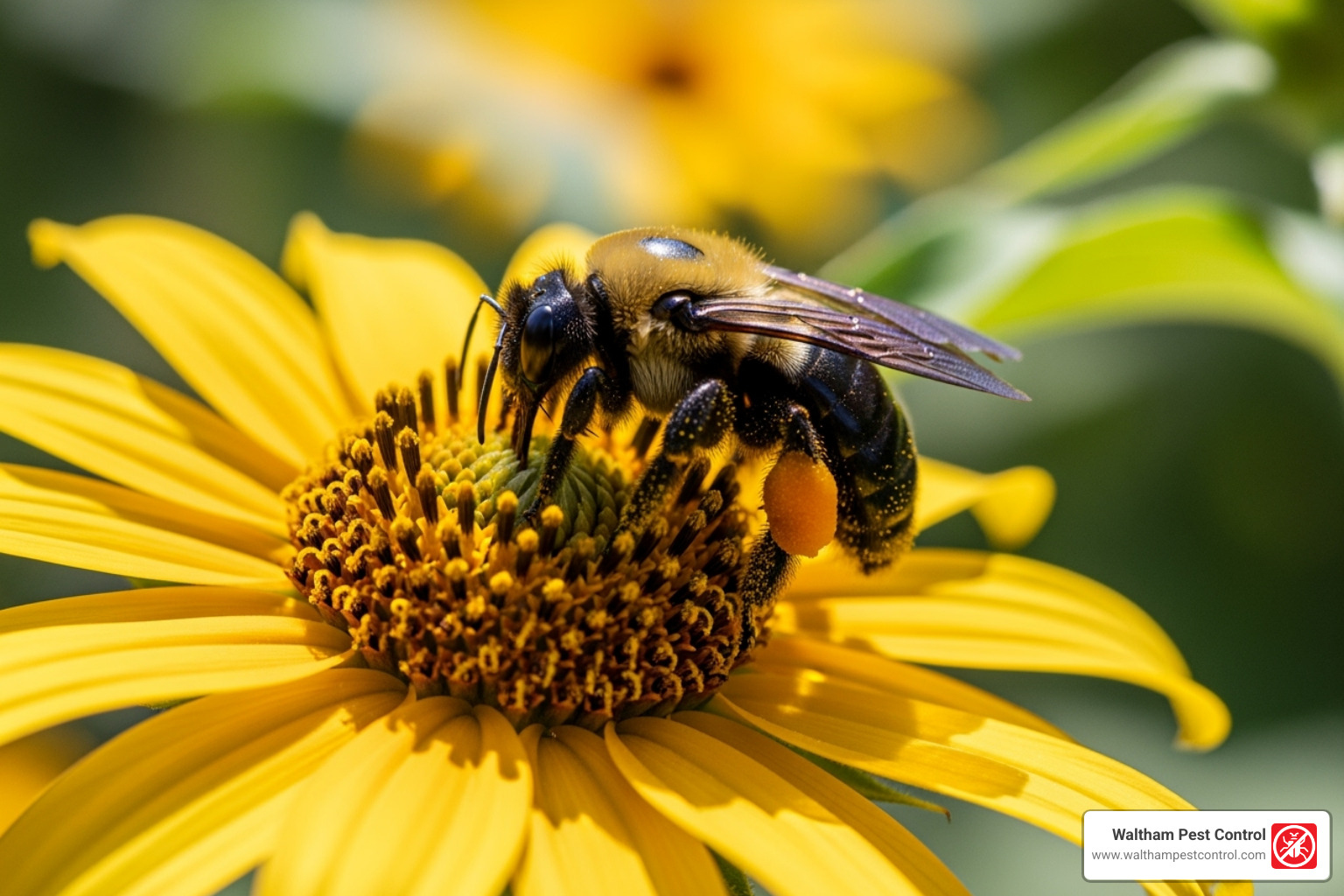
Carpenter bees are actually remarkable pollinators, and as native bees, they’ve been doing this job in New England far longer than we’ve been building wooden structures for them to tunnel into. Their size and strength make them particularly effective at what scientists call “buzz pollination” – they grab onto a flower and vibrate their powerful flight muscles to shake pollen loose from plants that keep their pollen locked away in deep chambers.
This special technique makes them absolutely essential for crops like tomatoes, eggplants, and blueberries. These plants have evolved specifically to require this vigorous shaking to release their pollen, and carpenter bees are among the best in the business. They’re also important pollinators for native wildflowers like maypop (Passiflora incarnata), where they’re sometimes the only insect capable of effectively transferring pollen.
Beyond their pollination services, carpenter bees support a whole network of wildlife. Woodpeckers – the same ones that cause secondary damage to your home – rely on carpenter bee larvae as a protein-rich food source for their own young. Shrikes and bee-eaters hunt adult bees, while various parasitic bee flies have evolved specifically to target carpenter bee nests, laying their eggs near tunnel entrances so their larvae can feed on the bee’s provisions.
You can learn more about the critical importance of native pollinators at the Pollinator Partnership website, which details how native bees like carpenter bees contribute to both wild plant communities and agricultural systems.
Weighing the Good with the Bad
So where does this leave us as homeowners? The truth is, carpenter bees present a classic case of being in the right ecological niche but sometimes the wrong location from our perspective.
In our four decades of pest management experience, we’ve learned that the key is balance. A few carpenter bees hovering around your garden flowers? That’s actually beneficial – they’re providing valuable pollination services. But when they start targeting your deck railings, fascia boards, or porch eaves, that’s when their natural behavior becomes a property management issue.
The decision to control carpenter bees should be based on active damage, not just their presence. If you’re seeing those telltale round holes, piles of sawdust, or hearing chewing sounds from within your wooden structures, it’s time to take action. Waiting too long can lead to extensive tunnel systems that weaken structural integrity and create entry points for moisture and other pests.
At the same time, we don’t believe in blanket elimination of beneficial insects. Our approach focuses on protecting your specific structures while allowing these important pollinators to continue their ecological work elsewhere on your property. This is where integrated pest management really shines – we can target problem areas while preserving the broader environmental benefits these bees provide.
This balanced approach becomes even more important when we consider the broader decline in pollinator populations. Native bees like carpenter bees are facing pressure from habitat loss, pesticide use, and climate change. By using targeted, environmentally conscious methods, we can protect your home without contributing to these larger ecological challenges.
You can find more info about green pest control approaches that balance effective pest management with environmental responsibility. These methods allow us to address your carpenter bee concerns while supporting the health of our local ecosystems.
Professional Management and Prevention
When it comes to carpenter bees, we always tell homeowners that an ounce of prevention is worth a pound of cure. After four decades in the pest control business throughout Eastern Massachusetts, we’ve seen too many beautiful decks and porches riddled with holes because prevention was overlooked.
Painting and staining your wood surfaces is hands down the most effective way to keep carpenter bees away. These bees are quite particular – they strongly prefer unpainted, unfinished, or weathered wood. A fresh coat of oil-based paint or polyurethane creates a hard, glossy surface that they find unappealing for drilling. If you prefer the natural look of stained wood, that’s better than nothing, but paint generally offers superior protection.
Sealing up entry points is equally important. Even the smallest crack, old nail hole, or previously abandoned carpenter bee tunnel can become an attractive starting point for new nests. We recommend filling these openings with quality caulk, wood putty, or even steel wool for larger holes before applying your protective finish. Think of it as closing the door before the guests arrive.
For homeowners planning new construction or replacing heavily damaged wood, composite materials offer a permanent solution. Vinyl siding, aluminum fascia, and composite decking eliminate the problem entirely – carpenter bees simply can’t drill into these materials. While the upfront cost might be higher, you’ll save money and headaches in the long run.
When professional help becomes necessary is usually when nests are in hard-to-reach places like high eaves or complex rooflines, or when you’re dealing with a large infestation. Trying to treat overhead nests from a ladder isn’t just ineffective – it’s dangerous. Plus, applying treatments without proper training often means missing the target entirely.
Our experienced team can safely identify the full extent of your carpenter bee problem and apply targeted treatments directly into the tunnels where these bees actually live and breed. We use professional-grade insecticides that reach deep into the galleries, ensuring we eliminate both adults and developing larvae. After treatment, we’ll guide you through proper sealing techniques to prevent re-infestation and protect your wood from moisture damage.
You can learn More info about residential pest control and find how we protect homes throughout Burlington, Waltham, and the surrounding Eastern Massachusetts communities.
Preventing Future Carpenter Bee Problems
Managing carpenter bees isn’t a one-and-done situation, especially if your home features lots of exposed wood. Think of it more like maintaining your car – regular attention prevents major problems down the road.
Annual inspections in early spring, before carpenter bees become active, can save you significant trouble. We recommend checking all wooden structures for new holes, fresh sawdust, or signs of hovering bees. Catching an infestation early means dealing with just a few holes instead of extensive tunnel systems.
Maintaining your wood finishes requires ongoing attention, but it’s worth the effort. Reapply paint, stain, or varnish as needed, paying special attention to areas that get heavy sun or weather exposure. These protective coatings don’t last forever, and carpenter bees are quick to notice when wood becomes vulnerable again.
Focus your prevention efforts on historically vulnerable areas like fascia boards, soffits, eaves, deck railings, and outdoor furniture. These are the spots where we typically see the most carpenter bee activity year after year.
For commercial properties with extensive wooden structures, these preventative measures become even more critical. A small infestation can quickly become a major liability issue. We provide comprehensive More info about commercial pest control services designed to protect your business assets from wood-destroying pests like carpenter bees. Our team can develop a customized maintenance and inspection plan that fits your property’s specific needs and budget.
Conclusion: Protecting Your Home from Wood-Boring Bees
After four decades of helping Eastern Massachusetts homeowners deal with Carpenter Bees, we can tell you that these fascinating insects truly embody nature’s complexity. They’re remarkable pollinators that our ecosystem depends on, using their unique buzz pollination technique to help produce the tomatoes and blueberries we enjoy. Yet when they decide your deck railing is the perfect nursery, they quickly transform from beneficial neighbors into unwelcome guests.
The key to successful carpenter bee management starts with proper identification. Telltale shiny, hairless abdomen that looks like polished black plastic – that’s your dead giveaway you’re dealing with Carpenter Bees rather than their fuzzy bumblebee cousins. Once you spot those perfectly round holes and piles of coarse sawdust, you know they’ve moved in.
Don’t let their intimidating hovering behavior fool you. Those aggressive-looking males putting on aerial displays are all show and no sting. The females, while capable of stinging, are generally too busy with their construction projects to bother with you unless you bother them first.
Prevention truly is your best strategy when it comes to these wood-boring bees. A fresh coat of paint or stain on your wooden surfaces acts like an invisible shield, making your home far less attractive to prospective carpenter bee mothers. Sealing up cracks and old holes eliminates their favorite starting points, while composite materials can eliminate the problem entirely for new construction.
When prevention isn’t enough – or when you’re dealing with established galleries in hard-to-reach places – that’s where professional expertise makes all the difference. Our licensed technicians know exactly how to target treatments directly into their tunnels, ensuring complete elimination while protecting your family and property.
The damage Carpenter Bees cause isn’t just about the holes they drill today. It’s about the weakened wood structures, the moisture intrusion, and yes, even the woodpeckers that follow to feast on their larvae. What starts as a few small holes can become a serious structural concern if left unchecked.
At Waltham Pest Control, we understand the delicate balance between protecting your home and respecting these important pollinators. Our approach focuses on targeted control where it matters most – safeguarding your property while being mindful of their ecological value.
Don’t wait until those small round holes become extensive tunnel networks. Early detection and prompt action save both money and headaches down the road.
For comprehensive and effective management of carpenter bees in Eastern Massachusetts, it’s best to consult with professionals. Contact us for Carpenter Bee Control and let us help you protect your biggest investment.
