

Carpenter Bees Treatment and Prevention: 10 Powerful Proven Tips 2025
Understanding the Carpenter Bee Challenge in Massachusetts
Carpenter bees treatment and prevention requires understanding these large, solitary wood-boring insects that emerge each spring to drill perfectly round holes in your decks, siding, and outdoor structures. While they’re valuable pollinators, their nesting habits can cause significant damage to your property over time.
Quick Solutions for Carpenter Bee Problems:
• Immediate Treatment: Apply insecticidal dust into active holes at dusk, wait 24 hours, then seal with wood putty
• Natural Prevention: Spray citrus oil mixtures around vulnerable wood surfaces every 3-4 weeks
• Long-term Protection: Paint or varnish all exposed wood annually; carpenter bees prefer unpainted surfaces
• Professional Help: Call for severe infestations, high-reach nests, or structural damage assessment
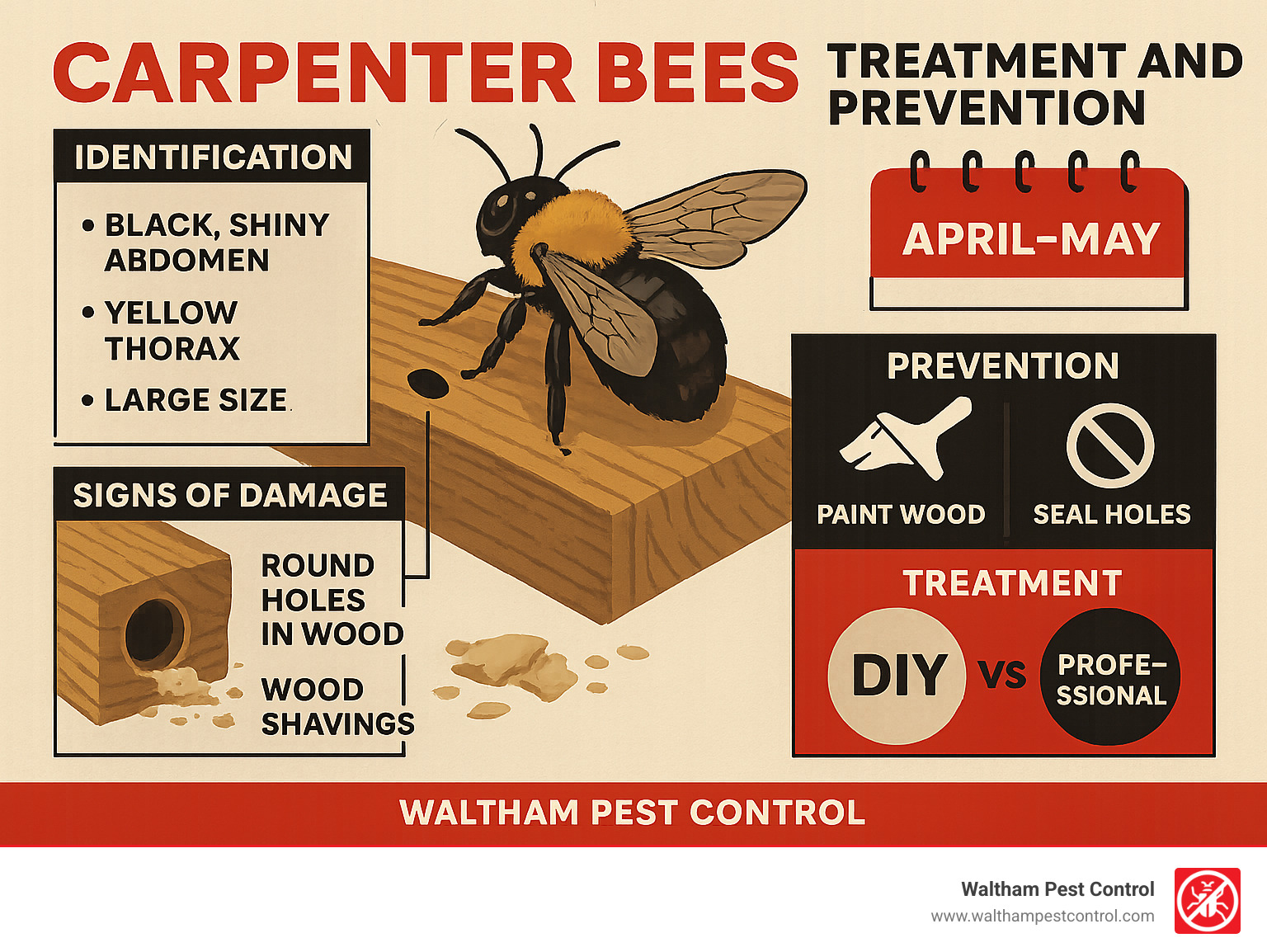
Carpenter bees are often mistaken for bumblebees, but their shiny black abdomens and wood-boring behavior make them distinct. These solitary bees create ½-inch diameter tunnels that can extend up to 10 feet over multiple generations, potentially weakening wooden structures. Most activity occurs from April through May when females emerge from overwintering sites to mate and establish new nests.
The key to effective control lies in timing and method selection. While male carpenter bees may hover aggressively near nests, they cannot sting. Only females possess stingers and rarely use them unless directly handled. Understanding this behavior helps homeowners approach treatment with confidence rather than fear.
I’m Waltham Pest Control, and in my 40+ years leading Waltham Pest Control, I’ve helped thousands of Massachusetts homeowners successfully implement carpenter bees treatment and prevention strategies that protect their properties while respecting these important pollinators. Our integrated approach combines targeted treatments with preventive measures to deliver long-lasting results.
Simple guide to carpenter bees treatment and prevention:
- average price of carpenter bee pest control treatment
- carpenter bees sting treatment
- carpenter bees treatment cost
Carpenter Bees 101: Identification, Life Cycle & Seasonality
If you’ve ever spotted a large, shiny black bee hovering around your deck or fence, you’ve likely encountered a carpenter bee. These impressive insects are among our largest native bee species, measuring a substantial ¾ to 1 inch long—about the size of your thumb tip.
The most striking feature that sets carpenter bees apart is their glossy, metallic black abdomen that catches sunlight like polished metal. Unlike their fuzzy bumblebee cousins who sport hair all over their bodies, carpenter bees look like they’ve been professionally polished. This shiny abdomen is your best identification clue.
Here in Massachusetts, we primarily deal with Xylocopa virginica, and understanding the difference between males and females helps with carpenter bees treatment and prevention. Male carpenter bees are the ones you’ll see hovering aggressively near your outdoor structures, sporting distinctive white or yellow facial patches. Despite their intimidating aerial displays, these guys are all bark and no bite—they don’t even have stingers. Female carpenter bees have solid black faces and do possess stingers, but they’re typically too busy excavating tunnels to bother with humans.
Carpenter bees follow a remarkably predictable schedule with one generation per year. The entire development from tiny egg to full-sized adult takes about three months. What’s fascinating is their specialized pollination technique—this scientific research on buzz pollination reveals how carpenter bees use unique vibrations to shake pollen loose from flowers that other pollinators simply can’t access effectively.
Spot-the-Bee Checklist
Identifying carpenter bees becomes easier when you know what to look for beyond just their large size and shiny black abdomen. Their thorax often displays beautiful metallic blue, green, or purple hues that shimmer as they move.
Behaviorally, hovering males are your biggest clue—they’ll patrol the same area repeatedly, often diving toward anyone who approaches their territory. Listen for loud buzzing sounds during these territorial displays, which sound distinctly different from other bee species.
The real giveaway is finding fine sawdust (called frass) scattered beneath wooden structures. This powdery debris accumulates as females excavate their tunnels. You might even hear faint chewing or drilling sounds coming from within the wood itself, especially during quiet morning or evening hours. Fresh holes often have yellow pollen-like residue around the entrance where females have brushed against the opening.
Calendar of Activity
Understanding carpenter bee seasonality is crucial for effective treatment timing. Spring (March through May) marks their peak activity period when overwintered females emerge from old tunnels, mate, and begin creating new ½-inch diameter holes in unpainted wood surfaces. This is your prime window for intervention.
During summer months (June through August), females stay busy provisioning their tunnels with pollen and nectar, creating individual brood chambers for their eggs. Meanwhile, males continue their territorial guarding behavior while larvae develop safely inside the wood tunnels.
Fall (September through November) brings a second wave of activity as new adults emerge. They may clean out existing tunnels or excavate short new galleries before settling in for winter. This presents another excellent treatment opportunity.
Winter (December through February) finds adult bees hibernating deep within old tunnels. This quiet season is perfect for wood repairs and preventive treatments since you won’t disturb active bee populations. Planning your carpenter bees treatment and prevention strategy during winter months sets you up for success when spring activity resumes.
Damage & Infestation Warning Signs
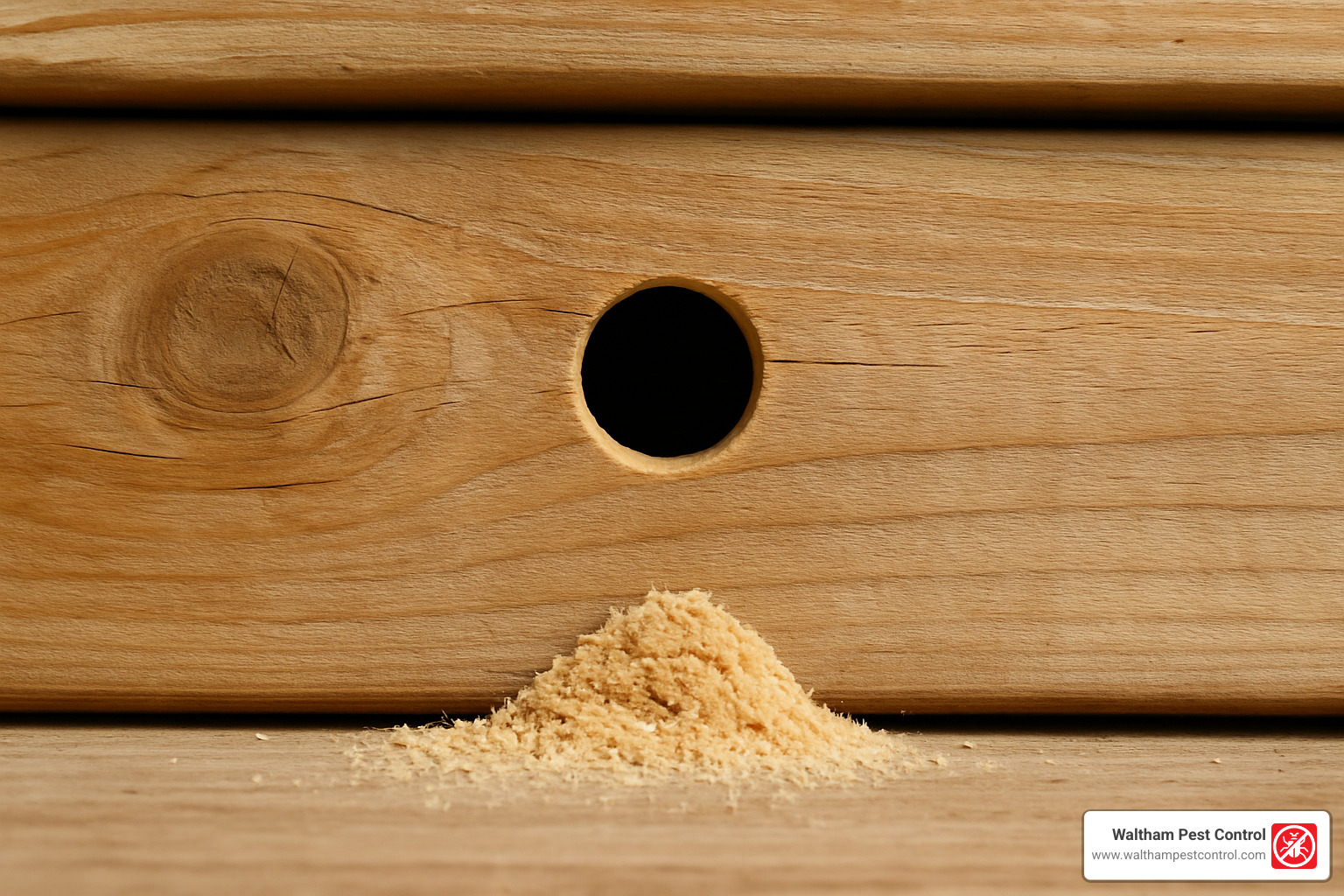
That perfectly round hole in your deck railing isn’t just an eyesore—it’s the beginning of what could become serious structural damage if left untreated. Carpenter bees treatment and prevention becomes critical once you understand how these persistent insects work their way through your property’s wooden elements.
Each female carpenter bee creates her own architectural masterpiece: a straight entry tunnel that suddenly takes a sharp 90-degree turn, running parallel to the wood grain for 6 to 10 inches. Think of it as nature’s version of a subway system, complete with individual “stations” where she deposits pollen balls and eggs for her developing young.
The real trouble starts when these tunnels become multi-generational family homes. New females often return to expand existing galleries, turning those initial 6-inch tunnels into sprawling 10-foot networks that can seriously weaken wooden structures. It’s like having invisible termites, except these ones announce their presence with perfectly round ½-inch holes and telltale piles of sawdust.
But here’s where things get really interesting—and expensive. Woodpeckers have figured out that carpenter bee tunnels are like underground grocery stores packed with protein-rich larvae. Their excavation efforts while hunting for these tasty treats often cause far more damage than the original bee activity. Add moisture seeping through those entrance holes, and you’ve got a recipe for wood rot and unsightly stained streaks that can compromise both structure and appearance.
You’ll know carpenter bees have moved into your neighborhood when you start hearing that distinctive buzzing and drilling sound coming from your wooden structures. Fresh sawdust frass appearing overnight beneath holes is another dead giveaway, along with those aggressive male bees hovering around like tiny security guards protecting their territory.
How Much Damage Is “Too Much”?
Determining when carpenter bee activity crosses the line from minor nuisance to serious problem requires some detective work. During my four decades in pest control, I’ve learned that the tunnel length and structural weakening potential matter more than the number of visible holes.
When you’re dealing with more than 10 holes in a single wooden element, especially in load-bearing structures, it’s time to call in professional help. The same goes for any visible sagging or weakness in heavily targeted areas—these are red flags that the hidden tunnel network has compromised the wood’s integrity.
Woodpecker secondary damage around carpenter bee holes signals a more extensive infestation than what’s visible on the surface. These birds are excellent at detecting larvae-filled tunnels that might not have obvious entrance holes yet. If you’re seeing their distinctive rectangular excavations, there’s likely a thriving bee community inside your wood.
Water rot and staining around entrance holes indicate long-term moisture penetration that can lead to expensive repairs beyond just treating the bee problem. Unpainted softwoods like cedar, pine, and fir are particularly vulnerable, which is why these areas need immediate attention during your inspection.
Professional assessment becomes essential when dealing with high-reach areas, extensive tunnel networks, or any situation where structural integrity might be compromised. Our licensed technicians can evaluate the full scope of damage and recommend appropriate treatment strategies that address both current infestations and future prevention needs.
What looks like a few harmless holes today can become a major structural headache tomorrow. Early intervention with proper carpenter bees treatment and prevention strategies saves both money and frustration down the road.
Carpenter Bees Treatment and Prevention
When it comes to carpenter bees treatment and prevention, timing is everything. These wood-boring insects are most vulnerable during their peak activity periods in April and May, and again in late summer when new adults emerge. Miss these windows, and you’ll be dealing with established tunnels that become much harder to treat effectively.
The good news? You have several proven options that range from quick DIY solutions to comprehensive professional treatments. The key is matching the right method to your specific situation—whether you’re dealing with a few exploratory holes or a multi-generational infestation that’s been building for years.
Chemical treatments remain the gold standard for active infestations. Insecticidal dusts work like tiny time bombs, staying effective for over a year once properly applied deep into tunnel systems. These desiccant-based products literally dry out adult bees and developing larvae, even months after application. It’s like having a security guard posted inside each tunnel.
Surface sprays offer a different approach—they’re perfect for immediate knockdown when you catch bees in the act, but they typically last only 7-14 days. Think of sprays as your quick response team, while dusts are your long-term defenders.
For homeowners who prefer eco-friendly approaches, natural repellents can effectively discourage nesting when applied consistently. Citrus-based sprays, essential oil mixtures, and physical deterrents work well for prevention, though they require more patience and frequent reapplication than chemical options.
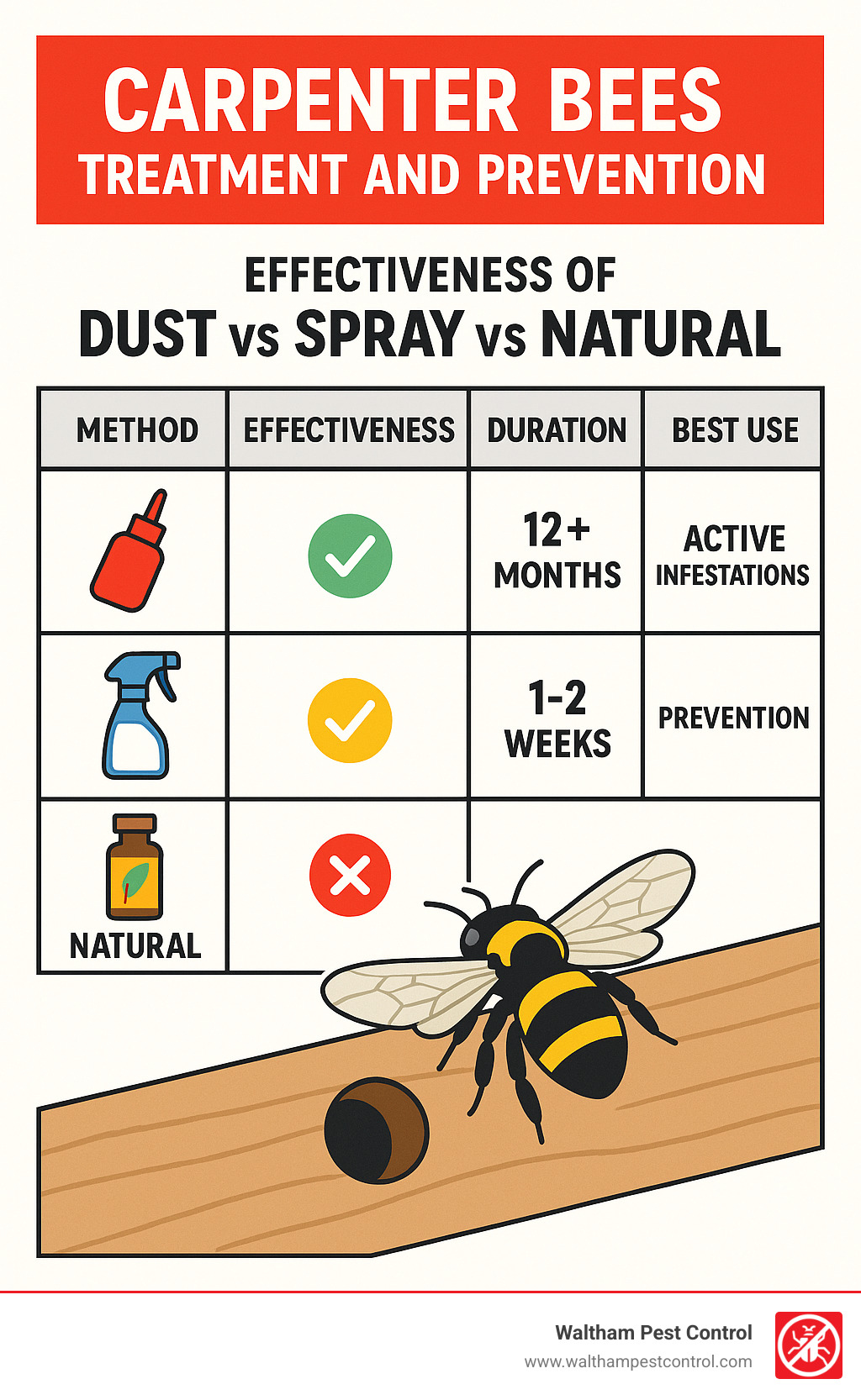
The choice between methods often comes down to effectiveness versus environmental impact. Insecticidal dust achieves 95% control rates lasting 12+ months, while residual sprays provide 85% effectiveness for 7-14 days. Natural repellents typically achieve 60% effectiveness lasting 3-4 weeks, and traps can reduce populations by 70% throughout the season.
DIY vs Pro: Carpenter Bees Treatment and Prevention
Many homeowners successfully tackle minor carpenter bee problems themselves, especially when dealing with easily accessible areas and fewer than five active holes. The decision between DIY and professional treatment really depends on your comfort level, the severity of the infestation, and whether you can safely reach all affected areas.
DIY treatments work best for ground-level decks, railings, and other accessible wooden structures. You’ll need proper protective equipment—gloves, safety eyewear, and respiratory protection are non-negotiable when working with insecticides. The secret to DIY success lies in treating holes at dusk when bees are less active and more likely to be inside their tunnels.
Remember the golden rule: never seal holes immediately after treatment. Wait at least 24 hours to ensure maximum exposure to the insecticide. It’s tempting to plug those unsightly holes right away, but patience here makes the difference between success and having to repeat the entire process.
Professional treatment becomes the smarter choice when you’re dealing with high-reach areas, extensive tunnel systems, or structural concerns. Licensed applicators have access to commercial-grade products and specialized equipment that simply aren’t available to homeowners. They also carry insurance and provide warranties—something to consider when ladder work is involved.
For detailed information about professional service options, check out our average price of carpenter bee pest control treatment page. Professional treatments typically involve residual insecticides that remain effective for 90 days or longer, significantly reducing the need for repeated applications.
Natural Carpenter Bees Treatment and Prevention Methods
Natural methods appeal to homeowners who want to protect their property while minimizing environmental impact. These approaches require more persistence than chemical treatments, but they can effectively deter carpenter bees when applied consistently—and your garden’s beneficial insects will thank you.
Citrus oil repellents top the list of effective natural deterrents. Boil citrus peels from lemons, oranges, or grapefruits in water for 15 minutes, strain the liquid into a spray bottle, and add one tablespoon of citrus essential oil per eight ounces of water. Apply this mixture around vulnerable wood surfaces weekly during the active season. The strong citrus scent overwhelms the bees’ ability to detect suitable nesting sites.
Essential oil blends offer another proven approach. Mix 20-30 drops of eucalyptus oil per ounce of water, or create a broader repellent effect by combining lavender, peppermint, and citronella oils. Tea tree oil works particularly well—use one tablespoon per eight ounces of water. Reapply every 3-4 weeks or after rain washes away the scent.
Physical deterrents can be surprisingly effective. Steel wool soaked in vinegar and stuffed into tunnels creates an unpleasant environment that encourages bees to relocate. Fake wasp nests hung under eaves exploit carpenter bees’ natural predator avoidance instincts—they’ll typically avoid areas where they perceive competition or threats.
Some homeowners swear by the sound and vibration method—playing loud music or using subwoofer vibrations near infested areas for 2-3 days. The constant vibration encourages bees to relocate, though this approach requires patience and consideration for neighbors.
Alternative nesting blocks placed away from your home’s structures can redirect carpenter bees to less problematic locations. Think of it as giving them a better option—untreated wood blocks positioned in garden areas where their pollination benefits outweigh the minor damage.
Professional Solutions & When to Call
Professional intervention becomes necessary when DIY methods fall short or when safety concerns make self-treatment impractical. Our licensed technicians bring specialized equipment, commercial-grade products, and decades of experience to even the most challenging carpenter bee situations.
High-reach infestations represent the most common reason homeowners call for professional help. Treating holes in second-story eaves, tall deck posts, or roof overhangs requires specialized equipment and safety training. It’s simply not worth the risk of ladder accidents for most property owners.
Extensive tunnel systems that have developed over multiple generations often require professional assessment and treatment. When carpenter bees have been active in the same location for several years, tunnel networks can extend 10 feet or more through structural elements. These situations demand comprehensive treatment strategies that go beyond surface applications.
Structural damage concerns warrant immediate professional evaluation. When you notice sagging, weakening, or extensive woodpecker damage around carpenter bee holes, it’s time to call in experts who can assess both the pest problem and potential structural implications.
Commercial-grade dusts and injection systems ensure thorough coverage of tunnel systems that homeowners cannot reach effectively. Professional treatments typically remain effective for 90 days or longer, and many companies offer seasonal programs that provide ongoing protection throughout peak activity periods.
For comprehensive information about professional treatment options, visit our carpenter bees treatment cost page. Treatment approaches vary significantly based on infestation severity, property size, and accessibility challenges, but professional intervention often proves more cost-effective than repeated DIY attempts for serious infestations.
Repair & Wood Protection Strategies
After successfully treating carpenter bee infestations, proper hole repair and wood protection become your strongest defense against future problems. I’ve seen too many homeowners rush to seal holes immediately after spotting them, only to have bees force their way out or create new tunnels nearby. The secret lies in treating first, waiting, then sealing with the right materials.
Think of it this way: sealing an active carpenter bee tunnel without treatment is like locking someone in a room with a drill. They’re going to find their way out, and you won’t like the results.
Wood selection makes a huge difference in preventing future infestations. Hardwoods like oak, maple, and cherry rarely attract carpenter bees—their dense grain structure makes tunneling extremely difficult. Pressure-treated lumber contains chemical preservatives that naturally deter wood-boring insects, while cedar and redwood offer some natural resistance (though they’re not completely immune).
For homeowners building new structures or replacing damaged wood, composite materials eliminate the problem entirely. No wood means no carpenter bee interest.
Surface protection through painting or varnishing provides your most effective long-term prevention strategy. Carpenter bees strongly prefer weathered, unpainted wood surfaces. Fresh paint or polyurethane finishes create a barrier that discourages nesting attempts—painted wood is rarely attacked.
Oil-based paints and quality wood stains provide longer-lasting protection than water-based alternatives. Annual reapplication keeps wood surfaces protected throughout peak carpenter bee season.
Borate wood preservatives offer an excellent upgrade for vulnerable areas. These treatments penetrate deep into wood fibers, providing years of protection against carpenter bees and other wood-destroying insects without requiring frequent reapplication.
For information about treating carpenter bee stings during repair work, consult our carpenter bees sting treatment guide.
Step-by-Step Hole Repair
The proper repair sequence ensures maximum effectiveness while preventing re-infestation. Rushing this process often leads to incomplete control and wasted effort.
Start with tunnel cleaning using a flexible wire or coat hanger to break up pollen plugs and remove debris. Female carpenter bees pack brood chambers with pollen balls that can block insecticide penetration. Thorough cleaning ensures treatment reaches all areas where larvae might be developing.
Apply your chosen treatment by injecting insecticidal dust deep into each tunnel. Use a hand duster to deliver 3-4 puffs per hole, ensuring dust reaches the back chambers where eggs and larvae develop. This step is crucial for preventing next generation emergence.
Wait 24-48 hours before sealing any holes. This waiting period allows maximum exposure time for any bees inside tunnels. I know it’s tempting to seal immediately, but patience here prevents future problems.
Seal holes properly using ½-inch tapered cork plugs or quality wood putty. Cork plugs work particularly well because they fit snugly while allowing some residual dust to remain active behind the seal. Wood putty provides a more permanent solution for heavily damaged areas.
Finish with matching paint or stain to blend repairs with existing surfaces while providing ongoing protection. This final step not only improves appearance but creates the painted surface that carpenter bees naturally avoid.
Monitor your repairs monthly during active season (April through September). Fresh sawdust around sealed holes or new holes nearby indicate continued activity requiring additional treatment. Early detection makes control much easier than waiting for extensive re-infestation.
Most repairs hold up well when done correctly, but carpenter bees occasionally test sealed areas during peak activity periods. Quick response to new activity prevents establishment of new tunnel systems.
Balancing Control with Pollinator Conservation
Here’s something that might surprise you: those same carpenter bees drilling holes in your deck are actually pollination superstars in your garden. These impressive insects perform a specialized service called buzz pollination that many other pollinators simply can’t match. They grab onto flowers and vibrate their flight muscles at just the right frequency to shake pollen loose—kind of like nature’s tiny jackhammers, but in a good way this time.
This creates an interesting challenge for homeowners. You want to protect your property, but you also don’t want to eliminate beneficial insects that help your tomatoes, blueberries, and native wildflowers thrive. The good news? You absolutely can have both.
Smart timing makes all the difference when implementing carpenter bees treatment and prevention. Treating holes in the late evening when bees are settling in for the night minimizes impact on their daytime pollination activities. This approach targets the structural damage while allowing bees to continue their beneficial work during peak flower-visiting hours.
Targeted treatments work better than broad approaches for both effectiveness and environmental responsibility. Rather than spraying entire areas, focus applications directly into entrance holes. This concentrates the treatment where it’s needed most while protecting other beneficial insects visiting nearby flowers.
The concept of providing alternative nesting sites sounds almost too simple, but it really works. Placing untreated wood blocks in sunny garden areas at least 50 feet from your house gives carpenter bees attractive alternatives to your deck railings. Think of it as a compromise—they get suitable nesting sites, and you get to keep your structures intact.
Bee-Friendly Yard Tips
Creating a pollinator-friendly landscape while managing carpenter bees requires some thoughtful plant choices and timing considerations. Native spring bloomers like serviceberry and redbud provide early-season nectar when carpenter bees first emerge from overwintering. Summer flowers including bee balm and black-eyed Susan keep them well-fed during their active nesting period, while fall bloomers like goldenrod and New England aster support the next generation before they settle in for winter.
Water sources matter more than most people realize. A shallow dish with landing spots or a dripping faucet gives bees the hydration they need without encouraging them to linger around wooden structures. Avoiding broad-spectrum insecticides during bloom periods protects not just carpenter bees but the entire community of beneficial insects working in your landscape.
Sequential blooming creates the ideal setup—plant flowers that bloom from early spring through late fall so there’s always something attractive blooming away from your house. Clustering similar plants together rather than scattering individual specimens makes your garden more appealing to pollinators while creating natural zones where beneficial insects can thrive.
The most successful approach balances structural protection with ecological stewardship. You’re not choosing between protecting your property and supporting beneficial insects—you’re creating a plan that accomplishes both goals effectively.
Frequently Asked Questions about Carpenter Bees Treatment and Prevention
Do carpenter bees sting and are they dangerous?
Here’s something that surprises most homeowners: those big, intimidating carpenter bees hovering around your deck are probably harmless males putting on a show. Male carpenter bees cannot sting at all—they’re essentially flying bluffs, using aggressive displays to protect their territory without any real ability to back up their threats.
Female carpenter bees tell a different story. They do have stingers and can use them repeatedly since their stingers aren’t barbed like honeybees. However, female carpenter bees are remarkably docile creatures. They’re busy with the serious work of excavating tunnels and provisioning nests, rarely bothering with humans unless directly threatened.
Stings typically happen only when you accidentally trap a female bee against your skin or clothing, handle one directly, or disturb active nests during peak daylight hours. Even then, carpenter bee stings are less painful than wasp or hornet stings and rarely cause serious reactions.
The key difference lies in their solitary nature. Unlike social bees that defend colonies with dozens of sisters, carpenter bees work alone and prefer avoiding confrontation. That aggressive male hovering near your porch rail? He’s trying to look tough while being completely harmless—nature’s version of a security system with no actual security.
When is the best time for carpenter bees treatment and prevention?
Timing makes all the difference when it comes to effective carpenter bees treatment and prevention. Think of it like catching someone at home—you need to know when they’re actually there.
The golden window opens in April and runs through May, when newly emerged females are actively boring fresh tunnels and males are hovering conspicuously around nest sites. This is when you’ll hear that distinctive drilling sound and see fresh sawdust appearing beneath holes. Miss this window, and you’re essentially treating empty tunnels.
Late summer offers a second opportunity when new adults emerge from their development chambers. While less critical than spring treatments, this timing works well for preventive applications and population reduction before overwintering.
Within each day, evening treatments prove most effective. Apply treatments at dusk when bees are likely inside their tunnels rather than out foraging. Daytime applications often miss the target entirely and may provoke unnecessary defensive behavior from protective males.
For preventive measures, March applications of residual sprays can create protective barriers before bee emergence. Follow up with monitoring through peak season, seal treated holes in June, and complete wood repairs during fall months when bees are less active.
The worst timing? Sealing holes immediately after treatment or applying sprays during midday heat when products break down quickly and bees are away from nest sites.
Are carpenter bee traps really effective?
Carpenter bee traps work, but they’re not magic solutions. Think of them as one tool in your toolbox rather than the entire solution to your bee problem.
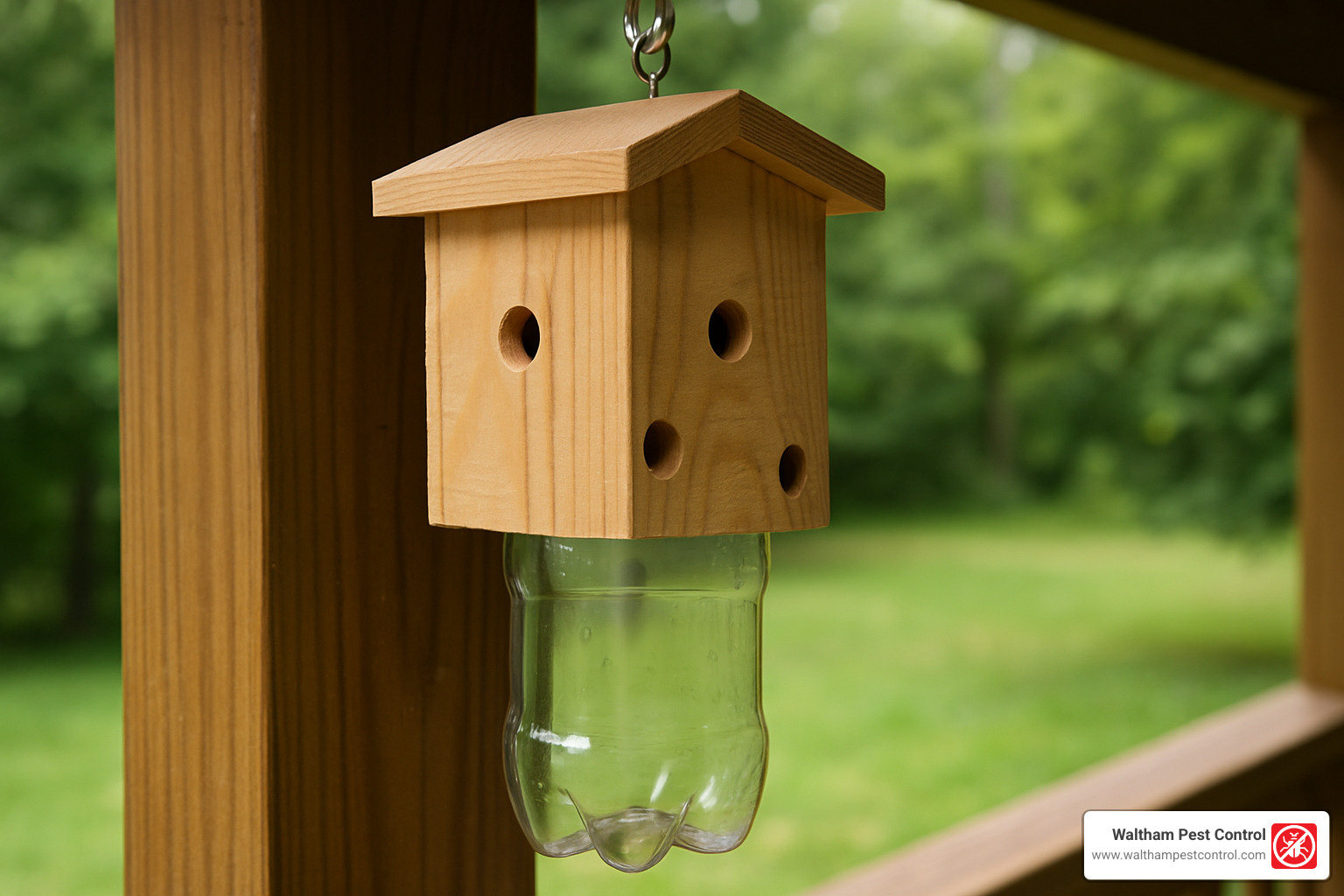
Well-placed traps can reduce local bee populations significantly within five days, especially when positioned at building corners or other strategic sunny locations near active nests. The key lies in understanding what traps can and cannot accomplish.
Commercial traps often outperform homemade versions due to optimized designs and included attractants, but simple DIY versions using scrap lumber and collection containers can provide cost-effective population reduction when you deploy multiple units.
The limitations are important to understand. Traps don’t address existing tunnel systems or developing larvae already inside your wood. They require regular maintenance throughout the active season, and they may not capture all females before egg-laying occurs. For large or dispersed infestations, traps alone rarely provide complete control.
Traps work best when integrated with tunnel treatments and preventive wood protection. Use them to reduce adult populations while simultaneously addressing existing nests through dust applications and hole sealing. This combination approach targets both current problems and future prevention.
The bottom line? Traps are effective population management tools that work especially well for minor infestations or as ongoing monitoring devices. They’re particularly valuable for homeowners who prefer reducing bee numbers without extensive chemical treatments, but they need consistent attention and work best as part of comprehensive carpenter bees treatment and prevention programs.
Conclusion
Managing carpenter bees treatment and prevention successfully comes down to understanding these fascinating insects and taking the right steps at the right time. It’s not just about getting rid of them—it’s about protecting your home while respecting their important role in our ecosystem.
The best defense against carpenter bee damage starts with simple prevention. Regular painting or staining of exposed wood creates an almost foolproof barrier, since these bees have a strong preference for weathered, unpainted surfaces. Think of it as giving your deck or siding a protective shield that also happens to keep your home looking great.
When you do find those telltale ½-inch holes, acting quickly makes all the difference. Insecticidal dust treatments applied at dusk provide the longest-lasting control—often over a year of protection from a single application. The timing matters because that’s when the bees are home, so to speak, making the treatment most effective.
For homeowners who prefer gentler approaches, natural repellents using citrus oils and other eco-friendly methods can work well for minor problems. Just remember that these solutions need consistent reapplication to stay effective—think of them as maintenance rather than one-and-done fixes.
Here in Eastern Massachusetts, I’ve seen just about every carpenter bee situation imaginable over the past four decades. From single holes in deck railings to extensive tunnel systems threatening structural integrity, the pattern is always the same: early intervention saves both money and headaches down the road.
What makes our approach at Waltham Pest Control different is that we don’t just eliminate the problem—we help you understand it. We’ve developed comprehensive programs that protect your property while keeping these valuable pollinators doing their important work in your garden. After all, the same bees boring holes in your deck are also helping your tomatoes and flowers thrive.
The most successful carpenter bee management combines professional expertise with smart homeowner maintenance. Whether you’re dealing with a few scattered holes or a more serious infestation, the key is creating a long-term plan that prevents future problems.
Don’t wait until those small holes become big structural concerns. Every spring brings a new generation of carpenter bees looking for nesting sites, and preventing problems is always easier than fixing damage.
If you’re ready to take control of your carpenter bee situation, our team is here to help. We serve communities throughout Middlesex, Essex, and Norfolk counties, bringing decades of experience to every job. For more information about our comprehensive approach to carpenter bee management, visit our carpenter bee services page.
Effective carpenter bee control isn’t about declaring war on these beneficial insects—it’s about finding the right balance between protecting your home and supporting the pollinators that make Massachusetts gardens beautiful. With the right approach, you can have both carpenter bee-free structures and a thriving ecosystem right in your backyard.
