

Carpenter Bee Pest Control: Expert Protection 2025
Why Carpenter Bees Are a Serious Threat to Your Home
Carpenter bee pest control is essential for protecting your home’s wooden structures from these destructive insects that can cause thousands of dollars in damage over time. Here’s what every Massachusetts homeowner needs to know:
Immediate Control Methods:
- Professional treatment – Most effective, targets larvae and adults
- Residual insecticide sprays – Applied to affected wooden areas
- Insecticidal dust – Injected directly into bee tunnels
- Hole sealing – Prevents reuse of existing nests
Prevention Strategies:
- Paint or stain all exposed wood surfaces
- Use hardwoods like oak instead of softwoods
- Seal cracks and crevices in wooden structures
- Apply treatments in early spring before nesting begins
Those large, intimidating black bees buzzing around your deck aren’t just a nuisance – they’re carpenter bees, and they’re actively drilling perfectly round, half-inch holes into your home’s wooden structures. Unlike bumblebees that nest in the ground, carpenter bees bore directly into wood to create tunnels for their eggs, weakening your property’s structural integrity with each passing season.
What makes carpenter bees particularly problematic is their habit of returning to the same nesting sites year after year. Female carpenter bees not only reuse existing holes but expand them, creating tunnel systems that can extend several feet into wooden beams, siding, and trim. This ongoing damage compounds over time, potentially requiring expensive repairs to decks, porches, and other wooden structures.
I’m Peter Rania, and with over 40 years of experience at Waltham Pest Control, I’ve seen how carpenter bee infestations can escalate from minor annoyances to major structural concerns without proper carpenter bee pest control intervention. Our integrated approach combines targeted treatments with long-term prevention strategies to protect Eastern Massachusetts homes from these persistent wood-boring pests.
Explore more about carpenter bee pest control:
Identifying Carpenter Bees and Recognizing Their Damage
The key to effective carpenter bee pest control starts with knowing exactly what you’re dealing with. I can’t tell you how many times homeowners have called us worried about “those big black bees” only to find they’re actually dealing with harmless bumblebees instead!
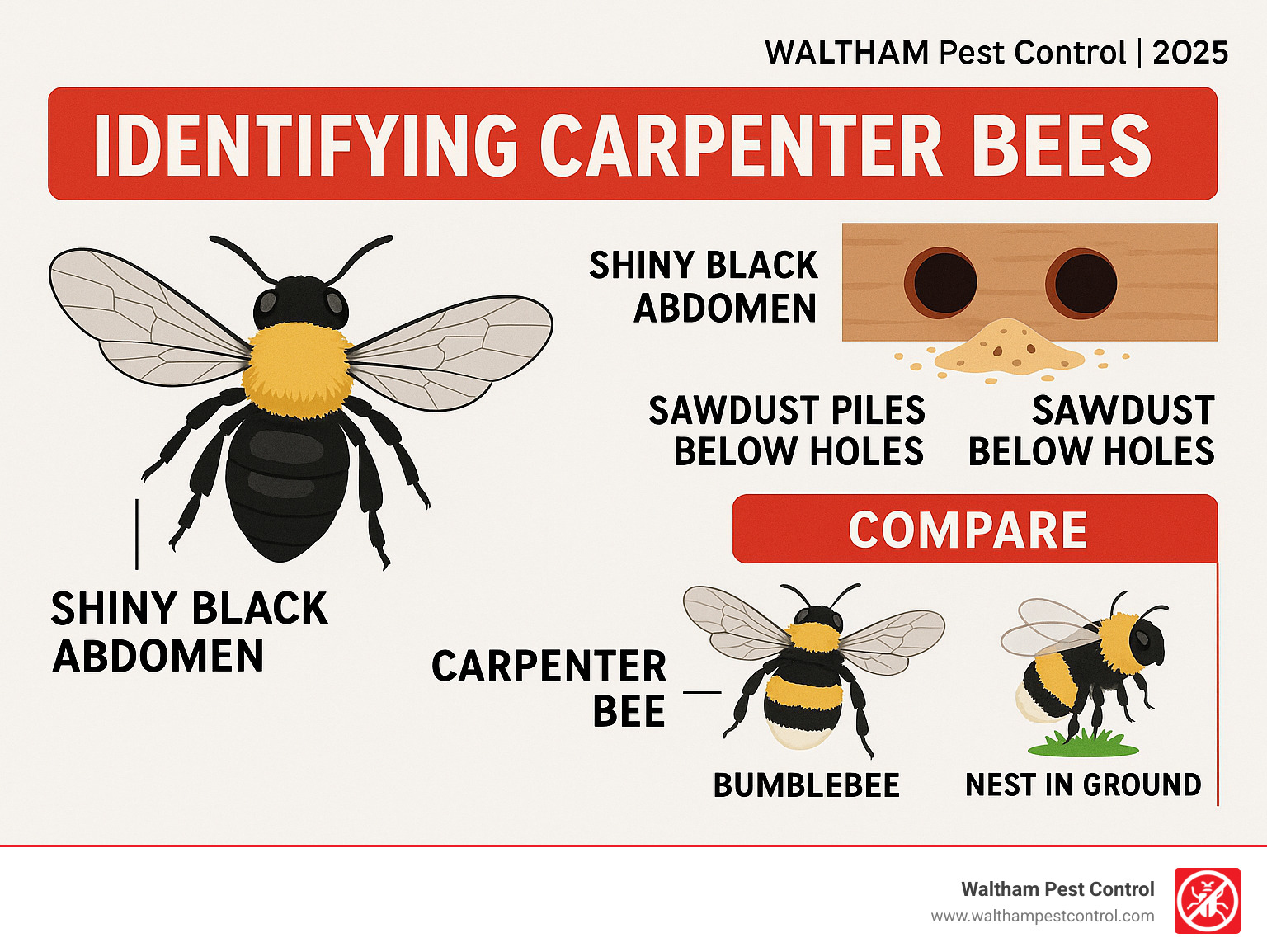
Here’s the telltale difference: carpenter bees have a shiny, black, hairless abdomen that looks almost polished, while bumblebees are fuzzy all over like little flying teddy bears. It’s this smooth, glossy appearance that gives carpenter bees away every time.
Unlike their social bumblebee cousins who live in underground colonies, carpenter bees are solitary nesters. Each female is essentially a single mom, drilling her own private tunnel to raise her babies. You might see several bees working in the same area, but they’re not cooperating – they just happen to have similar taste in real estate!
Telling males from females is pretty straightforward too. Male carpenter bees sport a distinctive white face patch and love to play the tough guy, buzzing aggressively around anyone who gets too close to their territory. The good news? They’re all buzz and no bite – literally. Male carpenter bees can’t sting. Female bees have completely black faces and can sting, but they’re usually too busy with their construction projects to bother with you.
One unexpected clue that you might have carpenter bees? Woodpecker activity on your home. These birds have figured out that carpenter bee tunnels are like wooden takeout containers filled with plump, protein-rich larvae. If woodpeckers are suddenly treating your deck like their personal diner, you probably have carpenter bees.
Signs of a Carpenter Bee Infestation
Recognizing a carpenter bee problem early can save you from watching these industrious insects turn your beautiful wooden structures into Swiss cheese. After four decades in the pest control business, I’ve learned to spot the warning signs from a mile away.
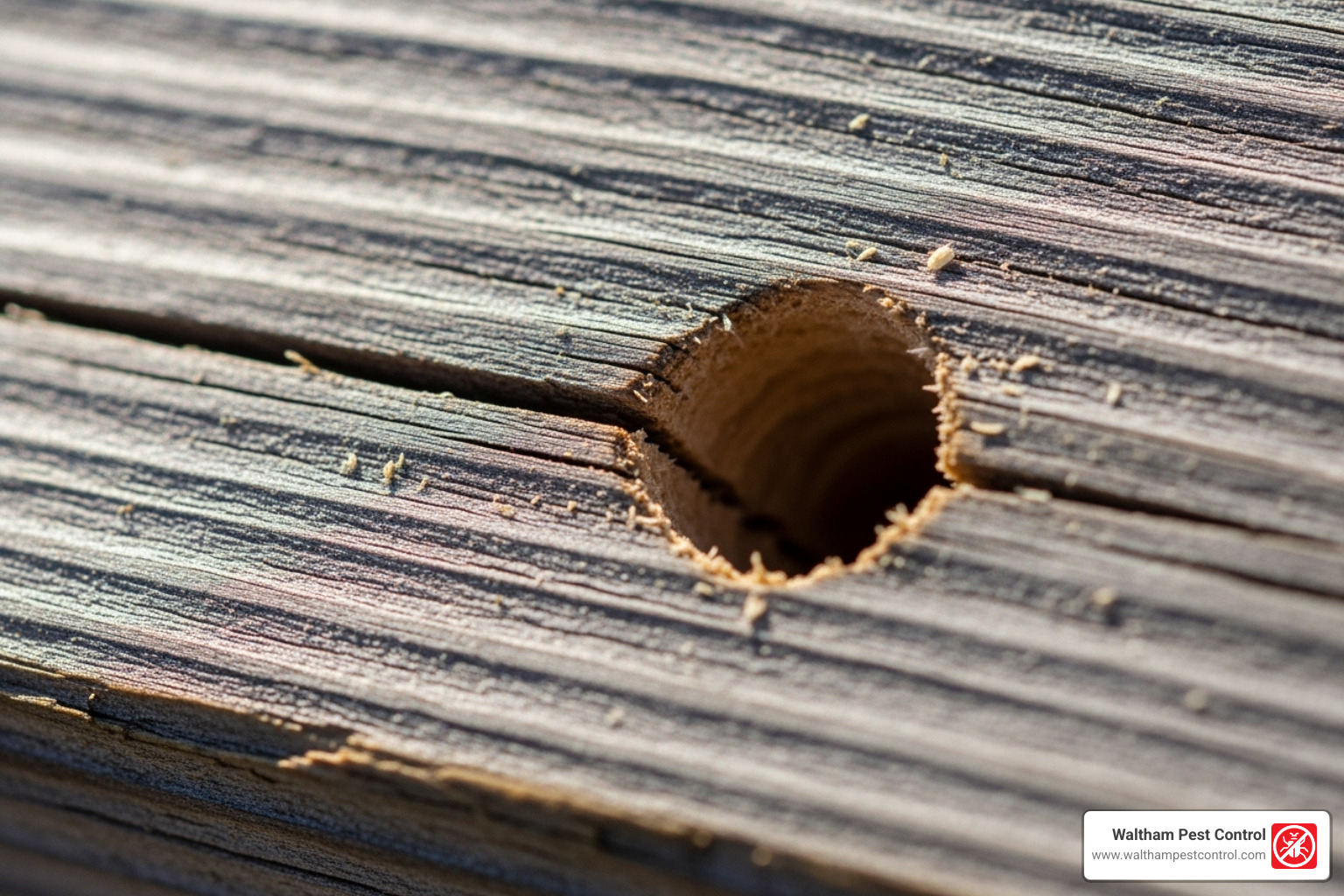
The most obvious sign is those perfectly round holes – and I mean perfectly round, like someone took a drill bit to your wood. These holes are typically half-inch in diameter and look almost machine-made in their precision. You’ll usually find them on the undersides of eaves, deck railings, window trim, and anywhere else there’s exposed wood.
Look for sawdust-like frass piling up beneath these holes. As the bees excavate their tunnels, they kick out wood shavings that collect in neat little piles below their work sites. It’s like finding wood chips at the base of a tree after someone’s been chopping – except much smaller and more refined.
Those unsightly yellowish-brown stains on your wood aren’t from weather damage – they’re carpenter bee droppings. Nobody wants to think about bee bathroom habits, but these stains are a clear indicator that you’ve got active tunnels above.
The aggressive male bees I mentioned earlier are another dead giveaway. If you’ve got a bee that seems to have appointed itself the bouncer of your back porch, hovering and darting at you every time you step outside, you’re probably looking at a male carpenter bee defending his territory.
In severe infestations, you might even hear chewing sounds in your walls – a rhythmic, almost musical gnawing that’s most noticeable during quiet evening hours. It sounds strange, but once you hear it, you’ll never forget it.
If you’re seeing any of these signs around your Eastern Massachusetts home, it’s time to consider professional carpenter bee pest control before these determined insects cause serious structural damage.
Proactive Prevention: Your First Line of Defense
When it comes to carpenter bee pest control, I always tell my clients that prevention is your best investment. After four decades in this business, I’ve learned that stopping these wood-boring pests before they start is far easier—and cheaper—than dealing with an established infestation.

Here’s what I’ve observed over the years: carpenter bees are surprisingly picky about their real estate choices. They have a strong preference for weathered wood and unfinished wood surfaces. That beautiful cedar deck you’ve been meaning to stain? It’s like putting up a “Vacancy” sign for carpenter bees. The softer, more weathered the wood becomes, the easier it is for female bees to drill their perfect half-inch tunnels.
The good news is that painting surfaces and staining wood creates a barrier that carpenter bees find much less appealing. Think of it as putting armor on your home’s wooden structures. While staining offers decent protection, painting is your heavyweight champion here. A fresh coat of paint creates a harder surface that’s significantly more difficult for bees to penetrate.
When building new structures or replacing damaged wood, consider using hardwoods like oak and maple. These dense woods are tough enough that carpenter bees typically look elsewhere for easier drilling. It’s like the difference between trying to dig through concrete versus soft soil—they’ll take the path of least resistance every time.
Don’t overlook the importance of sealing cracks and crevices around your property. Those small gaps, unsealed nail holes, and tiny openings in your wooden structures are like welcome mats for carpenter bees. A little caulk or wood putty can close these entry points and send the message that your home isn’t available for nesting.
For areas that see heavy carpenter bee activity, consider upgrading to vinyl siding or wrapping vulnerable wooden trim with aluminum. These materials create an impenetrable barrier that even the most determined carpenter bee can’t chew through.
The beauty of prevention is that it serves double duty—protecting your home while maintaining its curb appeal. A well-maintained property with properly painted and sealed wood surfaces isn’t just more attractive; it’s naturally resistant to carpenter bee damage. For comprehensive protection strategies custom to your Eastern Massachusetts home, explore our residential pest control services that include long-term prevention planning.
Professional Carpenter Bee Pest Control: The Most Effective Approach
When carpenter bees have already moved in and made themselves at home, prevention strategies alone won’t solve your problem. That’s when professional carpenter bee pest control becomes not just helpful, but essential. After four decades in this business, I can tell you that a professional approach makes all the difference between temporary relief and long-term protection.
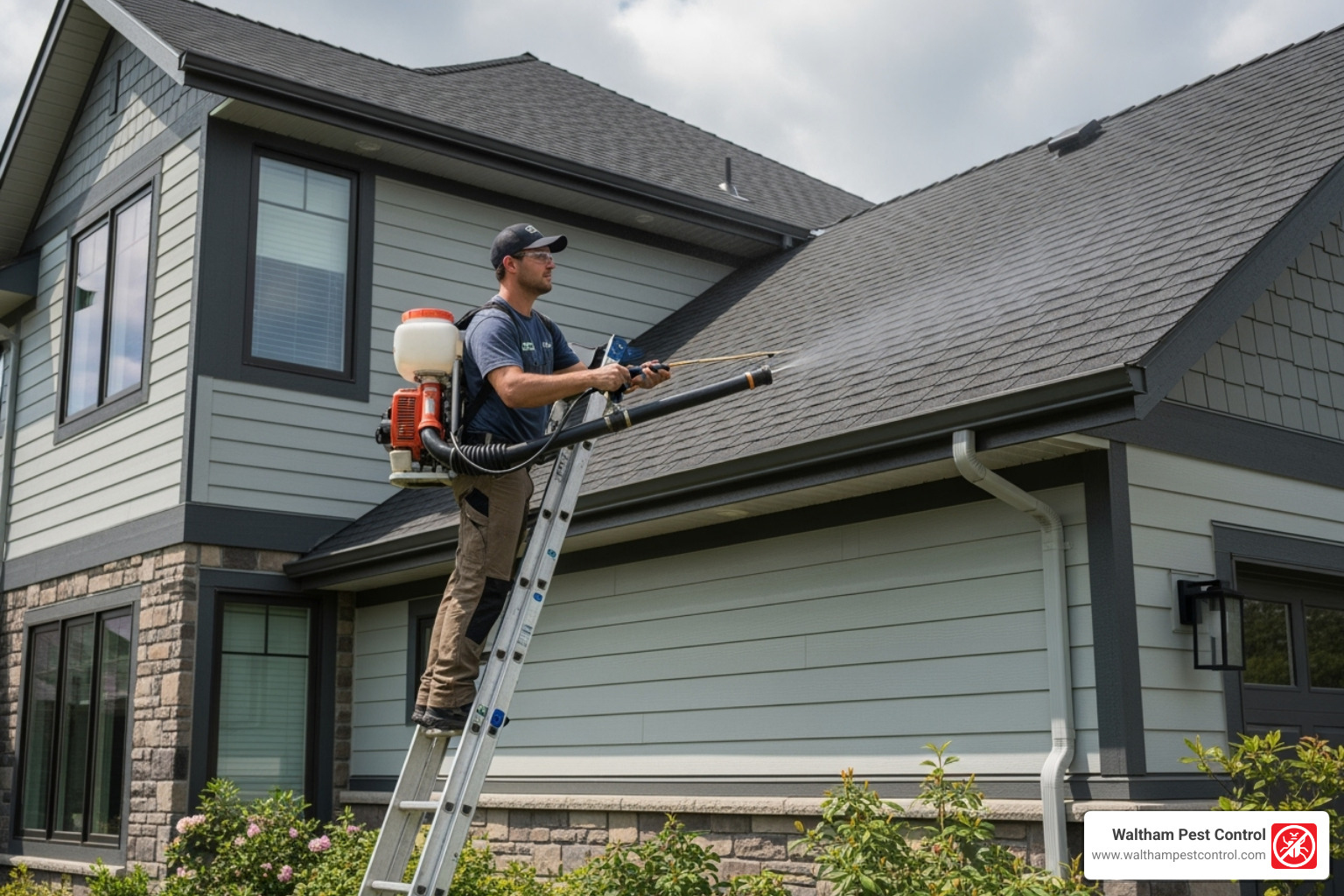
At Waltham Pest Control, we don’t believe in the “spray and pray” approach. Instead, we use Integrated Pest Management (IPM), which means we take the time to thoroughly assess your specific infestation, apply targeted treatments where they’ll be most effective, and provide you with a roadmap for keeping these wood-boring pests away for good. It’s like having a family doctor for your home’s pest problems.
The secret to successful carpenter bee treatment lies in timing. We typically schedule treatments during two critical windows: early spring when overwintering adults emerge and start looking for nesting sites, and late summer to early fall when the new generation emerges from their tunnels. Think of it as catching them at their most vulnerable moments.
Our professional arsenal includes professional-grade residual sprays that create an invisible barrier on wooden surfaces, eliminating bees on contact and providing lasting protection. For established tunnels, we use specialized equipment to apply insecticidal dust directly into the holes. This dust coats the entire tunnel system, targeting both the adult bees and any developing larvae hiding deep inside.
Here’s something many homeowners don’t realize: nest sealing is just as important as the treatment itself, but timing is everything. We only seal holes after we’re absolutely certain the treatment has eliminated all the bees inside. Seal too early, and you’ll either trap live bees (who will just chew new exit holes) or force them to create additional damage trying to escape.
Throughout the entire process, we follow strict safety protocols to protect your family, pets, and the environment. Our technicians are trained to handle these treatments safely, even in hard-to-reach areas like eaves and soffits where carpenter bees love to nest.
This comprehensive approach is why homeowners across Eastern Massachusetts trust us with their most valuable investment. You can learn more about our systematic approach through our IPM program.
Why DIY Carpenter Bee Pest Control Can Fall Short
I understand the appeal of tackling a carpenter bee problem yourself – who doesn’t want to save some money and feel like they’ve conquered the problem? But after seeing countless homeowners struggle with DIY attempts, I have to be honest: carpenter bee pest control is one of those jobs where professional expertise really shows.
The biggest issue is that store-bought products simply aren’t strong enough. The insecticides available to homeowners are like bringing a water gun to a serious fight. They might kill a few bees on the surface, but they rarely penetrate deep enough into those tunnels to eliminate the larvae. So while you might see fewer bees for a few weeks, the next generation is already developing inside your wood.
Then there’s the safety factor. Female carpenter bees can sting, and they get particularly defensive when you’re messing around near their nests. Many of these nests are located in high, awkward spots like eaves and fascia boards. Without proper ladders and safety equipment, you’re putting yourself at risk for both stings and falls.
Even if you manage to apply treatment safely, reaching all the affected areas can be nearly impossible. Carpenter bee tunnels can extend several feet in multiple directions, with side chambers for larvae. A simple spray from a can just can’t reach these deep, complex tunnel systems.
Here’s where many DIY attempts go wrong: people plug the holes immediately after spraying, thinking they’ve solved the problem. But if any bees or larvae survive inside, they’ll simply chew new exit holes, often creating even more damage than you started with. It’s like playing whack-a-mole, but the moles keep multiplying.
For those interested in the science behind effective carpenter bee management, this research on carpenter bee management provides detailed insights into why professional approaches are more successful.
The Best Time for Professional Carpenter Bee Pest Control
Timing isn’t just important in carpenter bee pest control – it’s everything. These bees follow predictable patterns, and knowing when to strike can mean the difference between eliminating the problem and just temporarily reducing it.
Early spring treatment is our first opportunity to break the cycle. As temperatures warm up, overwintering carpenter bees emerge from their tunnels like bears coming out of hibernation. They’re groggy, focused on mating, and beginning to scout for nesting sites. This is when they’re most exposed and vulnerable to treatment. By targeting active adults during this period, we prevent them from laying eggs and starting a whole new generation of wood damage.
The second critical window comes in late summer and early fall. This is when the new generation of adult carpenter bees emerges from their developmental tunnels. These fresh adults haven’t had time to disperse widely yet, making treatment more effective. More importantly, eliminating overwintering bees during this period dramatically reduces the population that will emerge to cause damage next spring.
What makes professional timing so effective is that we’re preventing egg-laying at the most crucial moments. A single female carpenter bee can lay up to 10 eggs in her lifetime, with each egg developing into an adult that will create its own tunnels. By interrupting this cycle at the right moments, we can prevent exponential population growth.
The beauty of this approach is that it works with the bees’ natural behavior rather than against it. We’re not just randomly spraying and hoping for the best – we’re strategically targeting the carpenter bee population when they’re most vulnerable and when our treatments will have the greatest long-term impact.
What to Expect: The Professional Removal Process and Cost
When you contact Waltham Pest Control for carpenter bee pest control, you’re not just hiring exterminators – you’re partnering with a team that’s been protecting Eastern Massachusetts homes for over 40 years. We understand that dealing with carpenter bees can feel overwhelming, which is why our process is designed to give you complete peace of mind from start to finish.
Your journey with us begins with a comprehensive inspection by one of our skilled technicians. We don’t believe in one-size-fits-all solutions, so we take the time to thoroughly examine your property, identify every active nest, and assess the full extent of any damage. This detailed evaluation allows us to create a treatment plan that’s specifically custom to your situation – because every carpenter bee problem is unique.
Once we’ve mapped out the infestation, our treatment process combines precision with power. We apply professional-grade residual insecticides to all affected wooden surfaces where bees are active, creating a protective barrier that eliminates current threats and prevents new ones. For those established tunnels that carpenter bees love to call home, we use specialized dusting equipment to inject insecticidal powder deep into each hole, ensuring that both adult bees and developing larvae are completely eliminated.
Here’s something many homeowners don’t realize: timing matters when it comes to sealing those holes. We’ll provide you with specific guidance on when to seal the entry points – typically a few days after treatment – to ensure the insecticide has done its job completely. Seal too early, and you might trap live bees that will simply chew new exit holes!
Now, let’s talk about cost – because we know that’s probably on your mind. The investment in professional carpenter bee pest control varies significantly based on several key factors, and understanding these can help you make an informed decision.
| Factor | Description |
|---|---|
| Infestation Severity | A few isolated holes will cost much less than extensive damage across multiple structures. The size of the carpenter bee population directly impacts treatment complexity and time required. |
| Accessibility/Height | Ground-level deck railings are straightforward to treat, but nests in high eaves or complex rooflines require specialized equipment and additional safety measures, affecting the overall cost. |
| Number of Nests | Each active tunnel system needs individual attention. More nests mean more product application and treatment time, which influences the final price. |
| Type of Wood/Structure | Different wooden materials and structural designs may require specific application techniques or specialized products to achieve complete elimination. |
| Guarantees/Follow-ups | Companies offering service warranties and follow-up visits provide added value and assurance that your carpenter bee problem is truly resolved. |
Based on internet data, average costs for carpenter bee removal can range dramatically – from around $75 for very minor, easily accessible problems to $1,500 or more for severe infestations requiring multiple treatments or specialized equipment for hard-to-reach areas. The wide variation reflects just how different each situation can be.
What sets us apart isn’t just our four decades of experience – it’s our commitment to transparency and quality. We always provide a clear, honest quote after our inspection, so there are no surprises. As a licensed and insured company, we stand behind our work and focus on delivering cost-effective solutions that protect your home for the long term, not just quick fixes that leave you dealing with the same problem next season.
Frequently Asked Questions about Carpenter Bees
Over four decades of helping Eastern Massachusetts homeowners, we’ve answered countless questions about these wood-boring pests. Let me share the most common concerns we hear and put your mind at ease with straightforward answers.
Are carpenter bees dangerous to people or pets?
Here’s some good news that usually surprises homeowners: carpenter bees pose very little danger to you, your family, or your pets. While their size and aggressive buzzing can be intimidating, the reality is much less scary.
Those male carpenter bees that seem to dive-bomb you when you’re enjoying your deck? They’re all show and no sting. Male carpenter bees literally cannot sting you – they don’t have stingers. Their territorial behavior is their only defense mechanism, so they put on quite the dramatic performance, hovering near your face and buzzing loudly. It’s their way of saying “please stay away from my nest,” but they’re completely harmless.
Female carpenter bees do have stingers, but they’re remarkably docile creatures. Unlike wasps or hornets that might sting at the slightest provocation, female carpenter bees are focused on their work – drilling tunnels and caring for their young. They’ll only sting if you grab them or trap them against your skin. Even then, their stings aren’t barbed like honeybees, so they won’t get stuck in your skin.
The bottom line? Carpenter bee pest control is needed to protect your home’s wood, not because these bees pose a significant threat to people or pets.
Do carpenter bees actually eat the wood they bore into?
This might be the biggest misconception we encounter! Despite all that drilling and the piles of sawdust they leave behind, carpenter bees don’t actually eat wood. They’re not tiny termites munching away at your home’s structure.
Think of carpenter bees as skilled carpenters (hence the name!) who excavate wood to create the perfect nursery for their babies. They chew through wood fibers to create tunnels and galleries that serve as safe, protected spaces for nesting purposes. These tunnels can extend several feet into wooden beams, with multiple chambers branching off the main tunnel.
What do they actually eat? Carpenter bees have a pollen and nectar diet, just like other bees. They’re actually beneficial pollinators when they’re not busy drilling holes in your deck! The “bee bread” they store in their tunnels is a nutritious mixture of pollen and nectar that feeds their developing larvae.
So while they’re not consuming your home for dinner, the structural damage from their tunnel construction can still be significant over time – which is why effective carpenter bee pest control remains important.
Will carpenter bees return to the same spot every year?
Unfortunately, this is where carpenter bees become particularly frustrating for homeowners. The answer is a resounding yes – they absolutely will return to the same spots year after year.
Carpenter bees are creatures of habit and convenience. Female bees not only reuse existing tunnels but actively expand them, making the damage progressively worse each season. It’s like they’re adding onto their wooden condominiums every year, extending tunnels and creating new chambers.
What makes this behavior even more persistent is pheromone attraction. Previous generations leave chemical markers that essentially say “great nesting spot here!” to future carpenter bees. These scent trails can attract not just the original bee’s offspring, but other carpenter bees looking for prime real estate.
This is why the importance of sealing holes cannot be overstated. Simply eliminating the current bee population isn’t enough – those perfectly round holes will serve as open invitations for next year’s carpenter bees. After professional treatment has eliminated the bees, we always recommend properly sealing the tunnels with wood putty or wooden dowels.
Over time, these generational nesting sites can become seriously compromised. We’ve seen wooden beams that look solid from the outside but are riddled with interconnected tunnels on the inside. That’s why addressing carpenter bee problems early, before they become established generational sites, is so much more effective and cost-efficient than waiting until the damage is extensive.
Protect Your Home from Carpenter Bee Damage for Good
After four decades of helping Eastern Massachusetts homeowners deal with carpenter bees, I can tell you one thing with certainty: these persistent pests don’t give up easily. But here’s the good news – with the right combination of proactive prevention and professional expertise, you can win this battle and protect your home’s structural integrity for years to come.
Proactive prevention is key to keeping carpenter bees from choosing your home as their next construction project. Those simple maintenance tasks we discussed – keeping wood surfaces painted or stained, choosing dense hardwoods for new projects, and sealing even the smallest cracks – create a fortress that carpenter bees simply can’t penetrate. Think of it as making your home as uninviting as possible to these wood-boring guests.
However, when carpenter bees have already moved in and started their tunneling operations, that’s when professional expertise ensures complete removal. Our trained technicians don’t just spray and hope for the best. We use targeted treatments that reach deep into those tunnels, eliminate both adults and developing larvae, and provide the long-term solutions that store-bought products simply can’t match.
What sets professional carpenter bee pest control apart is our commitment to protecting your home’s long-term structural integrity. We’ve seen too many cases where DIY attempts provided temporary relief, only to have the bees return stronger than ever the following season. Our integrated approach breaks that cycle completely.
At Waltham Pest Control, we understand that your home is your biggest investment. That’s why our licensed and insured team brings over 40 years of experience to every job, combining proven treatment methods with practical prevention advice custom specifically to Eastern Massachusetts homes.
Don’t let another season pass while carpenter bees continue their destructive work. Every day you wait gives them more time to expand their tunnel systems and cause additional damage. The buzzing might be annoying now, but the structural repairs later will be far more costly and disruptive.
Schedule your professional pest inspection today! and take the first step toward a carpenter bee-free home. Your wooden structures will thank you, and you’ll have the peace of mind that comes with knowing your home is protected by true professionals who stand behind our work.
