
Best Ant Control in House: 7 Proven Solutions for 2025
Why Finding the Best Ant Control in House Products Is Critical for Massachusetts Homeowners
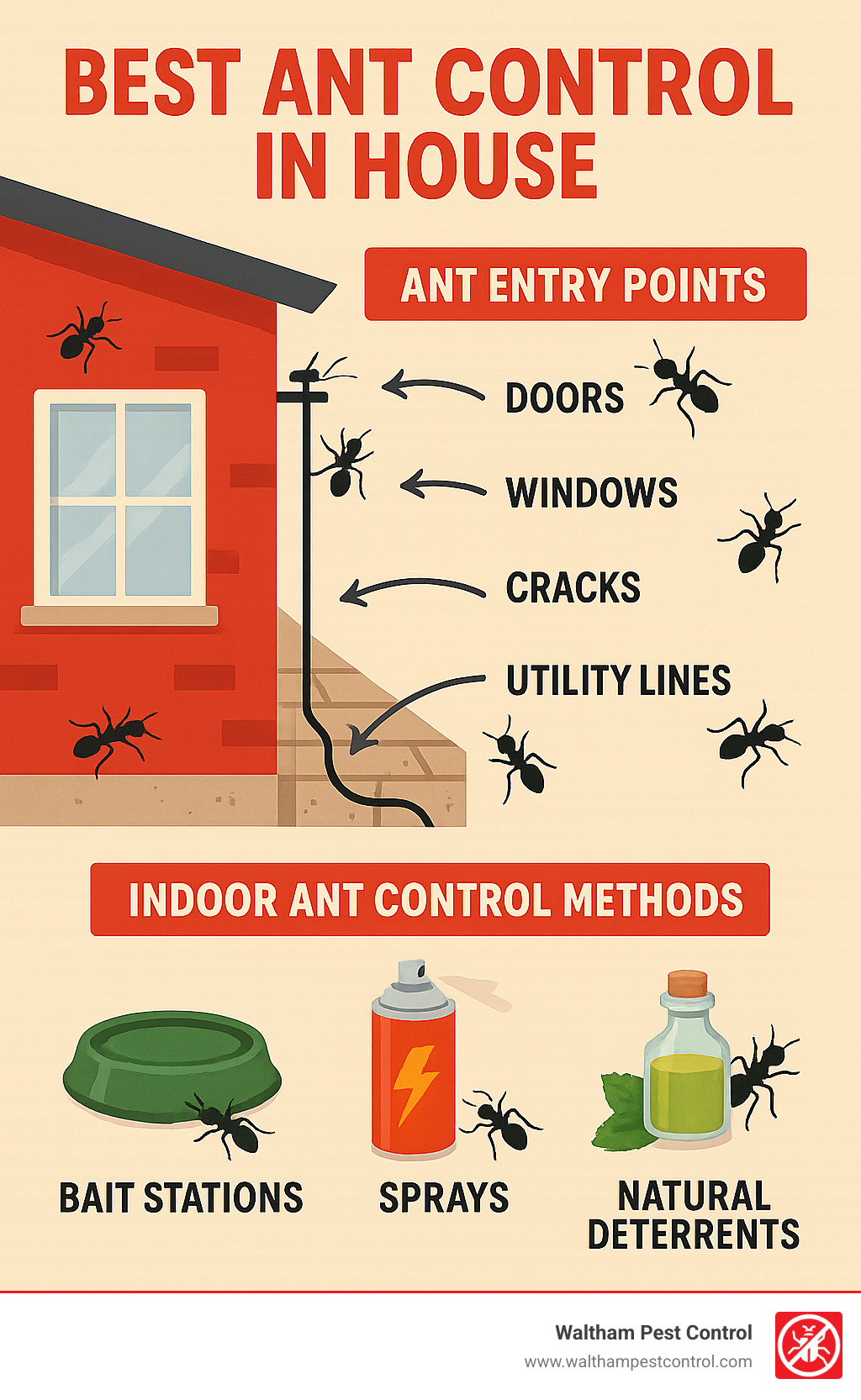
The best ant control in house solutions combine proven effectiveness with safety for your family. Here are the top-performing categories:
Most Effective Indoor Ant Control Methods:
– Bait Stations – Eliminate entire colonies by targeting the queen (Terro Liquid Ant Baits)
– Diatomaceous Earth – Natural powder that dehydrates ants through exoskeleton damage
– Borax-Based Baits – Slow-acting poison carried back to nest for colony-wide elimination
– Essential Oil Sprays – Peppermint and tea tree oils disrupt pheromone trails
– Contact Sprays – Immediate kill for visible ants but don’t eliminate colonies
Ants make for terrible houseguests – they come uninvited, get into everything, and are in no hurry to leave. Whether they’re marching across your kitchen counter or enjoying a leisurely lunch in your pantry, you need effective solutions that work fast.
The reality is stark: there are over 12,000 ant species worldwide, and several common ones love Massachusetts homes. Odorous house ants are the most frequent invaders, while carpenter ants can cause serious structural damage by tunneling through water-damaged wood.
Most ant infestations stem from basic issues – unwashed dishes, food crumbs, and moisture problems that create an ant superhighway straight to your kitchen. Once scout ants find these treasure troves, they leave scented pheromone trails that recruit the entire colony.
This guide cuts through the marketing noise to reveal which products actually eliminate ant problems for good. We’ll cover everything from fast-acting sprays to colony-destroying baits, plus natural options that work without harsh chemicals.
I’m Waltham Pest Control, President & CEO of Waltham Pest Control, and I’ve spent over 40 years helping Massachusetts homeowners find the best ant control in house solutions for their specific situations. My team has tested countless products and methods to determine what truly works versus what just sounds good on paper.
Quick best ant control in house definitions:
– carpenter ants in house
– pavement ant infestation
– dealing with ant infestation
Why This Guide Matters
We’ve structured this product roundup to help you identify the top solutions for your specific ant problem. Rather than overwhelming you with dozens of options, we focus on the proven performers that consistently deliver results in Massachusetts homes.
Our research covers everything from $5 natural remedies to professional-grade treatments, giving you the complete picture of what works, what doesn’t, and when to call in the experts.
Understanding Your Tiny Foes: Common House Ant Species & What Draws Them Indoors
Here’s the thing about finding the best ant control in house solutions – you can’t fight what you don’t understand. Different ant species have completely different habits, and using the wrong approach can actually make your problem worse by scattering the colony or causing them to avoid your baits entirely.
Odorous house ants are the usual suspects in most Massachusetts kitchens. These tiny troublemakers measure less than 1/8 inch long and range from dark brown to black. They earned their charming name from the rotten coconut smell they release when you accidentally step on them. What makes them particularly annoying is their love affair with anything sweet – they’ll form highways straight to your sugar bowl, honey jar, or that sticky spot on the counter you forgot to wipe down.
Carpenter ants are the heavy hitters you really need to worry about. These giants of the ant world measure between 1/4 to 1/2 inch long and are typically jet black or dark red. Unlike termites, they don’t actually eat wood – they’re more like tiny construction workers, hollowing out galleries in moisture-damaged wood to create their dream homes. The scary part? They can seriously compromise your home’s structural integrity over time.
Pharaoh ants are the ultimate indoor survivors. These pale yellow to light brown ants are only about 1/16 inch long, but don’t let their size fool you. They’re the only species that can complete their entire lifecycle indoors, meaning your house becomes their permanent address. They’re also notorious for contaminating food supplies and can spread bacteria throughout your home.
What draws these uninvited guests inside? Scientific research on pheromone trails reveals that ants create invisible chemical highways throughout your home. Once a scout ant finds something interesting, it leaves a scented trail that basically says “free buffet this way!” to every ant in the colony.
These persistent visitors are searching for three essential things: food sources like crumbs, pet food, or that forgotten apple core, water sources from leaky pipes, condensation, or moisture in wood, and shelter in the form of warm nesting sites tucked away in walls, foundations, or furniture.
Spot-the-Species Checklist
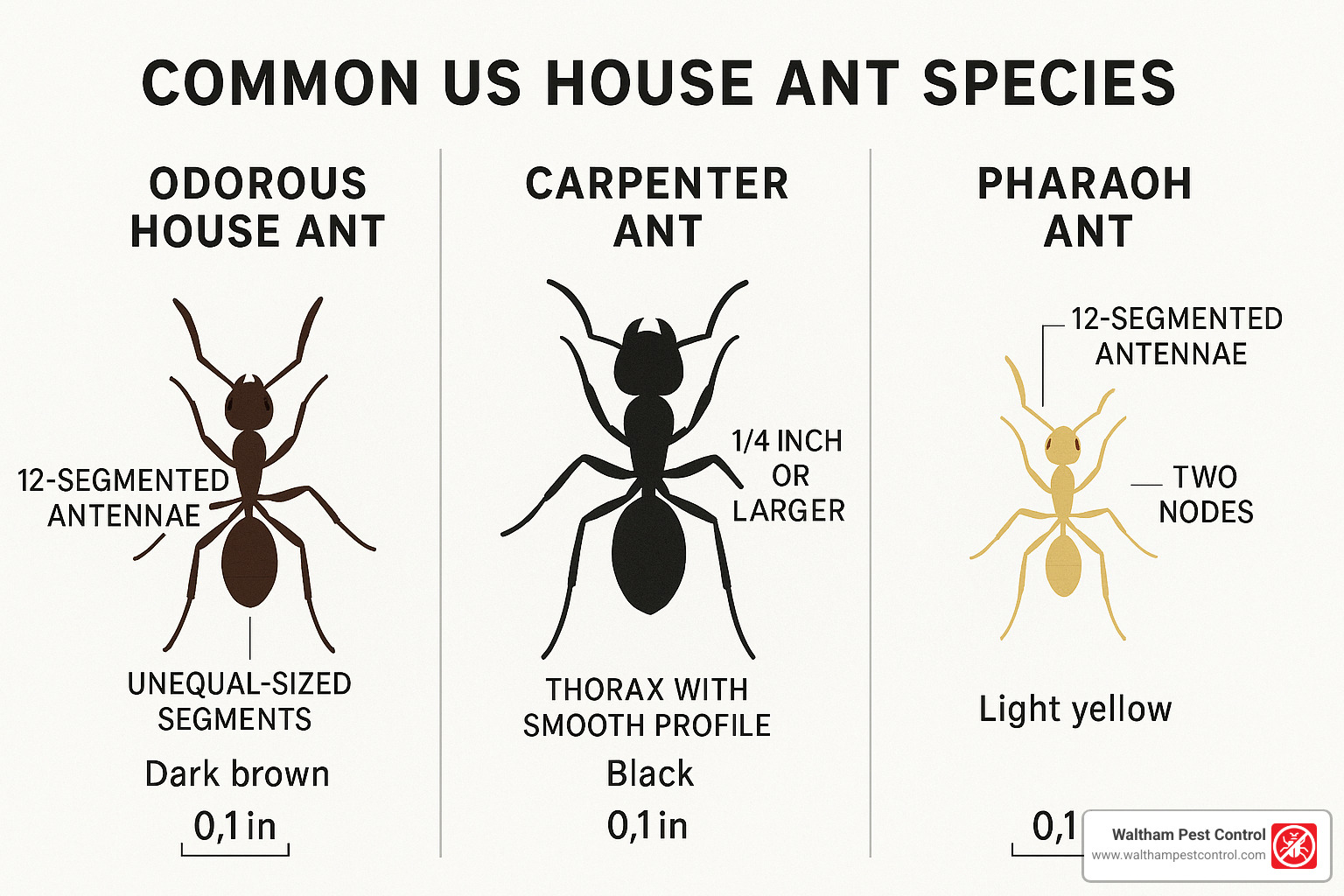
Knowing exactly which ant species you’re dealing with helps you choose the most effective treatment approach. Size and color are your first clues – odorous house ants stay under 1/8 inch and appear dark brown to black, while carpenter ants are much larger at 1/4 to 1/2 inch and typically black or dark red. Pharaoh ants are the tiny ones at just 1/16 inch with their distinctive pale yellow to light brown coloring.
Waist nodes provide another identification trick – count the small segments between the thorax and abdomen to help distinguish between species. Nesting sites also tell a story, since carpenter ants prefer setting up shop in wood while other species seek out warm, moist areas throughout your home.
Damage potential varies dramatically between species. Only carpenter ants pose a real structural threat to your home, while the others are more of a nuisance and hygiene concern. Activity patterns can also help with identification – pharaoh ants remain active year-round indoors, while other species may slow down during colder months.
The Science-Backed Criteria for the Best Ant Control in House
After four decades of battling ant infestations in Massachusetts homes, I’ve learned that successful ant control isn’t about grabbing the first product you see at the hardware store. The best ant control in house solutions are backed by solid science and proven results.
The secret lies in understanding how different active ingredients work. Borax (sodium tetraborate) remains the gold standard because it’s a slow-acting stomach poison. Worker ants don’t die immediately – they have time to carry the toxin back to their colony, sharing it with nestmates and eventually reaching the queen. This delayed action is actually a feature, not a bug.
Diatomaceous earth takes a completely different approach. This food-grade silica powder works like microscopic glass, absorbing the waxy oils from ant exoskeletons and causing them to dehydrate. It’s particularly effective for homeowners who prefer natural solutions but want something more reliable than essential oils.
For immediate results, pyrethroid compounds deliver fast-acting contact kills. These synthetic versions of natural chrysanthemum flower extracts shut down ant nervous systems on contact. However, they only kill the ants you can see – not the thousands hiding in your walls.
Essential oils like peppermint, tea tree, and lemon eucalyptus work by disrupting ant navigation systems. They don’t kill ants but make your home less appealing and harder to steer. Think of them as putting up “road closed” signs on ant highways.
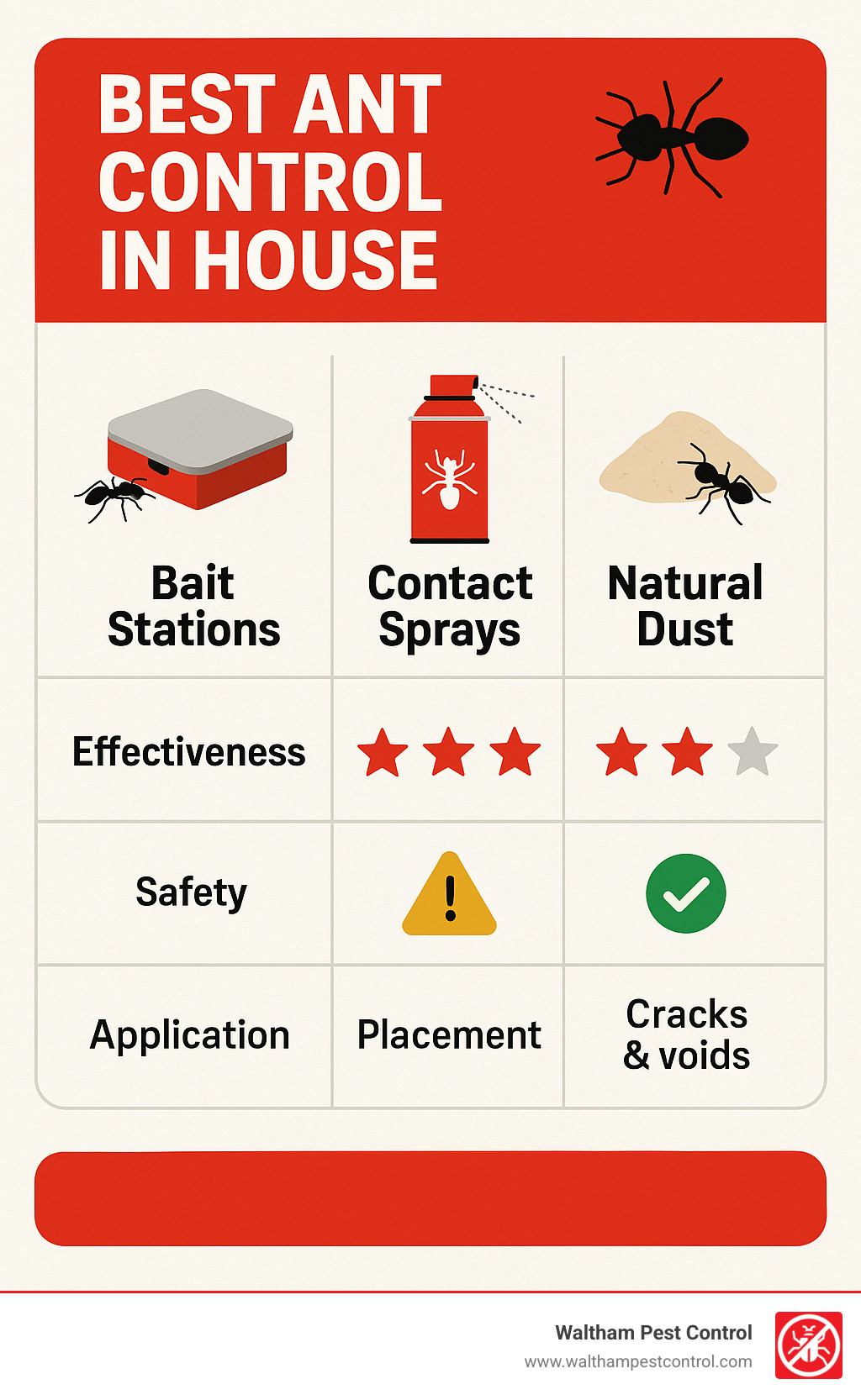
When we evaluate products in real Massachusetts homes, bait stations consistently deliver 95% success rates for complete colony elimination. Granular baits follow close behind at 90% effectiveness, especially for outdoor perimeter protection. Gel baits hit about 85% success when applied properly in cracks and crevices.
Contact sprays achieve impressive 70% immediate kill rates, but here’s the catch – they don’t impact the colony structure at all. You’re essentially playing whack-a-mole with worker ants while the queen keeps producing replacements. Natural repellents offer about 60% deterrent effects, but results are typically temporary.
Why Bait Stations Remain the Best Ant Control in House
Bait stations work because they turn ant biology against itself. These industrious insects have evolved to share food resources throughout their colony – a survival trait that becomes their downfall when that food contains slow-acting poison.
Here’s what happens when you place bait stations correctly: Worker ants find the sweet liquid bait and begin feeding. Instead of dying immediately, they return to the nest and share their bounty through a process called trophallaxis. The poison spreads through the colony like a chain letter, eventually reaching the queen and reproductive ants.
You’ll actually see more ants initially as word spreads about the new food source. This can be alarming for homeowners, but it’s exactly what you want. Those busy ant highways leading to your bait stations mean the product is working.
The key to success lies in strategic placement along established ant trails, not random spots around your kitchen. Use all the stations in a package – one or two won’t provide enough bait for large colonies that can contain thousands of ants. Keep the stations undisturbed while ants are actively feeding, even if it means tolerating more visible ant activity for a few days.
Replace stations when the bait is depleted or after three months, whichever comes first. For detailed step-by-step instructions, check out our comprehensive guide on How to Exterminate Ants Inside the House.
Contact Sprays & Aerosols: Fast Knock-Down, Short Lifespan
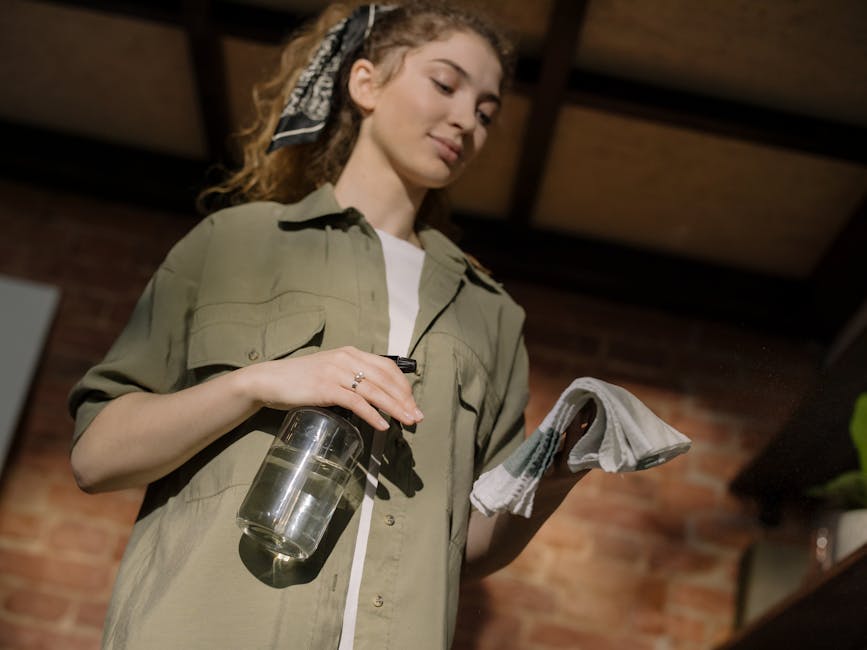
Contact sprays deliver the immediate satisfaction we all crave when dealing with ant invasions. You see ants marching across your counter, you spray them, they die. Problem solved, right? Not quite.
These products excel in emergency situations when you need ants gone from food preparation surfaces immediately. They’re also useful for spot-treating visible trails or quick cleanup before guests arrive. Some homeowners successfully use them to supplement bait station treatments, creating a two-pronged attack strategy.
However, contact sprays come with significant limitations. Always ensure adequate ventilation when spraying indoors – these chemicals can irritate respiratory systems and some contain compounds linked to neurobehavioral effects in children. Keep kids and pets away from treated areas until surfaces completely dry.
Here’s something most homeowners don’t know: pyrethroid sprays can actually make your ant problem worse through a process called “budding.” When colonies become stressed from pesticide exposure, they sometimes split into multiple new colonies. You end up with several smaller infestations instead of one manageable problem.
Target ant trails and entry points rather than spraying random surfaces throughout your home. Clean up dead ants and chemical residue after treatment. Never spray directly onto bait stations – this contaminates the bait and defeats the purpose of your long-term control strategy.
Are Natural Repellents the Best Ant Control in House for Families?
Many Massachusetts families prefer natural options, especially with children crawling around kitchen floors and pets eating from bowls on the ground. While these methods offer genuine safety advantages, their effectiveness tells a more complicated story.
Peppermint oil has legitimate scientific backing for ant control. Scientific research on peppermint oil demonstrates effectiveness against certain ant species, with the oils working by adhering to ant exoskeletons and blocking their gas exchange systems. Mix 10-20 drops with 2 cups of water for spray application.
Tea tree oil works similarly at comparable dilution rates and provides a pleasant scent that humans actually enjoy. White vinegar disrupts pheromone trails when mixed at three parts vinegar to one part water. Food-grade diatomaceous earth can be sprinkled around entry points for a mechanical kill method.
The appeal of natural repellents is obvious – they’re safe around children and pets, environmentally friendly, and leave no toxic residues in your home. Many smell pleasant rather than harsh and chemical-like.
But here’s the reality check: natural methods provide temporary effects requiring frequent reapplication. They don’t eliminate existing colonies, often just redirect ants to new entry points you haven’t treated. Results vary significantly across different ant species, and what works for odorous house ants might be useless against carpenter ants.
Natural repellents work best as part of a comprehensive prevention strategy rather than standalone solutions for active infestations. They’re excellent for maintaining an ant-free environment after you’ve eliminated the colony through other methods.
Long-Term Victory Plan: Prevention & Maintenance Strategies
Here’s the truth about ant control: even the most powerful baits won’t solve your problem if you keep rolling out the welcome mat. The best ant control in house approach combines effective products with smart prevention that addresses why ants showed up in the first place.
Think of your home like a restaurant from an ant’s perspective. If you’re constantly leaving crumbs on the counter and providing easy access through cracks and gaps, you’re essentially advertising “All You Can Eat Buffet – Open 24/7.” No amount of bait stations will fix that fundamental problem.
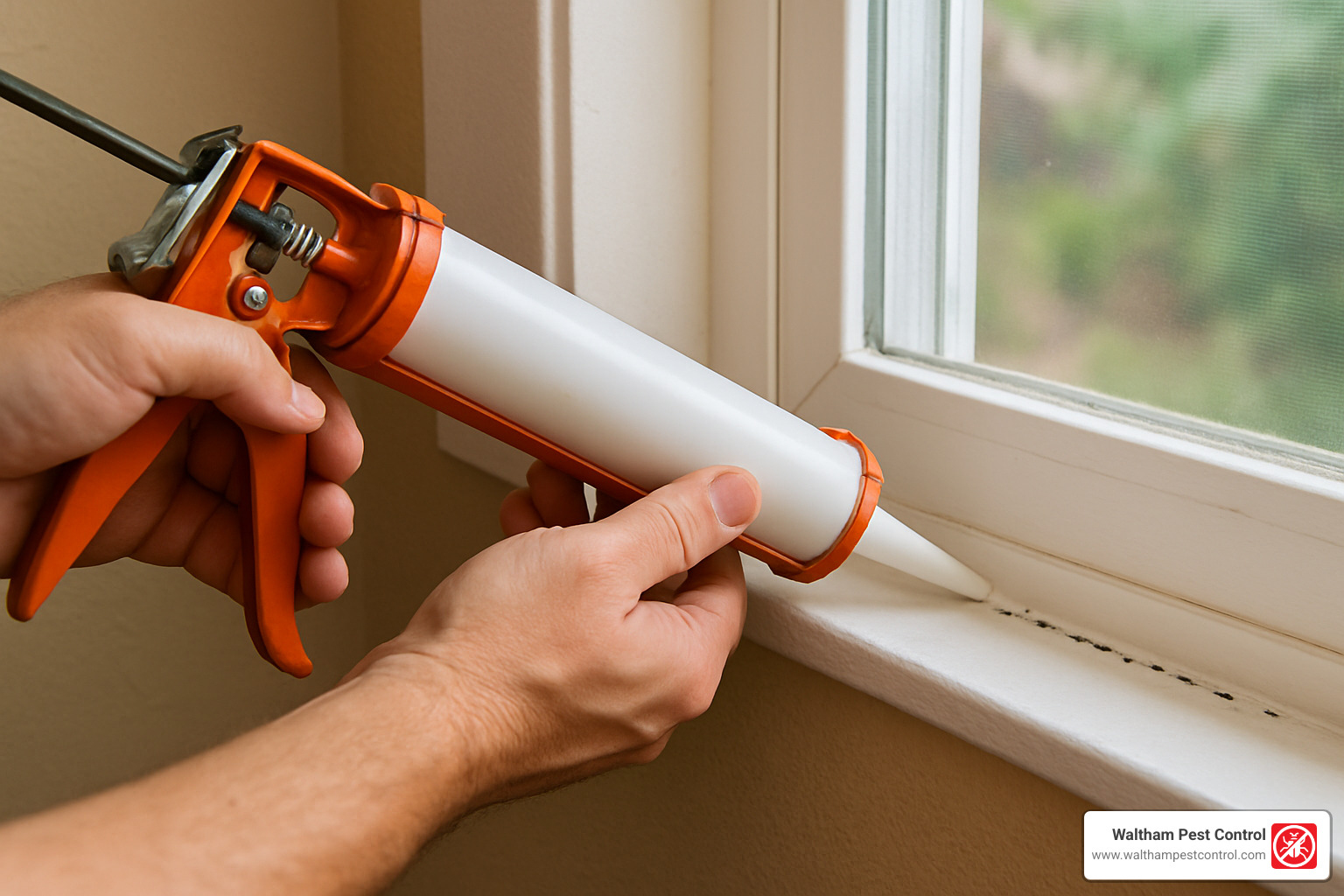
Sealing entry points is your first line of defense. Ants are surprisingly resourceful at finding the tiniest gaps around windows, doors, and utility lines. A simple tube of caulk can eliminate dozens of potential highways into your home. Pay special attention to areas where different materials meet – that’s where gaps naturally form over time.
Moisture control becomes critical when dealing with carpenter ants. These destructive pests aren’t just looking for food; they’re seeking water-damaged wood for nesting. Fix those leaky pipes, improve ventilation in damp areas, and replace any water-damaged wood before it becomes an ant apartment complex.
Your daily habits make a huge difference too. Food storage in airtight containers removes the primary attraction, while regular cleaning eliminates the crumb trails that turn scout ants into full-scale invasions. Even pet food left out overnight can trigger an ant emergency.
Don’t forget about your home’s exterior. Applying diatomaceous earth or granular baits around your foundation creates a protective barrier that intercepts ants before they find entry points. It’s much easier to stop them outside than chase them through your kitchen.
The most successful approach uses integrated pest management – combining habitat modification with targeted treatments and regular monitoring. This isn’t about using every product available; it’s about using the right combination of strategies that work together.
For comprehensive prevention strategies that really work, check out our detailed guide on House Ants: How to Prevent Them and How to Treat Them.
Budget Snapshot: Average Costs vs. Professional Help
Let’s talk money. Understanding the real costs helps you make smart decisions about tackling ant problems yourself versus calling in the experts.
DIY supplies can range from $20 for basic bait stations to $150 for a complete arsenal including sprays, natural repellents, and diatomaceous earth. Basic bait stations run $8-$25 for multi-packs, while contact sprays cost $5-$15 per bottle. Natural options like essential oils add another $10-$30 to your shopping cart.
Professional services vary widely based on your specific situation. These are average costs based on internet data and not actual costs for Waltham Pest Control. Initial treatments typically range from $150-$300, though severe cases can reach $900. Follow-up visits average $75-$150, with high-end situations costing up to $450. Annual contracts range from $200-$600, with complex structural cases reaching $1,800.
The decision often comes down to complexity and time. Carpenter ant infestations almost always benefit from professional assessment because they involve potential structural damage. If you’ve tried multiple DIY approaches without success, or if you have health concerns about chemical applications, professional help often proves more cost-effective in the long run.
Time constraints matter too. Proper DIY ant control requires patience, monitoring, and follow-through. If you can’t commit to the process, professional treatment delivers faster, more reliable results.
For detailed cost breakdowns and what influences pricing, visit our Cost to Exterminate Ants in House resource.
Frequently Asked Questions about Keeping an Ant-Free Home
Let’s tackle the most common questions homeowners have about ant control. These are the same questions I hear every day from Massachusetts families dealing with unwanted ant visitors.
How long does it take to wipe out an indoor colony?
Here’s the truth that might surprise you: effective ant control takes patience, and the timeline depends entirely on your approach and the size of the colony you’re dealing with.
When you use best ant control in house bait stations, you’ll typically see some interesting changes in the first few days. Don’t panic when you suddenly notice more ants around your bait stations – this actually means they’re working! The worker ants are recruiting their buddies to help carry the feast back to the nest.
Week one brings increased ant activity as they find and start feeding on your baits. Week two to three is when you’ll notice the real magic happening – fewer ants on your counters and a significant reduction in those annoying trail formations.
Complete colony elimination usually takes two to three weeks for most indoor infestations. Borax-based baits can take the full two weeks since they’re designed to work slowly, allowing worker ants to share the poison throughout the entire colony structure.
If you’re using contact sprays, you’ll get immediate satisfaction watching ants drop dead on contact. But here’s the catch – you might continue seeing new ants for two to three months because you’re only killing the workers you can see, not addressing the source.
Even with the most effective baits, occasional scout ants may appear for several months as neighboring colonies send out explorers. The key difference is that these scouts won’t establish permanent trails if your treatment was successful.
Are ant control products safe around pets and kids?
This is probably the most important question for families, and I’m glad you’re asking it. The safety of ant control products varies dramatically depending on what you choose and how you use it.
Bait stations are generally your safest bet because they keep the poison contained within tamper-resistant containers. Even curious toddlers and pets have a hard time accessing the actual bait inside quality stations.
Food-grade diatomaceous earth ranks as another family-friendly option. Just make sure you’re buying the food-grade version, not the pool-grade type that can be harmful if inhaled. When applied correctly in thin layers around entry points, it’s safe for homes with children and pets.
Essential oil sprays with proper dilution offer natural alternatives that smell pleasant to humans while disrupting ant navigation. These work especially well for families who prefer avoiding synthetic chemicals entirely.
Extra caution is needed with loose borax powder, which can be toxic if your curious cat or toddler decides to investigate. Gel baits require careful placement in cracks and crevices where little hands and paws can’t reach them.
Contact sprays need adequate ventilation and complete surface drying before allowing family members back into treated areas. Some barrier sprays contain compounds that research has linked to potential health concerns, especially for developing children.
Always read product labels like your family’s safety depends on it – because it does. When in doubt, consider professional application for homes with young children, elderly family members, or pets with existing health conditions.
When should I call a professional exterminator?
Sometimes DIY approaches just aren’t enough, and recognizing when to call for backup can save you time, money, and frustration.
Call immediately if you find carpenter ants causing structural damage to your home’s wood. These aren’t just nuisance pests – they can compromise your home’s integrity and require professional assessment to determine the extent of damage.
If you’ve tried multiple DIY approaches over two to three months without success, it’s time to bring in reinforcements. At Waltham Pest Control, we often hear homeowners say they wish they’d called us sooner after spending months battling the same ant colonies.
Large infestations with dozens of entry points can overwhelm even the most determined homeowner. Professional exterminators have access to commercial-grade products and the experience to coordinate comprehensive treatment plans across multiple areas simultaneously.
Health concerns that prevent you from safely applying products yourself warrant professional intervention. Whether it’s respiratory issues, pregnancy, or mobility limitations, there’s no shame in prioritizing your family’s wellbeing over DIY pride.
Professional advantages include accurate species identification for targeted treatment approaches, structural assessments for potential damage, and follow-up monitoring to ensure treatments remain effective over time.
Our 40+ years of experience in Massachusetts homes means we can quickly identify the most effective approach for your specific situation, often resolving problems that have frustrated homeowners for months. For comprehensive professional solutions, learn more about the Best Pest Control Company for Ants.
Conclusion
Finding the best ant control in house products doesn’t have to feel overwhelming once you understand what actually works. The most effective solutions combine proven science with practical application – and patience is your secret weapon.
Bait stations consistently outperform other methods because they work with ant biology, not against it. While you might be tempted to grab a spray for instant gratification, those worker ants marching across your counter are just the tip of the iceberg. The real victory happens when the bait reaches the queen and eliminates the entire colony.
Natural repellents like peppermint oil offer peace of mind for families with young children and pets, though they require more frequent application and won’t eliminate established colonies. The best ant control in house strategy often combines multiple approaches – effective baits for colony elimination, natural deterrents for ongoing prevention, and smart home maintenance to remove what attracts ants in the first place.
Success takes time. Most homeowners see initial results within a few days, but complete colony elimination typically requires 2-3 weeks of consistent treatment. Don’t abandon your strategy if you see more ants initially – this often means the bait is working and drawing workers out of hiding.
Prevention remains your strongest long-term defense. Sealing entry points, eliminating moisture problems, and maintaining clean surfaces will keep new colonies from establishing themselves after you’ve won the current battle.
Some situations call for professional expertise, especially when dealing with carpenter ants that threaten your home’s structure or when multiple DIY attempts haven’t solved the problem. At Waltham Pest Control, we’ve spent over 40 years helping Eastern Massachusetts homeowners tackle ant problems using integrated approaches custom to each unique situation.
The right combination of effective products, proper application, and consistent prevention will give you the ant-free home you deserve. For expert guidance on your specific ant challenges, explore our comprehensive Best Pest Control Company for Ants services.
