

Bald Faced Hornets Nest Removal: 7 Powerful Safe Tips 2025
Understanding the Danger: Bald-Faced Hornet Nests
Bald faced hornets nest removal should be approached with extreme caution. Here’s what you need to know right away:
| Safe Removal Basics | Details |
|---|---|
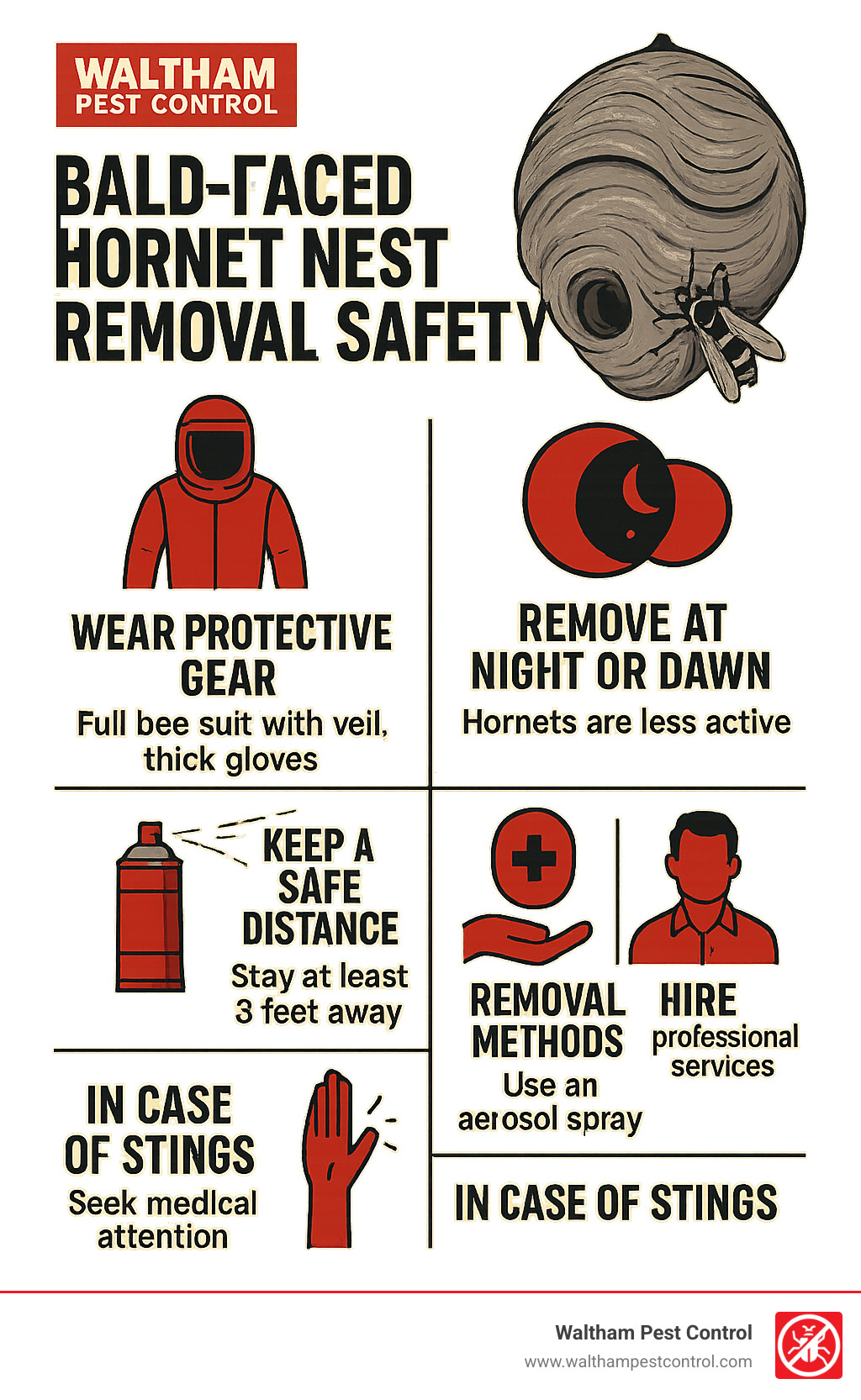
| Best time | Night or dawn when hornets are least active |
| Protective gear | Full bee suit with veil, thick gloves, and taped cuffs |
| Safe distance | Stay at least 3 feet away from active nests |
| DIY method | Long-range aerosol spray (20ft) directed at nest entrance |
| When to call pros | For nests near entrances, high locations, or if allergic |
If you’ve spotted the distinctive paper-like, football-shaped nest of a bald-faced hornet on your property, you’re facing one of New England’s most aggressive stinging insects. These large black and white wasps build impressive aerial nests that can house between 100-700 workers by late summer, each capable of delivering multiple painful stings when defending their colony.
Unlike honeybees, bald-faced hornets (which are actually a type of yellowjacket, not true hornets) don’t lose their stinger after an attack. This means a single hornet can sting repeatedly, making their nests particularly dangerous when located near homes, playgrounds, or frequently used outdoor spaces.
Attempting bald faced hornets nest removal without proper knowledge and equipment can lead to serious consequences, including multiple stings and potential allergic reactions that affect approximately 1-3% of the population.
I’m Waltham Pest Control, President of Waltham Pest Control with over 40 years of experience supervising thousands of bald faced hornets nest removal operations throughout Eastern Massachusetts, ensuring families can safely enjoy their outdoor spaces.
Simple bald faced hornets nest removal glossary:
– are hornets active at night
– cost to remove hornets nest
– hornet nest in the ground removal
Understanding Bald-Faced Hornets & Their Nests
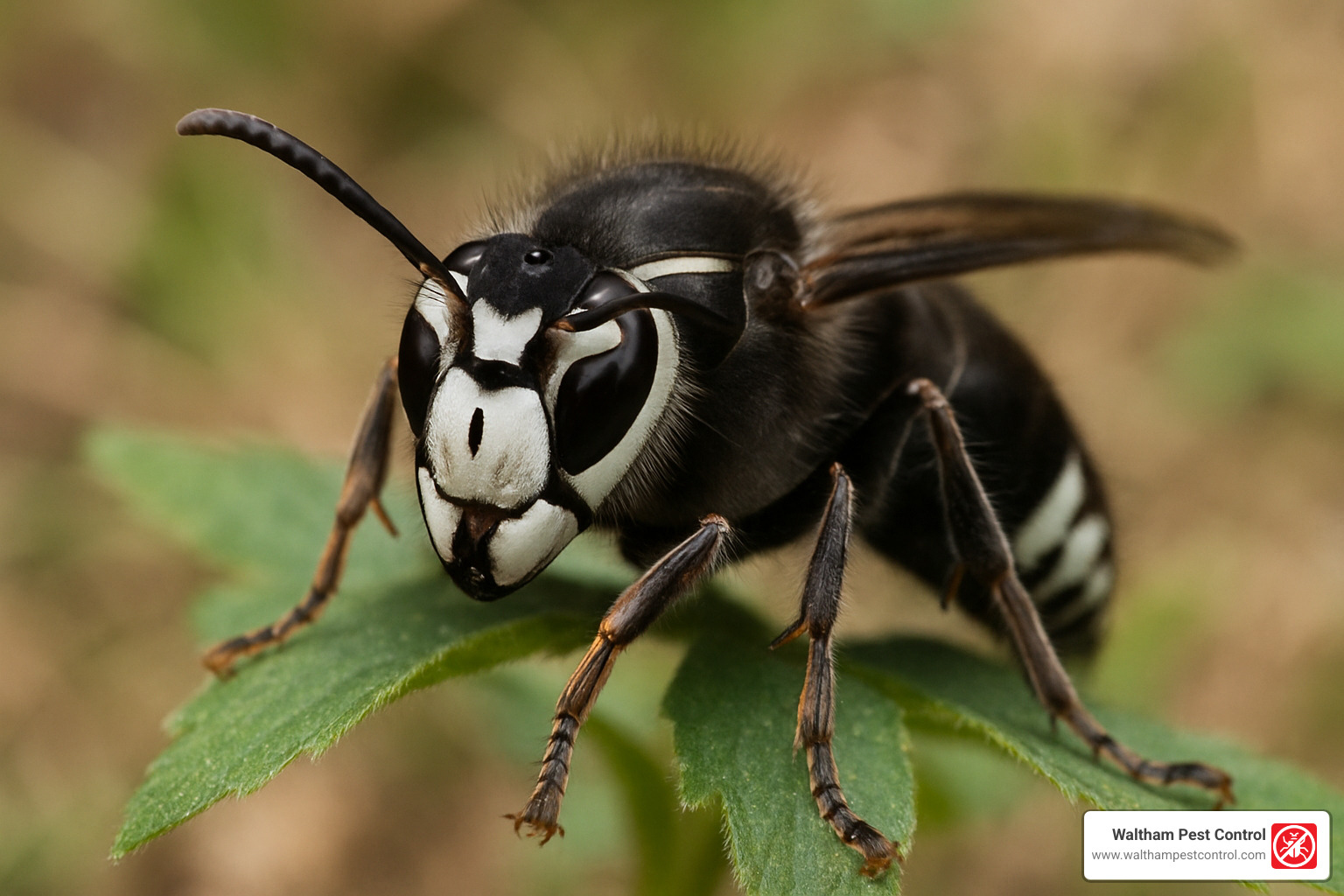
Bald-faced hornets (Dolichovespula maculata) might sound like true hornets, but they’re actually cousins to yellowjackets. These striking insects are nature’s own masked warriors, sporting distinctive white facial markings (that’s where the “bald-faced” name comes from) and three crisp white stripes on their otherwise black bodies.
What truly sets these insects apart is their incredible architectural talent. Think of their nests as natural papier-mâché masterpieces. The workers chew wood fibers, mix them with their saliva, and create a durable, weather-resistant shell around layers of hexagonal cells. By late summer, these aerial fortresses typically grow to basketball size or larger—sometimes stretching beyond 23 inches in length. Inside this paper palace, a busy community of 100-700 workers lives, works, and vigorously defends their home.
| Characteristic | Bald-Faced Hornets | Yellowjackets |
|---|---|---|
| Size | 15-20mm (0.6-0.8 inches) | 12-16mm (0.5-0.6 inches) |
| Color | Black with white face and markings | Black and yellow bands |
| Nest appearance | Grey, paper-like, football or basketball shaped | Paper-like, often in ground or structures |
| Nest entrance | Single hole at bottom | Multiple entrances possible |
| Aggressiveness | Highly aggressive if nest disturbed | Aggressive, especially in late summer |
| Colony size | 100-700 workers | 1,000-4,000 workers |
Despite their intimidating reputation, these insects actually help our gardens by feasting on flies, caterpillars, and other pest insects. A single colony works like a natural pest control service, consuming significant quantities of garden and agricultural pests throughout the season.
There’s good news for those worried about permanent hornet neighbors: bald-faced hornet colonies are strictly annual affairs. When winter’s first hard frost arrives, the entire colony—except for fertilized queens—perishes. These queens find cozy spots to hibernate, emerging in spring to start the cycle anew, always building fresh nests rather than recycling old ones.
Spotting an Active Nest
Before considering any bald faced hornets nest removal, you’ll want to confirm if a nest is actually active. Here’s what to look for:
The entrance hole is your first clue—active nests have a single opening at the bottom where hornets come and go. You’ll also notice guard wasps hovering near this entrance, like tiny security personnel monitoring for threats. On warm, sunny days, there’s regular traffic as workers shuttle in and out on various missions.
For your safety, always observe from at least 6-10 feet away. Bald-faced hornets establish a roughly 3-foot “danger zone” around their nest, and crossing this invisible boundary can trigger an immediate defensive response. These insects don’t mess around when it comes to home security!
If you’re not sure if a nest is active, here’s a simple test: take a long stick, gently tap a branch near the nest (never the nest itself), and quickly step back. If occupied, you’ll hear the buzzing intensify as hornets emerge to investigate the disturbance.
Typical Nest Locations
Bald-faced hornets are surprisingly strategic when selecting real estate for their colonies. They prefer locations that offer both protection from weather and good defensive positioning.
Trees are their favorite spots, especially at heights between 6-20 feet—just high enough to avoid ground predators but still sheltered by branches and leaves. Dense shrubs and bushes with sturdy branch support make excellent alternatives. Building eaves and overhangs offer ready-made shelter, while attic rafters and crawlspaces provide perfect protected environments.
We’ve even found nests built on playground equipment, abandoned sheds, and other outdoor structures across Eastern Massachusetts. From Acton to Woburn, Cambridge to Framingham, and throughout Middlesex and Essex counties, we’ve seen these adaptable insects make homes in surprising places.
What makes these nests particularly tricky is their natural camouflage. Summer foliage often hides them completely, only revealing their presence when autumn leaves fall—by which time the colony has reached peak size and defensiveness. By then, bald faced hornets nest removal becomes more challenging due to the increased number of defenders.
For more detailed information about bald-faced hornet biology and ecology, North Carolina State University’s Extension program offers excellent scientific research.
When and Why Bald Faced Hornets Nest Removal Is Necessary
Let’s face it—finding a bald-faced hornet nest on your property can be unnerving. But does every nest warrant immediate action? Not necessarily, though there are several compelling reasons why bald faced hornets nest removal becomes essential in many situations.
The pain factor alone is significant. These hornets deliver extraordinarily painful stings that feel like a hot nail being driven into your skin. Unlike honeybees that sacrifice themselves with a single sting, bald-faced hornets can sting repeatedly, injecting a potent venom cocktail that causes intense pain, swelling, and redness with each attack.
For most people, these stings are merely uncomfortable, but for approximately 1-3% of the population, they can trigger severe allergic reactions including anaphylaxis—a potentially life-threatening condition requiring immediate medical attention. If anyone in your household has known insect allergies, removing nearby nests becomes not just advisable but necessary.
Location matters tremendously when assessing risk. A nest tucked away high in a distant tree poses far less danger than one hanging over your deck or near your front door. Nests located near doorways, walkways, or children’s play areas create an unacceptable risk of accidental encounters that could end with multiple painful stings.
Families with young children, elderly members, or pets need to be especially cautious. These vulnerable groups may have more severe reactions to stings or may inadvertently disturb a nest while playing or exploring. Your beloved golden retriever chasing a ball into the wrong bush could return with much more than they bargained for.
Bald faced hornets nest removal also becomes necessary when nests block access to essential areas of your property. Finding a massive paper nest attached to your electrical box, AC unit, or garden shed creates practical problems beyond just the sting risk.
Property owners should also consider their legal responsibilities. Landlords and property managers have a duty to address potentially dangerous pest issues for tenants, while businesses must ensure premises remain safe for customers and employees. Ignoring a known hornet nest could potentially create liability issues if someone gets hurt.
All that said, these insects do provide ecological benefits worth acknowledging. Bald-faced hornets are nature’s pest control, voraciously consuming flies, caterpillars, and other garden pests. A single colony can eliminate thousands of nuisance insects throughout the season.
If you find a nest in a remote location far from human activity, you might reasonably choose to leave it until winter when the colony naturally dies off. This balanced approach respects the hornets’ ecological role while still prioritizing human safety.
Best Time of Year & Day
Timing is everything when it comes to safe bald faced hornets nest removal. Choose the wrong moment, and you might find yourself in a painful confrontation with dozens of angry defenders.
Dusk or dawn provide optimal conditions for removal. During these twilight hours, most worker hornets have returned to the nest and become less active due to cooler temperatures. Their vision is also compromised in low light, reducing their defensive capabilities.
Nighttime offers even better conditions if you have appropriate lighting. Using red-filtered flashlights is particularly effective since hornets don’t see this light spectrum well, allowing you to illuminate your work without alerting the colony.
Whatever you do, avoid midday removals when hornet activity peaks and the colony’s defensive response is most aggressive. A sunny afternoon approach practically guarantees you’ll face the full fury of the nest.
The calendar matters as much as the clock. In early summer (June), nests are smaller with fewer workers, making removal safer—though the smaller size also makes nests harder to spot among leafy branches.
By late summer (August-September), colonies reach peak population with up to 700 workers, making nests more dangerous but also more visible. The colony becomes increasingly aggressive during this period as they work to protect developing reproductive members.
As fall (October-November) arrives, worker activity begins to decline as temperatures drop, offering a slightly safer removal window.
Winter (December-March) presents the safest removal opportunity of all. After the first hard frost, the entire colony dies off except for fertilized queens, who leave to hibernate elsewhere. This leaves behind an empty structure that poses absolutely no threat—perfect for removal without protective gear or chemicals. For more information about winter removal options, visit our detailed winter removal guide.
Risk Assessment Before Action
Before grabbing that can of wasp spray, take a moment to honestly assess the situation. A proper risk evaluation could save you from a painful experience.
First, consider allergy factors. Has anyone in your household ever experienced severe reactions to insect stings? If so, professional removal is strongly recommended. Even if you’re not allergic, consider neighbors who might be affected if your removal attempt sends angry hornets throughout the neighborhood.
Next, carefully evaluate the nest location. A nest requiring a ladder to reach immediately increases risk—balancing on a ladder while being attacked by hornets is a scenario best avoided. Also consider proximity to doors, windows, and high-traffic areas where accidental encounters are likely.
Pay special attention to nests inside structural voids like walls or attics. These require specialized removal techniques since simply spraying insecticide could drive hornets into your living space through light fixtures or vents.
The size of the colony provides important clues about removal difficulty. Larger nests with heavy visible traffic indicate larger colonies, substantially increasing danger during removal attempts. By late summer, some nests can house hundreds of defensive workers.
Before proceeding, take inventory of your protective equipment and supplies. Do you have proper protective gear and appropriate insecticides rated for hornet control? Improvised protection often proves inadequate against determined hornets.
Always plan your escape route before approaching any nest. Clear a path for quick retreat and identify shelter locations in case things go wrong. This simple precaution has saved many amateur pest controllers from multiple stings.
Finally, check local ordinances regarding pest control methods and chemicals. Some municipalities restrict certain products or application methods, particularly near waterways or protected habitats.
This thorough assessment helps determine whether DIY removal makes sense or if professional assistance represents the safer option. When in doubt, we always recommend consulting with licensed pest control professionals who can evaluate your specific situation and provide the safest solution. Learn more about the dangers of DIY removal without professional help.
Safe Methods for Bald-Faced Hornet Nest Removal
If you’ve decided that bald faced hornets nest removal is necessary and you’re considering tackling it yourself, I can’t stress this enough: safety comes first. As someone who’s supervised thousands of removals, I’ve seen what happens when people underestimate these defensive insects.
Personal Protective Equipment Essentials
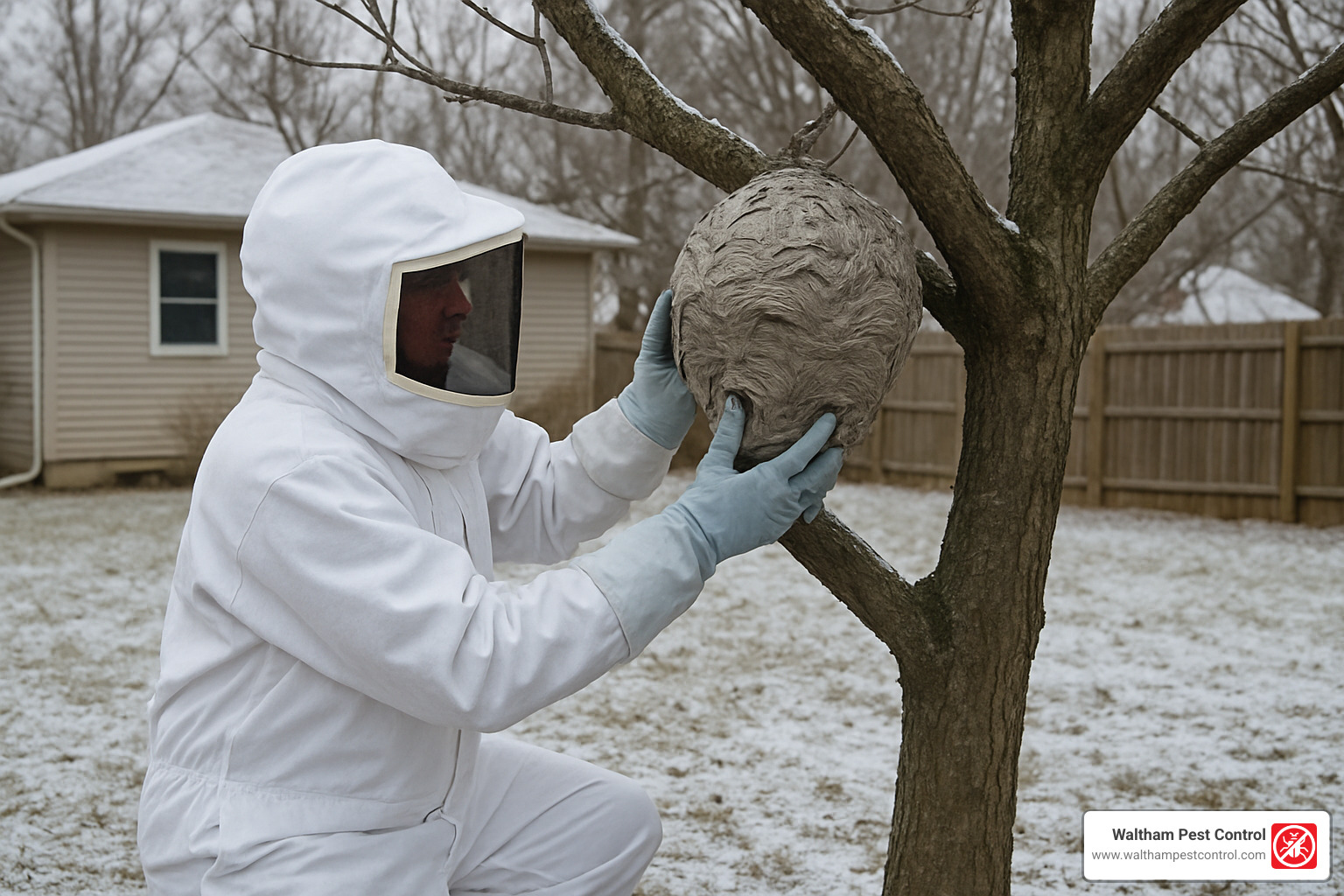
When it comes to protective gear, there’s simply no room for shortcuts. A proper bee suit provides your best defense against multiple stings. These specialized suits are designed with thick, impenetrable material that hornets can’t sting through. If you don’t have access to a professional bee suit, layer up with thick clothing, making absolutely sure no skin remains exposed.
Your face and head need special attention since hornets instinctively target these areas. A proper bee veil or hat with protective netting creates a crucial barrier. Your hands are particularly vulnerable during removal operations, so thick leather gloves that extend well up your arms are essential.
One of the most overlooked aspects of protection is sealing potential entry points. I’ve seen too many homeowners skip this step and regret it. Use duct tape to create tight seals where gloves meet sleeves, pants meet boots, and around any zipper closures. Finally, wear sturdy boots that hornets can’t sting through—they often drop to the ground during disturbance, making your feet an easy target.
Bald-faced hornets can sting through thin fabrics, so multiple layers aren’t just a suggestion—they’re a necessity.
Step-by-Step Nighttime Insecticide Approach
The darkness of night offers a significant advantage when dealing with hornets. After sunset, most of the colony returns to the nest and becomes less active as temperatures drop. Here’s how to use this to your advantage:
Start by gathering your supplies during daylight hours. You’ll need a “Wasp and Hornet” spray specifically labeled for “Immediate Knockdown” with a spray distance of at least 15-20 feet. This distance is non-negotiable—it keeps you safely outside the hornets’ defensive perimeter.
Dress in your full protective gear as the sun sets. Modify a flashlight with red cellophane covering the lens, as hornets don’t perceive red light well. Before you begin, clear your escape route of any obstacles—you don’t want to trip if you need to retreat quickly.
When approaching the nest, move slowly and deliberately. Quick movements trigger defensive responses. Position yourself with your escape route behind you, and aim your red-filtered light near—but not directly at—the nest entrance.
From your safe distance, spray directly into the nest entrance for 5-10 seconds, then thoroughly soak the entire exterior. If your spray stream breaks up before reaching the nest, do not move closer. Instead, retreat and reconsider your approach or tools.
After application, back away calmly along your planned escape route. Sudden movements might trigger an attack from hornets that weren’t in the nest. Once you’re at a safe distance, wait at least 24 hours before checking for activity. Only approach to remove the nest when you’re absolutely certain all activity has ceased.
For nests in wall voids or underground, insecticidal dusts often work better than sprays. These formulations allow workers to track the poison deeper into the nest’s structure. Apply at night, following the same safety protocols.
Some homeowners attempt the “trash bag technique,” quickly enclosing the nest in a heavy-duty plastic bag, sealing it, and cutting it free. I’ve seen this method go wrong more often than right—it’s extremely risky and only suitable for very small nests in perfectly accessible locations. When in doubt, DIY techniques should be approached with extreme caution.
Always prioritize insecticide safety by reading and following all label instructions. These products contain powerful chemicals that require proper handling and application techniques.
Post-Removal Handling & Preservation Options
Once you’ve successfully eliminated the colony, you have several interesting options for handling the nest.
Most homeowners simply dispose of the nest by double-bagging it in heavy-duty plastic bags, sealing them tightly, and placing them in an outdoor trash receptacle. Don’t forget to clean the area where the nest was attached—this removes pheromones that might attract future queens.
However, if you have a curious mind or children interested in nature, bald-faced hornet nests make fascinating educational displays. These architectural marvels showcase incredible insect engineering. To safely preserve a nest, first ensure all hornets are dead, then place it in a freezer overnight to eliminate any remaining eggs or larvae.
Contrary to what many believe, you don’t need to apply varnish or other preservatives. The paper-like material is naturally durable and will last for years if kept dry. Some nature enthusiasts carefully cut preserved nests in half to reveal the internal comb structure—a fascinating glimpse into the complex world of social insects.
According to scientific research on nest preservation, these preserved nests can serve as valuable educational tools for understanding insect societies and architecture. Just make absolutely certain the nest is completely inactive before handling, as even a few surviving hornets can deliver painful stings.
Whether you choose DIY removal or professional help, understanding these safe removal methods ensures you can address bald faced hornets nest removal with confidence and proper caution. When in doubt, professional pest control technicians have the training, equipment, and experience to handle even the most challenging nest situations.
Professional Solutions & Cost Expectations
When it comes to bald faced hornets nest removal, sometimes the smartest choice is to leave it to the professionals. While DIY methods certainly exist, there’s a reason why thousands of Massachusetts homeowners turn to experienced teams like ours at Waltham Pest Control. With over 40 years of safely removing hornet nests throughout Eastern Massachusetts, we’ve seen it all – from basketball-sized nests hanging from third-story eaves to colonies tucked inside structural voids.
Benefits of Hiring Experts
The peace of mind that comes with professional removal is invaluable. Our technicians don’t just show up with a can of spray – they arrive with specialized training in stinging insect behavior patterns that allows them to approach even aggressive colonies safely.
We use commercial-quality protective gear that goes beyond what’s typically available to homeowners, along with specialized application equipment that can reach nests up to 20 feet high without putting anyone on a ladder. The professional-grade insecticides we use provide more complete elimination with less product, meaning better results with less environmental impact.
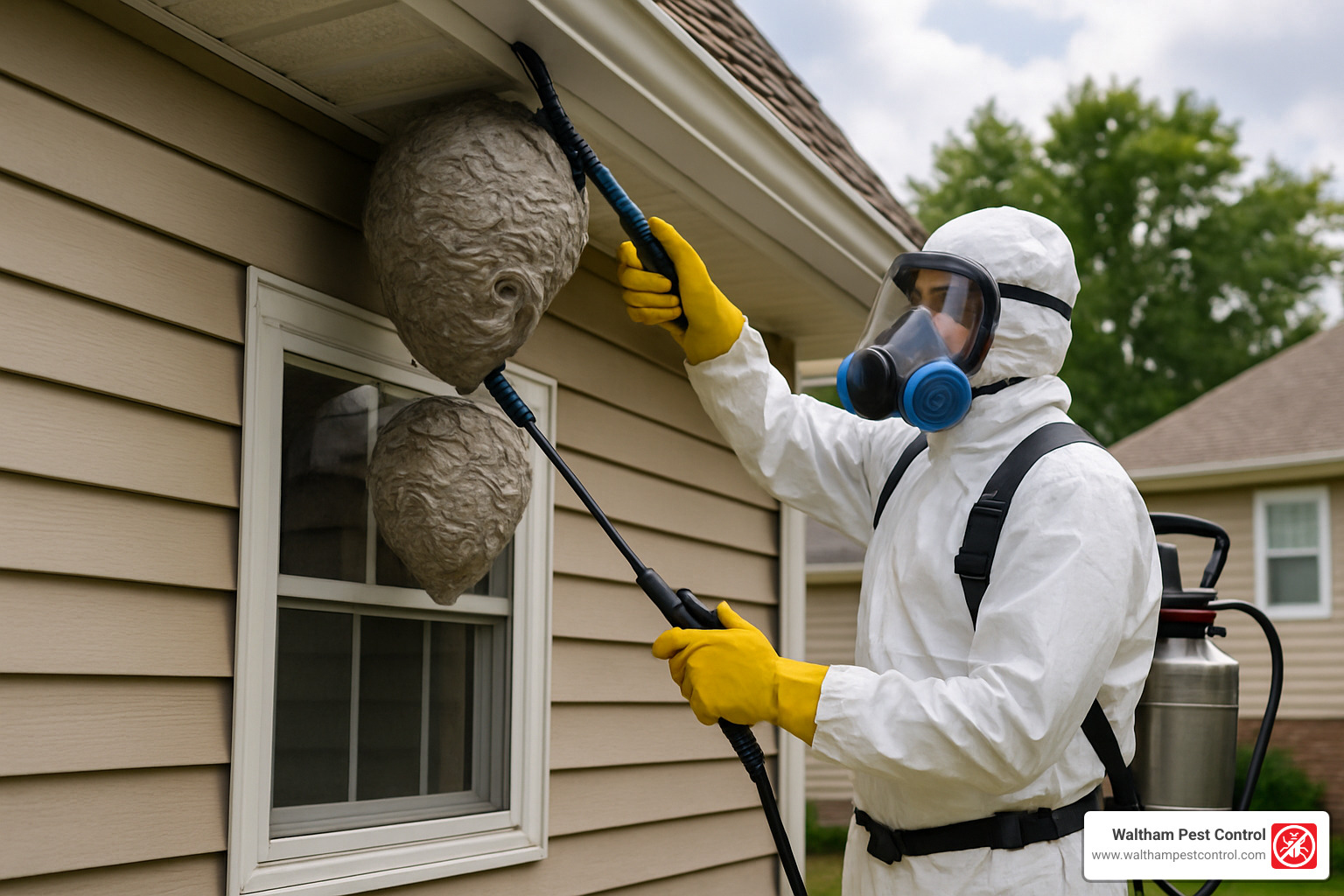
What truly sets professional service apart is our comprehensive approach. We don’t just spray and leave – we remove and properly dispose of the nest, treat the attachment area to discourage future colonies, inspect for additional nests you might have missed, and offer a follow-up guarantee if any activity persists. For nests inside walls or attics, our structural knowledge ensures we can access and treat these areas without damaging your property.
Professional removal becomes particularly valuable in certain situations: when nests require ladder work high in trees, when you’re dealing with particularly large and active colonies, when nests are located near entrances or high-traffic areas, in homes with children or pets, or when dealing with structural void nests that require specialized treatment approaches. The fact that our work is fully insured also protects you from liability if anything unexpected happens during removal.
Average Cost Range for Bald Faced Hornets Nest Removal
“How much will this cost me?” is naturally one of the first questions homeowners ask. Based on internet data (not Waltham Pest Control pricing), professional bald faced hornets nest removal typically falls between $150 and $600 for standard situations. However, complex scenarios involving multiple nests, difficult-to-access locations, or structural infestations can range from $800 to $1,500 or more.
Several factors influence where your particular situation might fall within this range:
Nest location and accessibility plays a major role – ground-level nests generally cost less than those requiring ladder work or specialized equipment. Nest size matters too, as larger colonies with more extensive nests may require additional treatment. Emergency service requests, especially same-day or after-hours calls, often carry a premium. Your geographic location within Massachusetts can affect pricing as well, and many companies offer additional services like preventative treatments or multiple nest discounts.
These figures represent industry averages based on internet research from sources like Forbes Home Improvement and not actual Waltham Pest Control pricing. For an accurate quote custom to your specific situation, we recommend contacting us directly for a free consultation.
When weighing the cost of professional service against DIY attempts, consider the potential hidden costs of the latter: medical treatment for multiple stings, property damage from improper removal, or the need for repeated treatments can quickly exceed professional service costs. Most importantly, the safety of your family and pets is something you simply can’t put a price tag on.
Frequently Asked Questions about Bald-Faced Hornets
How painful and dangerous are their stings?
If you’ve ever wondered just how bad a bald-faced hornet sting really is, I can tell you from both professional experience and client testimonials – they’re memorably painful. These stings deliver a sharp, burning sensation that transitions into intense throbbing that can last for hours, significantly more painful than typical yellowjacket or honeybee stings.
What makes encounters with these insects particularly concerning isn’t just the initial pain, but several compounding factors. Unlike honeybees, bald-faced hornets keep their stinger intact after striking, allowing them to sting repeatedly during a single defensive episode. Their venom contains a potent mixture of proteins that triggers immediate pain, swelling, and redness that can expand well beyond the sting site.
Perhaps most alarming is their communication system – when one hornet stings, it releases alarm pheromones that essentially sound a colony-wide alarm, calling nearby nest-mates to join the attack. This chemical signal often results in multiple hornets delivering multiple stings within seconds.
For the estimated 1-3% of people with severe insect venom allergies, even a single sting can trigger life-threatening anaphylaxis, with symptoms including breathing difficulty, facial or throat swelling, rapid pulse, dizziness, and nausea. Even those without diagnosed allergies can experience concerning systemic reactions when receiving multiple stings, with children, seniors, and those with compromised immune systems facing the highest risks.
Will hornets reuse an old nest next year?
Good news for homeowners dealing with bald faced hornets nest removal – these insects never reuse their nests from previous seasons. Bald-faced hornet colonies operate on an annual cycle, with the entire worker population dying after the first hard frost in fall. Only the fertilized queens survive winter, hibernating in protected locations like hollow logs, under bark, or in other sheltered spots – never in the old nest.
Come spring, these overwintered queens will start entirely new colonies from scratch, building fresh nests in new locations. The abandoned nests from previous years gradually deteriorate through winter weather exposure, becoming increasingly fragile.
This lifecycle knowledge offers strategic timing options for nest management:
Winter removal is ideal since the empty nest poses zero threat and requires no protective equipment – though be absolutely certain the nest is truly abandoned before approaching.
Early spring removal of old nests eliminates potential structural foundations that might attract new queens looking for advantageous building sites.
Active season removal always requires full safety protocols as described in previous sections, as the colony will aggressively defend their home.
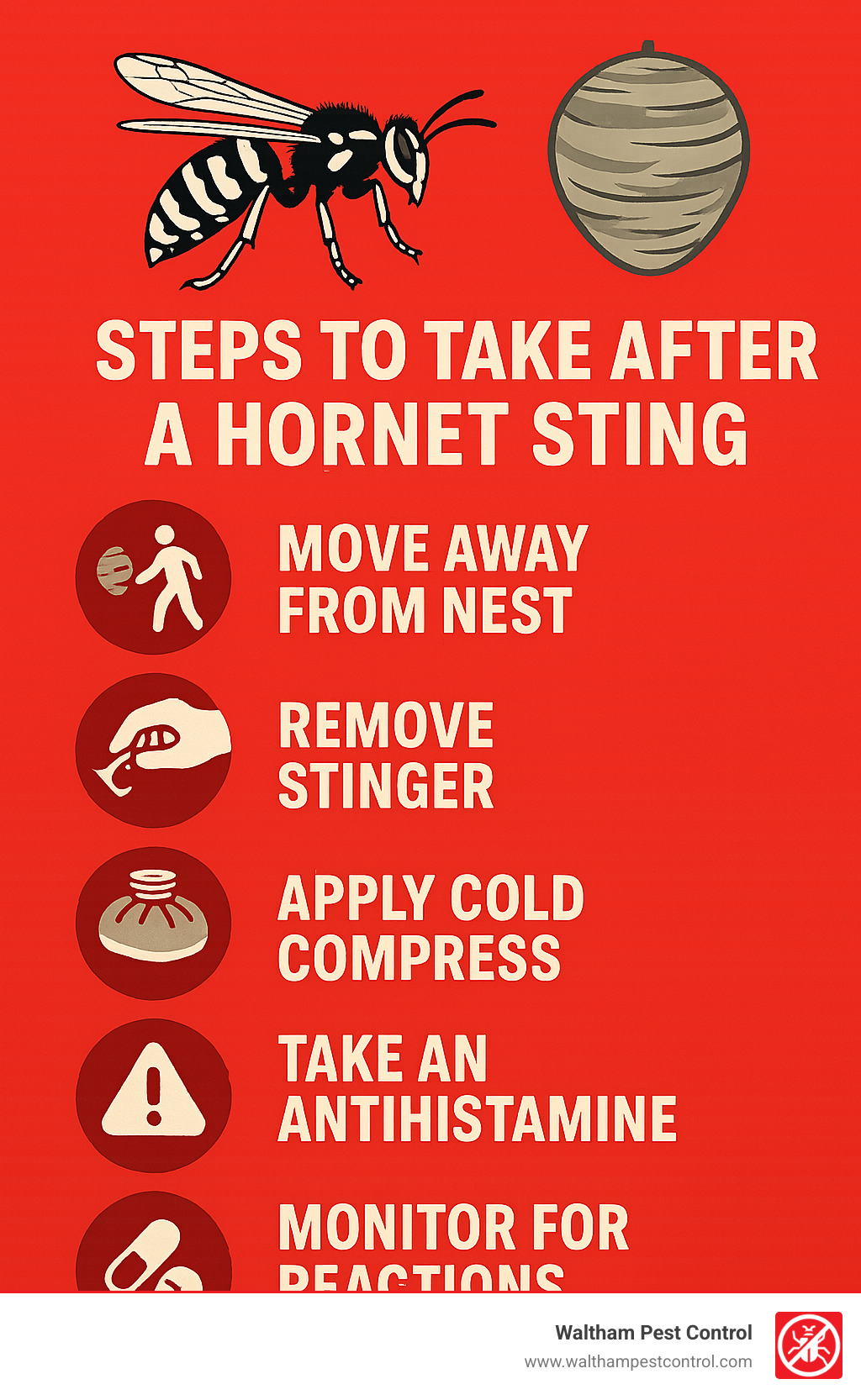
What should I do immediately after a sting?
If you or someone nearby receives a bald-faced hornet sting, quick action can make a significant difference in outcome and comfort:
Move away immediately from the area to prevent additional stings, as alarm pheromones may have been released. Walk calmly but purposefully – running and swatting may trigger more aggressive responses from nearby hornets.
Remove any visible stinger by gently scraping (not squeezing) with a credit card edge or similar flat object. While bald-faced hornets typically don’t lose their stingers, occasionally part may break off in the skin.
Clean the area thoroughly with mild soap and water to remove any remaining venom and reduce infection risk.
Apply a cold compress to the sting site for 15-20 minutes to reduce swelling, pain, and venom absorption. Wrap ice in a thin cloth rather than applying directly to skin.
Take an oral antihistamine like Benadryl (diphenhydramine) to help manage swelling and itching. Non-drowsy options are available if you need to remain alert.
Monitor closely for severe reactions, particularly during the first 30 minutes after the sting, which is when most serious reactions develop.
For anyone experiencing severe reactions – difficulty breathing, widespread hives, facial or throat swelling, dizziness, or nausea – call 911 immediately. Those with known allergies should carry an epinephrine auto-injector (EpiPen) and use it according to their doctor’s instructions before seeking emergency care.
Even without obvious allergic symptoms, medical attention is recommended for children, elderly individuals, or anyone receiving multiple stings, as systemic reactions can develop hours after the initial incident.
Conclusion
When it comes to bald faced hornets nest removal, nothing matters more than your safety. These territorial insects don’t take kindly to visitors near their nests, and approaching them without proper preparation can lead to painful—and potentially dangerous—consequences.
Throughout this guide, we’ve walked through everything you need to know to handle these intimidating insects safely. Successful and safe removal depends on several critical factors working together:
First, take time to properly identify what you’re dealing with. Bald-faced hornets have distinctive white facial markings and build those characteristic grey, papery nests that resemble an upside-down teardrop or football.
Timing truly is everything. The safest window for bald faced hornets nest removal is during nighttime or early dawn when temperatures have cooled and most of the colony is inactive inside the nest. This simple timing adjustment dramatically reduces your risk of multiple stings.
Never underestimate the importance of proper protection. Those full-coverage bee suits with sealed openings aren’t just for professional aesthetics—they provide crucial protection against hornets that can sting repeatedly when defending their colony.
Distance remains your greatest ally during any removal attempt. Those specialized long-range sprays are designed to keep you safely outside the hornets’ defensive perimeter, so use them as intended and resist the urge to get closer for a “better shot” at the nest.
Perhaps most importantly, recognize when a situation exceeds DIY capabilities. Nests in difficult-to-reach locations, particularly large colonies, or situations involving people with allergies are all scenarios where professional help isn’t just convenient—it’s the responsible choice.
At Waltham Pest Control, we’ve spent over four decades perfecting our approach to bald faced hornets nest removal throughout Eastern Massachusetts. Our technicians bring specialized training, professional-grade equipment, and a wealth of regional experience to every job. We understand New England’s unique pest challenges and have developed safe, effective solutions to address them.
Whether you’re in Lexington or Lowell, Woburn or Wakefield, our team provides prompt, professional service backed by decades of local expertise. We take pride in helping Massachusetts families reclaim their outdoor spaces safely.
Don’t risk painful stings or allergic reactions by tackling a dangerous nest yourself. Contact us today for a free consultation, and let our experts assess your situation and recommend the safest path forward. When dealing with aggressive stinging insects like bald-faced hornets, professional removal isn’t merely convenient—it’s an investment in your family’s safety and peace of mind.
Remember: when it comes to bald faced hornets nest removal, the right approach combines knowledge, timing, protection, and knowing when to call for professional assistance.
