

How to Kill Carpenter Bees: 3 Effective Steps
Why Carpenter Bees Pose a Serious Threat to Massachusetts Homeowners
As spring arrives in Massachusetts, homeowners eagerly open their windows and enjoy their decks. However, this is also the time when a destructive pest emerges. Learning how to kill carpenter bees is crucial because these large, intimidating insects can cause thousands of dollars in structural damage to your home. While they may look like harmless bumblebees hovering around your deck, eaves, or porch, carpenter bees are wood-destroying pests. They drill perfectly round, dime-sized holes into wooden structures to carve out extensive nesting galleries, compromising your home’s integrity from the inside out.
Quick Answer: Most Effective Methods to Kill Carpenter Bees
- Professional Pest Control Treatment – This is the safest and most effective method, especially for large infestations, nests located at dangerous heights, or for homeowners seeking a guaranteed, long-term solution.
- Insecticidal Dust Application – For accessible nests, applying a professional-grade dust like deltamethrin or borate dust directly into the nest holes with a bulb duster can be effective. The dust coats the tunnels and eliminates bees as they enter and exit.
- Liquid Insecticide Surface Sprays – Treating vulnerable wood surfaces with a residual liquid insecticide, such as a pyrethroid-based concentrate, creates a protective barrier that deters bees from drilling new nests.
- Proper Timing is Essential – The best time for treatment is in the early spring when bees are actively selecting nest sites, or in the late summer and early fall to eliminate the newly emerged generation before they overwinter.
- Seal All Entry Holes – After a nest has been successfully treated and eliminated, it is critical to fill the galleries with steel wool and seal the entrance with wood putty or caulk to prevent other bees from reusing the tunnels.
Unlike bumblebees, which have fuzzy abdomens, carpenter bees are distinguished by their shiny, hairless, black abdomens. They are particularly drawn to softwoods like pine, cedar, and redwood—all common materials in New England homes. While the male bees may buzz aggressively around your head to defend their territory, they are all bluff and cannot sting. It’s the silent, industrious females that bore into your wooden structures, causing the real, costly damage.
The damage accumulates alarmingly fast. According to industry data, carpenter bee infestations can lead to repair costs that easily range from hundreds to over $5,000 per affected area. These solitary bees have excellent homing instincts and return to the same nesting sites year after year, expanding their tunnel systems and progressively weakening structural wood. Furthermore, the round holes they create are an open invitation for woodpeckers, which will hammer away at the wood to feast on the bee larvae, causing significant secondary damage.
As someone who has spent over 40 years in pest control across Eastern Massachusetts, from the North Shore down to Norfolk County, I’ve seen how a few small holes can escalate into serious structural issues. Understanding how to kill carpenter bees effectively—and knowing when to call for professional help—is essential for protecting your most valuable investment: your home.
Massachusetts seasons matter. In our area, activity typically ramps up from late March through May as temperatures rise, and again in late summer when new adults emerge. Coastal communities may see activity slightly earlier than inland towns due to warmer temperatures, so plan inspections and treatments accordingly. For safety, avoid DIY treatments on high eaves, steep roofs, or second-story trim—falls from ladders are one of the most common home maintenance injuries.
If you choose any treatment approach, always follow the product label and avoid treating flowering plants or surfaces where bees and other pollinators are actively foraging. Apply at dusk or after dark when bees are less active, and keep people and pets away until products have dried or settled. In Massachusetts, pesticide applications must follow state and federal regulations; the licensed and insured technicians at Waltham Pest Control are trained to perform targeted treatments that minimize impacts to non-target species.
Finally, killing bees without correcting the conditions that attract them is only half the battle. Unpainted, sun-warmed softwoods will continue to draw carpenter bees back. Successful control pairs treatment with sealing old galleries and protecting the wood with paint or a high-quality stain, followed by periodic inspections. If you’re unsure where to start—or you want a guaranteed, long-term solution—professional service is the most reliable path.
How to kill carpenter bees terms simplified:
- average price of carpenter bee pest control treatment
- carpenter bees sting treatment
- how to deter carpenter bees
Identifying the Problem: Carpenter Bee Signs and Damage
Before you can effectively tackle how to kill carpenter bees, you must be absolutely certain you’re dealing with them and not their beneficial, fuzzy cousins, the bumblebees. Trust me—after four decades in pest control, I’ve seen countless homeowners in the Boston area waste time, money, and effort treating the wrong pest entirely. Proper identification is the critical first step.
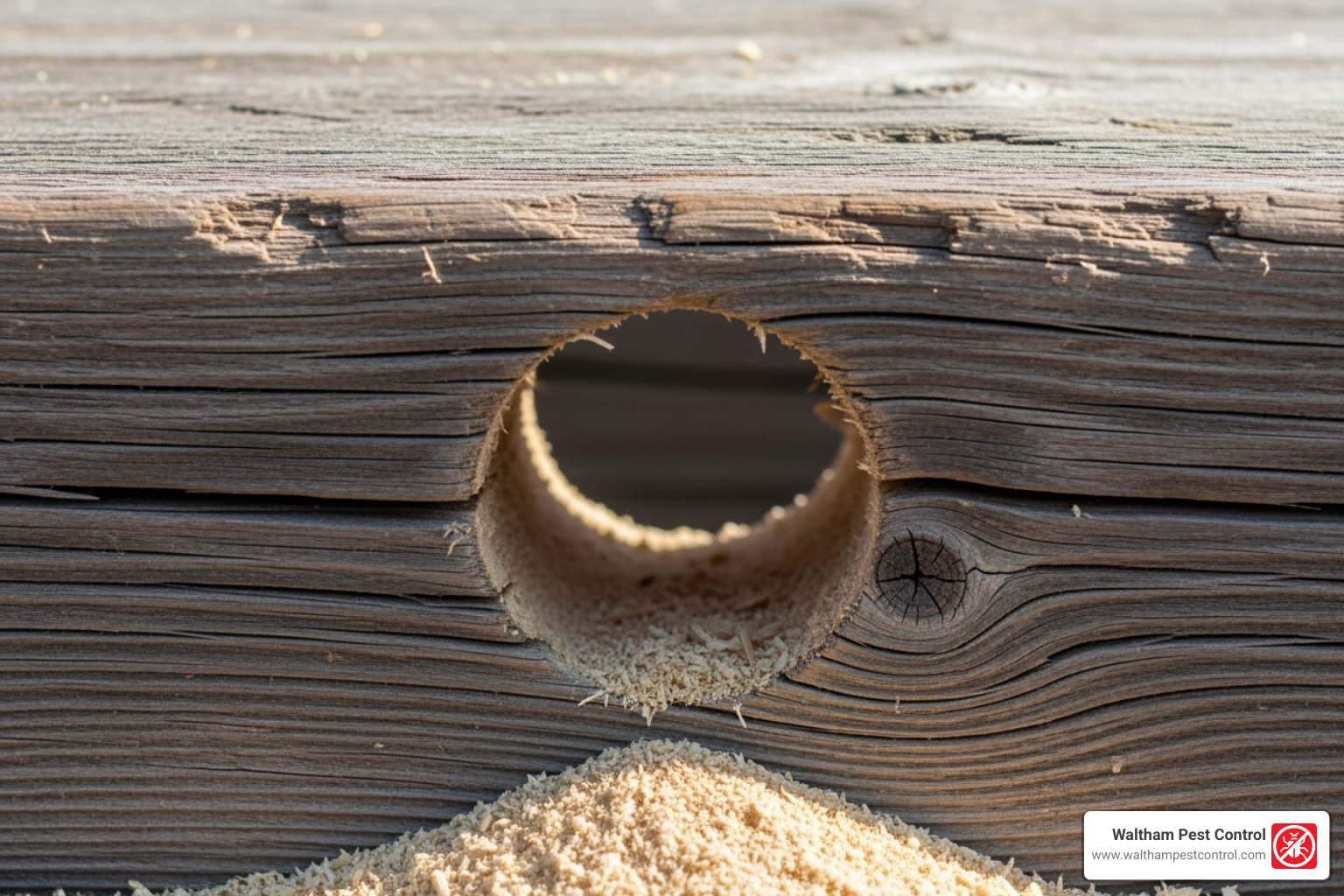
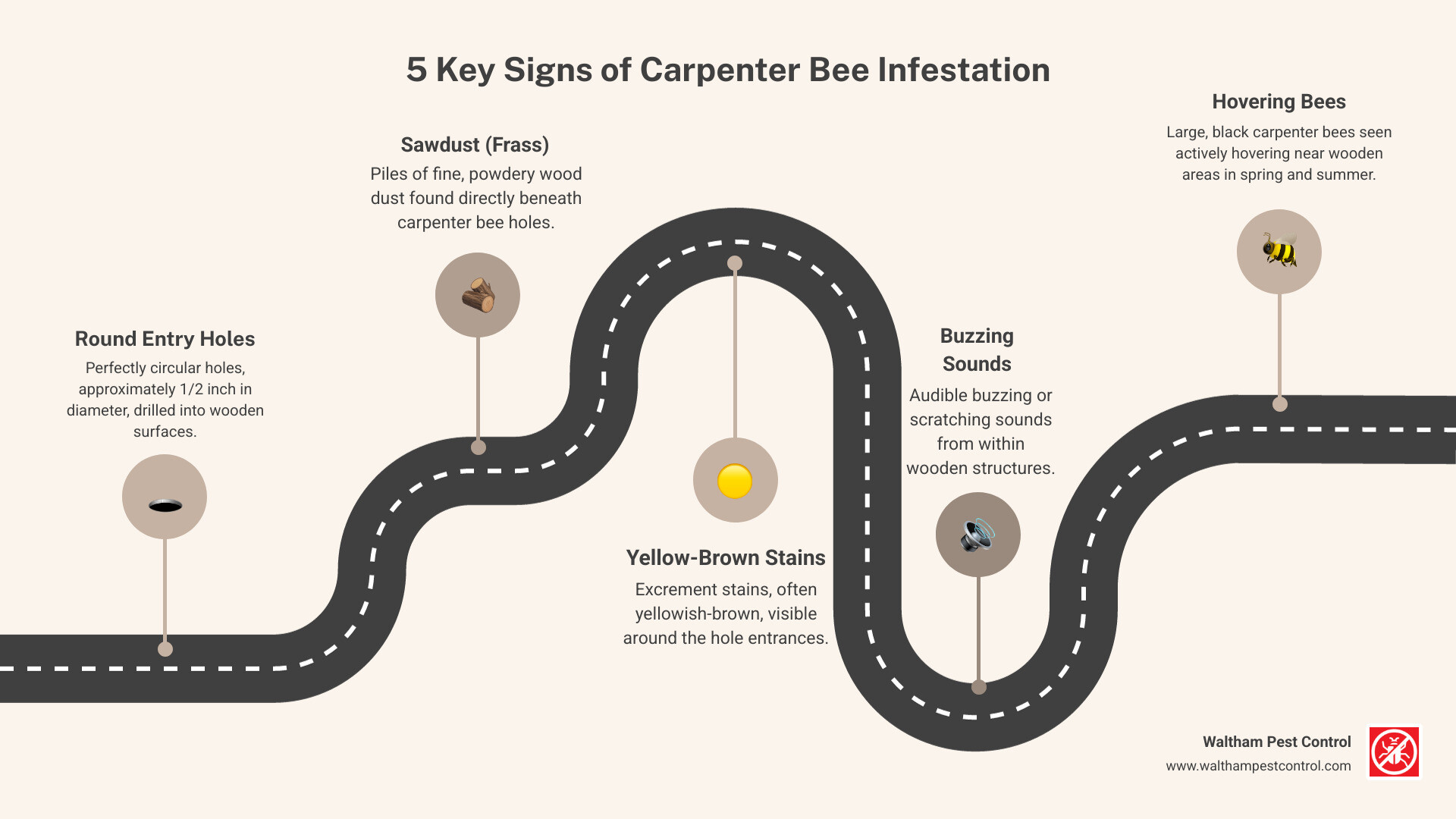
The telltale signs of carpenter bee activity are quite distinctive once you know what to look for. The most obvious clue is the round holes, approximately half an inch in diameter, that appear in wooden surfaces. They are perfectly circular and clean-cut, as if someone used a drill bit. Beneath these holes, you’ll often find small piles of coarse sawdust (called frass), which is the wood the bee has excavated. Look closely at the entrance of the hole, and you may also see yellow-brown stains, which are caused by bee excrement and pollen.
During the quiet moments of a spring or summer day, listen carefully. A low buzzing or vibrating sound from within wooden structures like walls, porch railings, or eaves is a dead giveaway that carpenter bees have moved in. And, of course, the most visible sign is the bees themselves: large, black bees hovering near wooden surfaces, with the aggressive males often darting at anyone who approaches their territory.
Carpenter Bee or Bumblebee?
Here’s where many homeowners get confused, and I don’t blame them. Both are large, buzzing bees that can seem intimidating. But the differences are crucial for proper identification and treatment. It’s a common mistake, but a critical one. While both are important for our local ecosystem—carpenter bees are surprisingly effective at what’s called buzz pollination—you only want one of them nesting in your home.
| Feature | Carpenter Bee | Bumblebee |
|---|---|---|
| Appearance | Shiny, hairless black abdomen with a fuzzy yellow thorax | Completely fuzzy body, typically with yellow and black stripes |
| Nesting | Solitary nesters that bore tunnels into wood (decks, eaves, siding) | Social nesters that live in large colonies, usually underground or in wall voids |
| Behavior | Males hover aggressively but cannot sting; females are docile and rarely sting unless handled | Generally docile but will defend their nest aggressively as a colony if threatened |
The shiny black abdomen is your biggest clue—it looks almost polished compared to a bumblebee’s fuzzy rear end. Carpenter bees are also solitary nesters. Each female works alone to create her nest, unlike social bumblebees that cooperate in large colonies.
Here’s something that surprises most homeowners: those aggressive male carpenter bees buzzing around your head? They’re completely harmless and can’t sting at all. It’s all a territorial display. The females can sting, but they are quite docile and typically only do so if you physically grab them or trap them against your skin.
The Damage They Leave Behind
The real problem isn’t the intimidating hover-dance of the male carpenter bees—it’s the systematic destruction happening inside your home’s wooden structures. A female carpenter bee creates a perfectly round entry hole about an inch deep, then makes a sharp 90-degree turn to excavate a gallery that runs parallel to the wood grain.
These tunnels, where she lays her eggs, can extend 6 to 10 inches in the first year alone. What makes it worse is that carpenter bees are creatures of habit. They return to the same nesting sites year after year, expanding existing tunnels and creating new ones, weakening the wood structure with each generation. I’ve seen decks, eaves, fascia boards, cedar siding, and window sills so riddled with holes they look like Swiss cheese and crumble to the touch.
The damage doesn’t stop there. Those carpenter bee larvae developing inside the wood galleries are a prime food source for woodpeckers. These birds will relentlessly hammer away at infested wood to reach the protein-rich larvae. This pecking can shatter siding, splinter trim, and create additional, larger holes that attract other pests and allow moisture to penetrate the wood, leading to rot and mold.
What starts as a few innocent-looking holes can quickly escalate into thousands of dollars in repair costs. The structural integrity of wooden components becomes compromised, and the aesthetic damage alone can significantly impact your home’s curb appeal and value.
In Eastern Massachusetts, the areas most frequently targeted include the undersides of deck rails and stair treads, exposed joists, fascia and rake boards, soffits, fence caps, playsets, and unpainted trim around windows and doors. Sun-exposed, unpainted softwood is especially attractive, and south or southeast-facing elevations often show the earliest signs of activity each spring.
A few extra ID tips help avoid false alarms. Male carpenter bees often have a pale or yellowish patch on the face; females typically have a darker, solid face. Frass from active galleries is coarse and piles up directly beneath holes, sometimes mixed with yellow pollen dust. Old, inactive holes may be weathered and lack fresh frass. Do not confuse carpenter bee holes with tiny exit holes from wood-boring beetles or with nail pops—carpenter bee entrances are clean, round, and about the size of a small finger.
Quick inspection checklist:
- Look for round, 1/2-inch holes on the underside of boards, rails, and trim.
- Check for fresh frass piles and yellow-brown staining beneath or around holes.
- Watch for large, black bees hovering and patrolling wooden surfaces on warm days.
- Listen for faint buzzing or rasping from within wood on quiet afternoons.
If you confirm these signs—or you’re unsure and want a professional inspection from Waltham Pest Control—addressing the problem early prevents the annual expansion of galleries and helps you avoid woodpecker follow-up damage.
