
House Ants Exterminator: 7 Powerful Tips for 2025 Success
Why House Ant Infestations Need Professional Attention
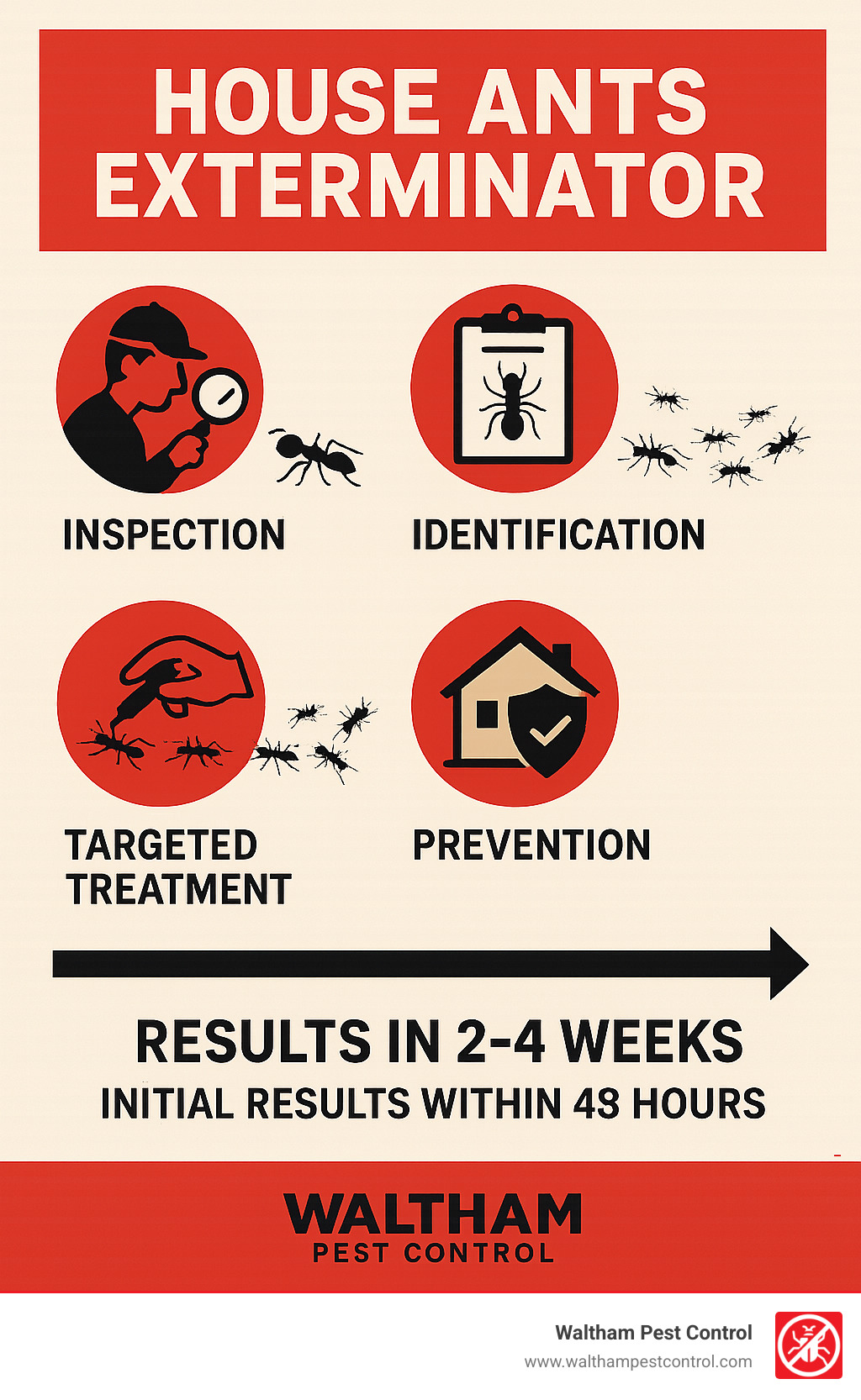
If you’re dealing with ants in your home, here’s what you need to know about hiring a house ants exterminator:
- When to call professionals: Multiple ant trails, recurring infestations after DIY attempts, or carpenter ant damage
- What to expect: Thorough inspection, species identification, targeted baiting, and follow-up treatments
- Average timeframe: Initial results within 48 hours, complete elimination within 2-4 weeks
- Key benefits: Colony elimination (not just visible ants), prevention of structural damage, long-term protection
Finding ants in your home can quickly escalate from a minor nuisance to a major headache. House ants exterminators are specialists who understand that the ants you see represent only about 10% of the actual colony. While DIY sprays might temporarily eliminate visible workers, professional exterminators target the source—the queen and entire colony—using specialized baits, non-repellent insecticides, and comprehensive treatment plans.
Ant colonies can consist of over 100,000 individuals, making professional intervention necessary for large infestations. Different species require different approaches: carpenter ants can damage wooden structures, pharaoh ants may contaminate food surfaces, and odorous house ants emit a distinctive smell when crushed. A professional exterminator will identify the specific species invading your home and implement a targeted treatment strategy.
I’m Waltham Pest Control, President of Waltham Pest Control, with over 40 years of experience eliminating house ant infestations throughout Eastern Massachusetts. As a certified house ants exterminator, I’ve developed specialized techniques for completely eradicating ant colonies while ensuring the safety of your family and pets.
House Ants Exterminator terminology:
– dealing with ant infestation
– how to exterminate carpenter ants in house
– pavement ant infestation
Understanding House Ant Invaders
When it comes to ant infestations, knowledge is power. With over 15,000 different species of ants worldwide, identifying exactly which type has invaded your home is crucial for effective treatment. In Eastern Massachusetts, we regularly encounter several common household ant species, each with unique behaviors and treatment challenges.
Ants are fascinating social insects that live in highly organized colonies. Most colonies contain a queen (or queens) who lays eggs, female worker ants (the ones scurrying across your counter), males for reproduction, and developing young in various stages. This complex social structure explains why squashing the visible ants rarely solves your problem—you’re only addressing a tiny fraction of the colony while the queen continues producing thousands of replacements behind the scenes.
Recent scientific research has revealed concerning trends in ant populations, particularly with invasive species. A 2022 study on fire-ant spread documented red imported fire ants in seven new counties across the United States, with federal quarantine zones expanded twice in recent years. These developments highlight why professional monitoring and control are increasingly important.
Why Ants Invade Homes & High-Risk Rooms
Think of ants as tiny survivalists searching for the perfect triangle of resources: food, water, and shelter. Understanding this motivation helps both in prevention and treatment.
When it comes to food sources, even microscopic crumbs can attract scout ants who then lay chemical trails for their nestmates to follow. Those sticky juice spills, pet food left out overnight, or forgotten snacks under the couch are like ringing the dinner bell for nearby colonies.
Water and moisture draw many ant species indoors, especially during dry periods. A dripping faucet or condensation under a refrigerator might as well be an ant oasis in the desert.
For shelter, ants seek protected spaces where they can establish satellite colonies or even relocate their main nest. Wall voids, spaces behind baseboards, and areas under appliances offer the perfect combination of darkness, protection, and proximity to resources.
Some rooms in your home are particularly vulnerable to ant invasions. Kitchens top the list with their perfect storm of food, water, and warmth. We’ve seen entire ant highways forming overnight when a honey jar leaked or sugar was spilled near a sink.
Bathrooms attract moisture-loving species like pharaoh ants and odorous house ants. The consistent humidity around sinks, tubs, and toilets creates ideal conditions for certain colonies.
Basements and crawl spaces often provide undisturbed nesting sites with potential moisture issues that ants find irresistible. And don’t forget laundry rooms, where water sources and warm, dark spaces behind appliances create prime ant real estate.
In our decades serving Eastern Massachusetts homes, we’ve noticed that improperly stored pet food is frequently the initial attractant that brings ants indoors. Those kibble pieces that roll under the refrigerator might seem insignificant to you, but they’re a jackpot for a hungry ant colony.
Common Household Ant Species to Know
Each ant species requires specific treatment approaches. Here are the most common household ants we encounter in Eastern Massachusetts:
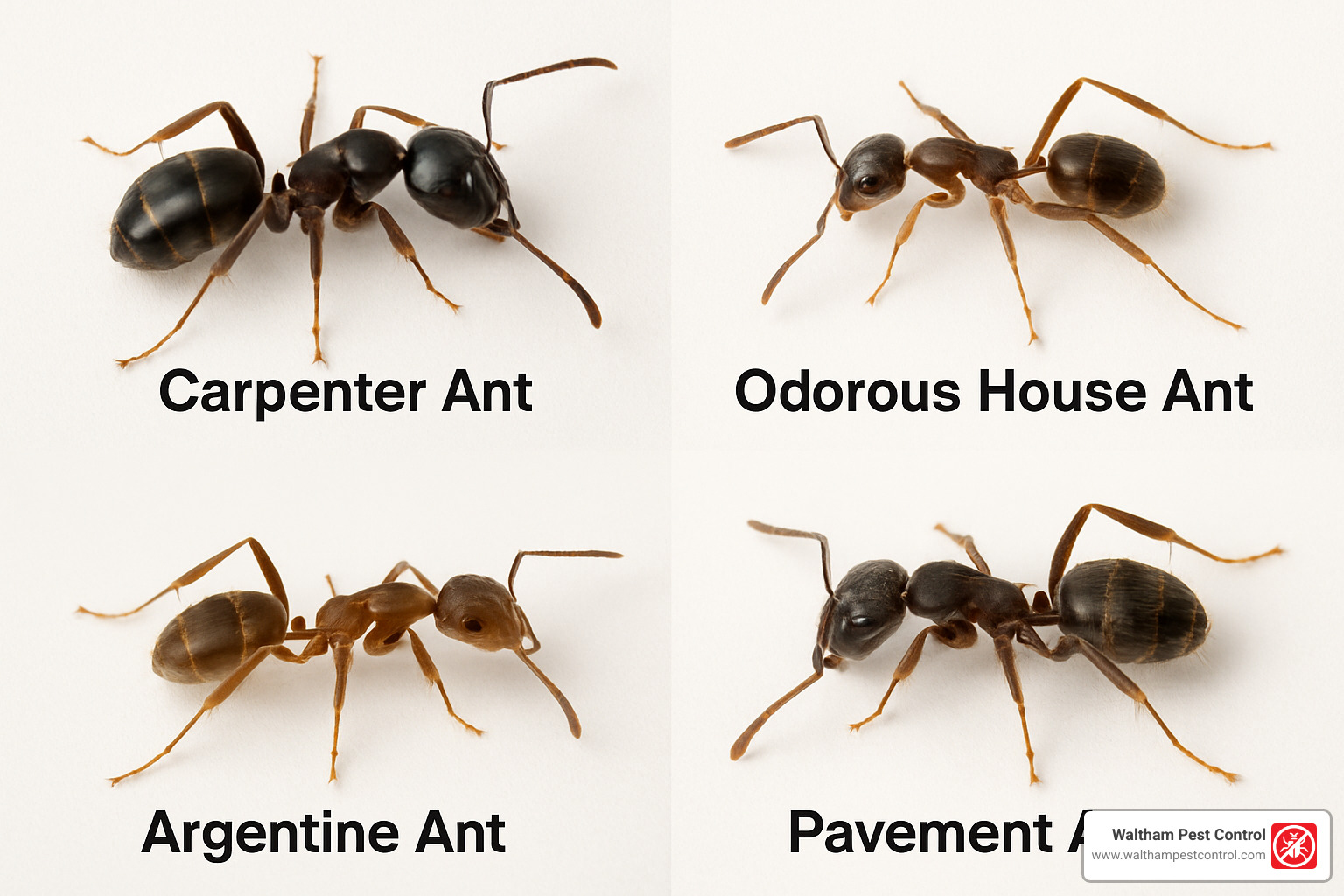
Carpenter Ants are the giants of our local ant world at 1/4 to 1/2 inch long, usually black but sometimes with reddish or yellowish coloration. Unlike termites, they don’t eat wood but excavate it to build their nests, creating smooth tunnels that can seriously compromise structural integrity over time. When we find carpenter ants, we consider them high-risk “silent destroyers” requiring immediate professional attention.
Odorous House Ants (often called sugar ants) are smaller at about 1/8 inch and range from brown to black. They’re notorious for establishing multiple nest locations both indoors and outdoors, making them particularly challenging to eliminate. Their distinctive trait? When crushed, they emit a smell often described as reminiscent of rotten coconut. While they don’t cause structural damage, they readily contaminate food.
Pavement Ants measure about 1/10 inch and are dark brown to black with pale legs. True to their name, they typically nest under sidewalks, driveways, and foundation slabs, then venture inside for food. They’re primarily a nuisance pest but can contaminate food when they find their way to your kitchen.
Pharaoh Ants are tiny (just 1/16 inch) and light yellow to reddish in color. They prefer nesting in hard-to-reach areas near moisture and food sources. What makes them particularly challenging is their colony’s ability to “bud” or split when disturbed—meaning that improper DIY treatment can actually make the infestation worse by creating multiple new colonies. In healthcare settings, they’re known to spread disease organisms.
Fire Ants measure 1/8 to 1/4 inch and have a distinctive reddish-brown color. While they primarily nest outdoors in soil mounds, they’re becoming more common in Massachusetts due to climate change. Their painful stings can cause serious allergic reactions in sensitive individuals, making them a high-risk species when found on properties.
Understanding which species has invaded your home is the crucial first step toward effective control. Our House Ants Exterminator team is specially trained to identify all common ant species in Eastern Massachusetts and develop targeted treatment plans that address not just the symptoms, but the source of your infestation.
When to Call a House Ants Exterminator
While a few random ants might be manageable with DIY methods, certain situations clearly signal the need for professional intervention. Knowing when to call a house ants exterminator can save you time, money, and prevent potential property damage.
Hints You Already Need a House Ants Exterminator
That little trail of ants might be telling you something important. Over our decades of experience in Eastern Massachusetts, we’ve found that most homeowners wait far too long before calling professionals, allowing colonies to establish deep roots in their homes.
You likely need a house ants exterminator when you notice persistent ant trails marching through your home, especially if they continue after DIY treatments. These highways of activity signal a well-established colony nearby. Similarly, seeing ants entering from multiple entry points around your home suggests you’re dealing with either a large colony or multiple colonies.
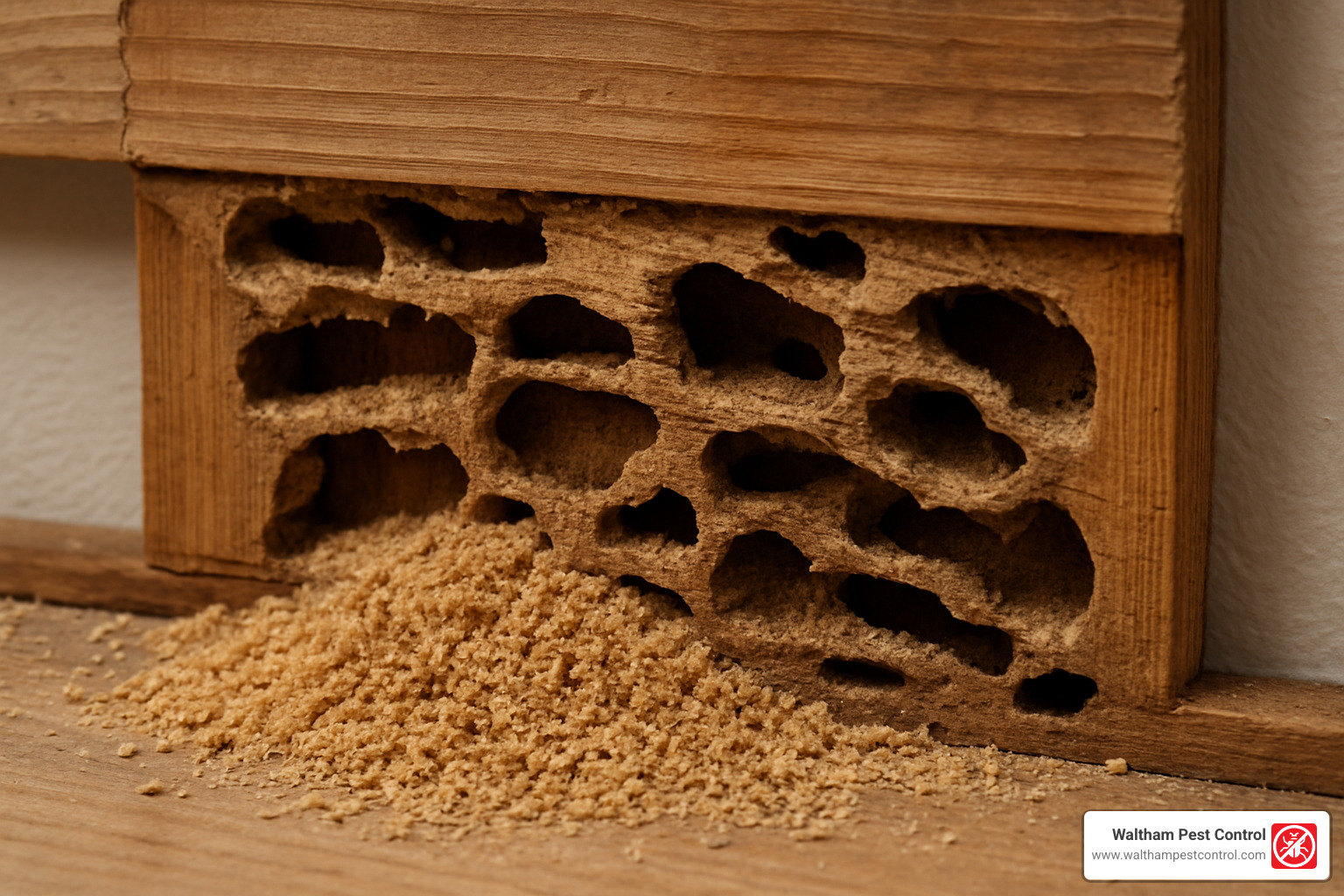
Pay attention to timing too. Nighttime activity is particularly telling – carpenter ants are primarily nocturnal, so large black ants appearing mainly after dark could indicate a carpenter ant infestation. These structural pests leave behind evidence: small piles of what looks like sawdust (actually frass – wood shavings mixed with ant waste) near wooden structures is a clear warning sign of carpenter ants excavating nests inside your home.
When you tap on wood that sounds hollow, that’s not just your imagination – it could indicate carpenter ants have been busy hollowing out structural elements. And that rotten coconut smell when you crush certain ants? That’s the distinctive odor of odorous house ants, confirming their presence in your home.
Weather patterns can also reveal infestation severity. A sudden appearance of ants after rainfall often indicates a nest close to your home, as ants seek drier conditions when their outdoor nests get soaked.
If you’ve experienced repeated DIY failures despite trying multiple over-the-counter products, the colony is likely larger or more complex than DIY methods can address. Any signs of structural damage potentially caused by carpenter ants requires immediate professional attention to prevent costly repairs.
Finally, the presence of tiny pharaoh ants should prompt a professional call immediately, as these require specialized treatment approaches – traditional methods can actually cause colony splitting and worsen the infestation.
DIY vs. Professional—A Reality Check
I completely understand the temptation to handle ant problems yourself. Many of our customers tried that route first. While DIY might work for very minor infestations, it’s worth understanding what you’re really up against.
| Factor | DIY Approach | Professional House Ants Exterminator |
|---|---|---|
| Initial Cost | $15-$50 for sprays and baits | $80-$500 average, potentially up to $1,500+ for severe infestations |
| Time Investment | Hours of research, application, monitoring | 1-2 hours of your time for inspection and consultation |
| Knowledge | General solutions not custom to species | Species-specific identification and targeted treatments |
| Effectiveness | Surface treatment of visible ants | Colony elimination targeting queens and nests |
| Safety | Potential misapplication risks | EPA-approved products applied by licensed professionals |
| Warranty | None | Service guarantees with follow-up treatments if needed |
| Long-term Results | Temporary relief, often with reinfestation | Comprehensive approach addressing root causes |
Here’s the reality that many homeowners don’t realize: most DIY treatments only address the visible ants—approximately 10% of the colony. Professional house ants exterminators target the entire colony, including queens and developing young. When you consider that ant colonies can consist of over 100,000 individuals, killing a few dozen or even a few hundred with spray will hardly make a dent if the queen continues producing thousands of new ants.
Even more concerning, some DIY approaches can actually worsen the problem. Spraying visible ants often disrupts their trails, causing colonies to split or relocate deeper into your home. Incorrect bait placement may never reach the queen, and some ant species (particularly pharaoh ants) respond to disturbance by splitting into multiple colonies – turning one problem into many!
When weighing costs, many of our customers share that their repeated DIY attempts ended up costing more than professional treatment would have initially, while allowing the infestation to grow larger and potentially cause damage. The average costs mentioned above are based on internet data and not actual costs for Waltham Pest Control services.
Professional exterminators bring not just products, but expertise in ant biology, behavior, and effective elimination strategies that target the true source of your problem – not just the symptoms you can see.
Professional Extermination Process & Average Costs
When you hire a professional house ants exterminator, you’re not just paying for products—you’re investing in expertise, specialized equipment, and proven methodologies developed through years of experience. Here’s what to expect from the professional extermination process.
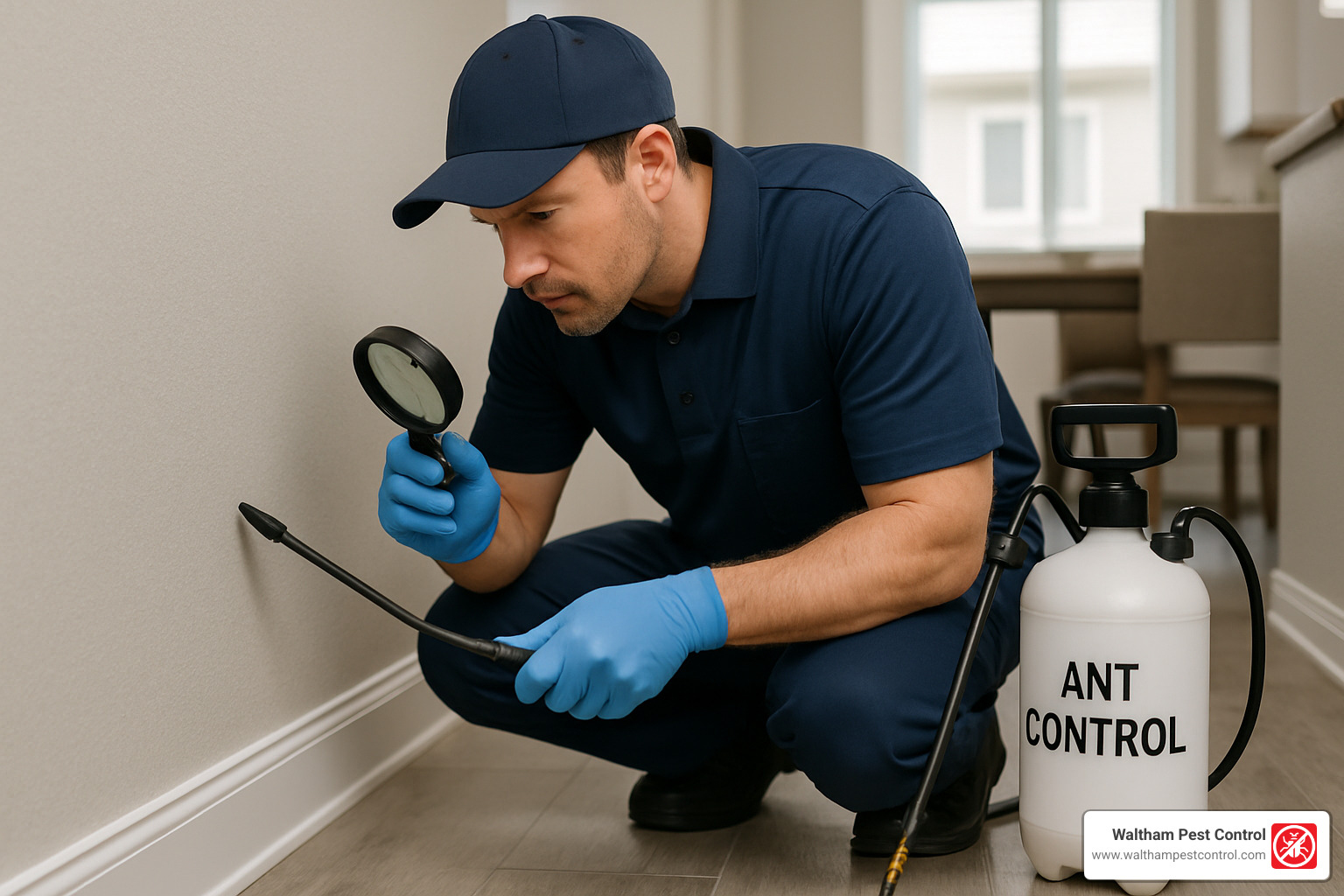
Think of professional ant treatment as a carefully orchestrated process rather than a one-time spray. It begins with a thorough inspection where we examine your property to identify which ant species has moved in, locate their nests, and determine how they’re getting inside. This detective work is crucial—different ants require completely different approaches.
Once we’ve identified the culprits, we develop a customized treatment plan specifically for your situation. This typically includes strategically placed bait stations that worker ants carry back to the colony (including to the queen), non-repellent insecticides that spread throughout the colony, direct nest treatment when possible, and preventative perimeter treatments to keep new ants from moving in.
What makes professional treatment so effective is that we don’t just target the ants you see—we eliminate the entire colony, including the queen who’s busy producing thousands of replacements for any workers you might kill with DIY sprays.
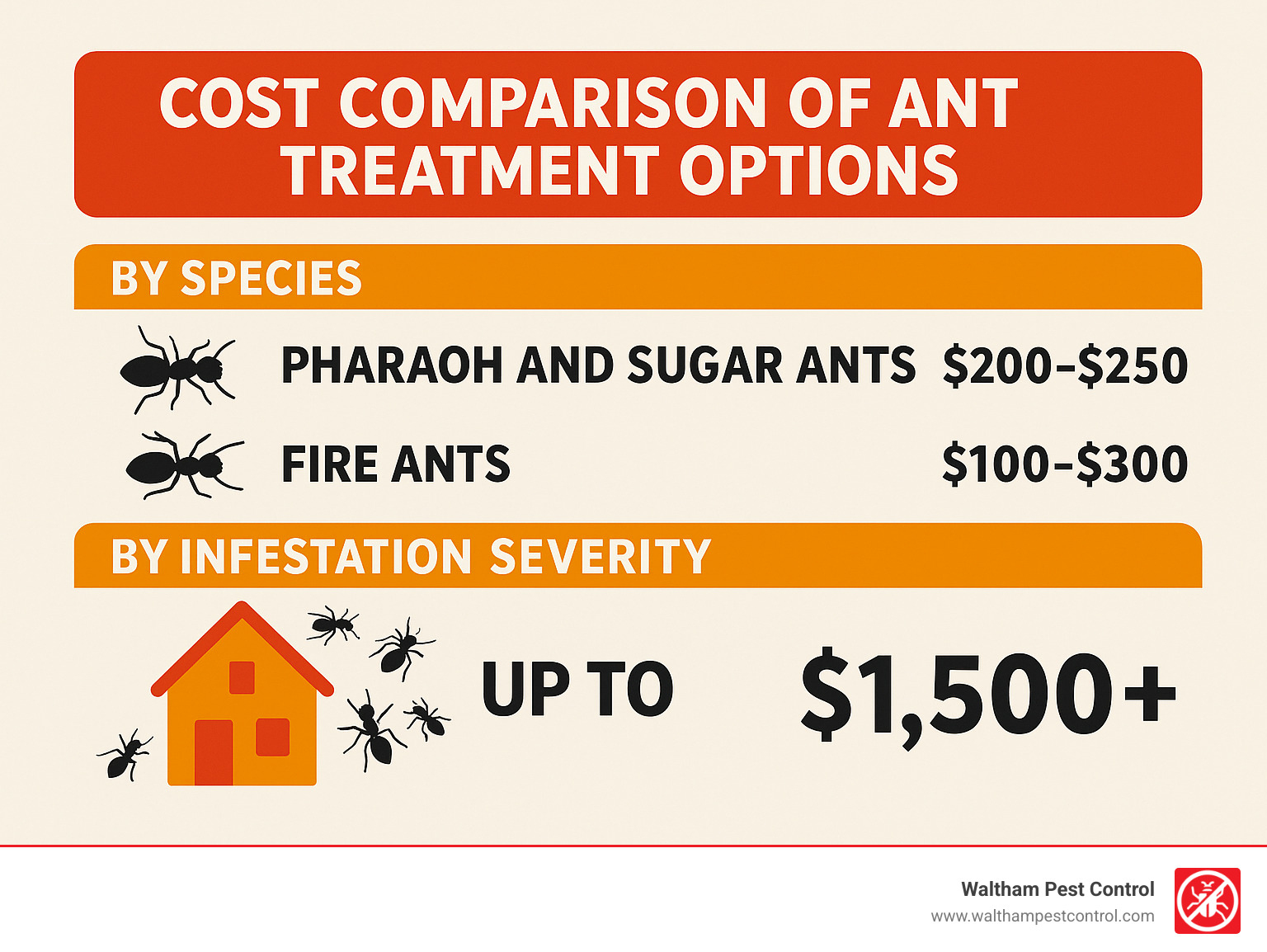
According to industry data from sources like HomeAdvisor, most homeowners can expect to pay between $80 and $500 for professional ant extermination, with severe infestations potentially costing up to $1,500 or more. These figures represent industry averages based on internet data and not actual costs for Waltham Pest Control services.
The cost varies significantly based on which ants have invaded your home:
– Pharaoh and sugar ant treatments typically average $200-$250
– Fire ant elimination ranges from $100-$300
– Carpenter ant extermination, because of potential structural damage concerns, averages $250-$500
Step-by-Step: What Your Exterminator Will Do
At Waltham Pest Control, we’ve refined our approach over 40 years to a comprehensive six-step process that ensures complete ant elimination:
First, we Investigate. We’ll thoroughly inspect your property inside and out, looking for ant trails, nests, entry points, and conditions that might be attracting them. We pay special attention to kitchens, bathrooms, utility areas, your foundation, and landscaping. We’ll also identify any moisture issues or structural problems that might be creating ideal ant habitats.
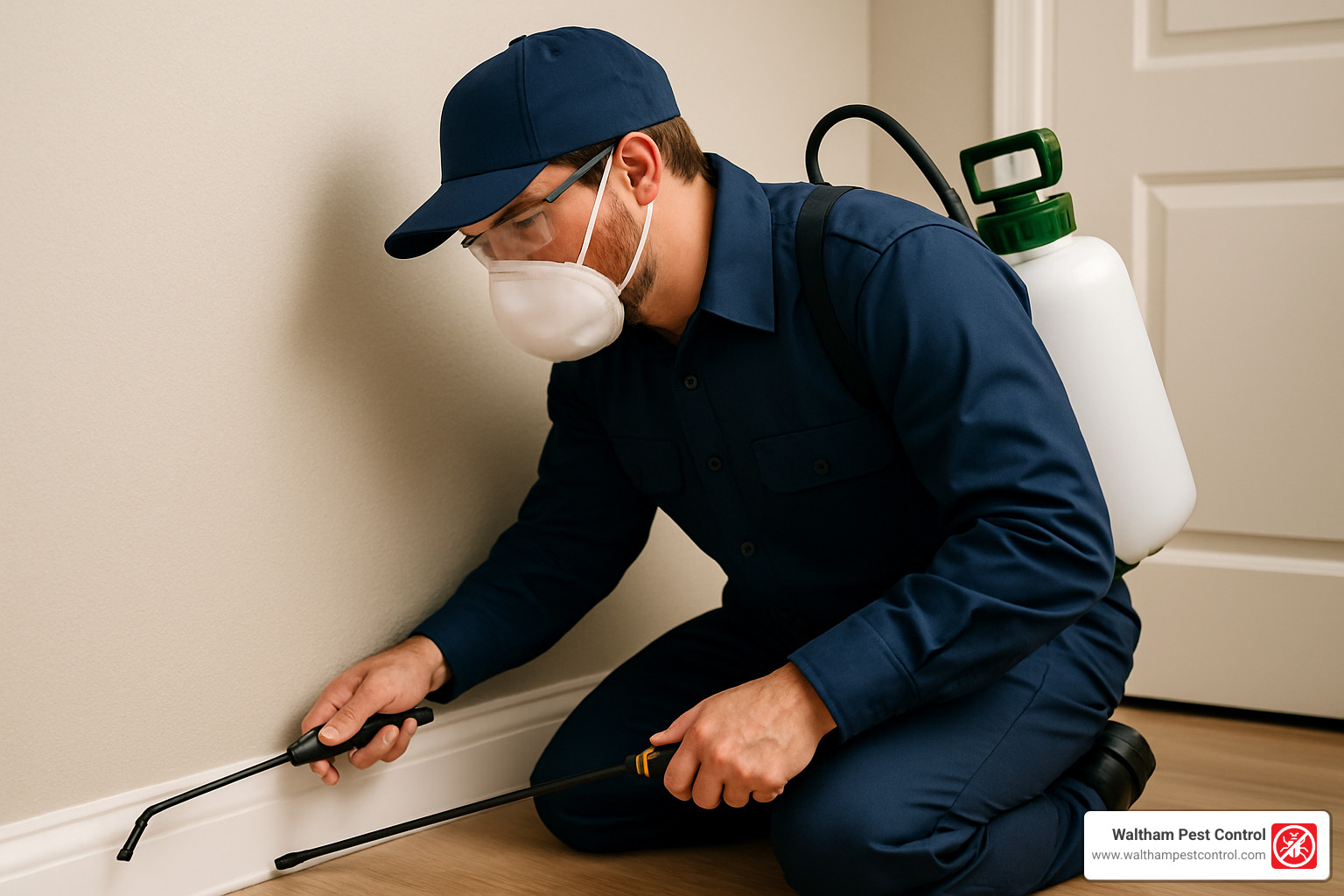
Next, we Protect your home with targeted treatments specific to your ant species. This might include interior baiting in safe, strategic locations your family can’t access, non-repellent insecticides that allow worker ants to unknowingly carry the treatment back to their colony, and direct nest treatment when we can access the nest itself.
We then Fortify your home against future invasions. This includes sealing entry points around pipes, wires, and foundation cracks, addressing moisture issues that attract ants, and recommending simple landscaping adjustments to make your yard less appealing to ant colonies.
To Keep Watch, we install monitoring systems in critical areas to detect any new ant activity before it becomes a full-blown infestation. We document all treatment locations for future reference.
We Report our findings, providing detailed documentation of what we found, which treatments we applied, and our recommendations for preventing future problems. You’ll receive a written service report explaining exactly what to expect after treatment.
Finally, we Follow Up with scheduled visits, typically 7-10 days after the initial treatment, to ensure the infestation is being resolved. We’ll provide additional treatments as needed until your ant problem is completely eliminated.
This systematic approach ensures we’re not just treating symptoms but addressing the root causes of your ant infestation.
What Influences Price & Duration
Several factors affect both what you’ll pay and how long it will take to eliminate your ant problem:
The ant species in your home makes a big difference. Carpenter ants, which nest in wood and can cause structural damage, typically require more intensive treatment than other species. They’re also more difficult to eliminate completely.
Your home’s size naturally impacts treatment costs. Industry averages suggest around $160 for homes under 2,000 square feet, approximately $180 for homes between 2,000-3,500 square feet, and about $200 for larger homes between 3,500-5,000 square feet.
Infestation severity plays a major role in both cost and timeline. A few ant trails might be resolved with a single treatment, while a home with multiple established colonies often requires multiple visits over several weeks. Minor infestations typically clear up within 1-2 weeks, moderate ones within 2-4 weeks, and severe cases (especially carpenter ants) can take 1-3 months for complete elimination.
Accessibility can complicate treatment. Nests hidden in wall voids, attics, or crawl spaces require specialized equipment and additional time to properly address.
The type of treatment plan you choose also affects overall costs. One-time treatments address current infestations, while ongoing maintenance plans provide continuous protection against future invasions.
Most ant treatments begin showing results within 48 hours, but patience is key—complete elimination takes time as the treatments work their way through the entire colony structure.
Are Modern Treatments Safe for Kids & Pets?
“Will these treatments harm my family or pets?” is one of the first questions most homeowners ask us—and it’s a good one. The good news is that modern professional ant control has evolved dramatically, with a strong focus on targeted, lower-risk treatments.
At Waltham Pest Control, we follow Integrated Pest Management (IPM) principles, which emphasize using the least toxic effective treatment, precise application in targeted locations, minimizing the amount of product used, and combining chemical and non-chemical approaches whenever possible.
Our child and pet-friendly approach includes using bait stations designed to be tamper-resistant, applying gel baits in cracks and crevices where curious fingers and paws can’t reach them, and selecting non-repellent products with low toxicity to mammals when properly applied. Many modern ant baits actually contain the same active ingredients used in flea and tick treatments for pets, just in different formulations.
When we treat your home, we provide clear safety guidelines, which might include recommended waiting periods before re-entering treated areas, specific instructions for cleaning surfaces after treatment, guidance on removing pet food and water dishes during application, and advice on covering fish tanks and turning off air pumps during treatment.
All products we use are registered with the Environmental Protection Agency (EPA) and applied according to label instructions by our licensed technicians, who receive ongoing training on the latest safety protocols and application techniques.
Our goal is always to provide the highest level of protection for your family and pets while effectively eliminating your ant problem—because peace of mind should come standard with pest control.
How to Choose the Best House Ants Exterminator Company
Selecting the right house ants exterminator is crucial for effective, safe, and lasting results. With numerous options available in Eastern Massachusetts, knowing what to look for can help you make an informed decision.
Red Flags & Must-Ask Questions
When you’re inviting someone into your home to solve an ant problem, you want to make sure they’re the real deal. Watch out for some telling red flags that might signal a less-than-professional operation.
Companies that provide quotes without ever seeing your property should raise immediate concerns. How can they accurately assess what you need without looking? Similarly, technicians who can’t identify specific ant species are probably not equipped to treat them effectively.
Other warning signs include missing state licenses or insurance, vague treatment plans (or mysterious “secret formulas”), no written guarantees, suspiciously low prices, or anyone using high-pressure tactics to get you to sign immediately.
Before signing any contract, have a conversation with your potential house ants exterminator. Ask about their licensing and certification: “Are your technicians licensed by the state of Massachusetts?” and “Do you have specialized training for ant control?”
Get specific about treatment details too. What products will they use? How will they ensure your children and pets stay safe? Will they target just the visible ants or the entire colony including the queen?
Service guarantees matter tremendously. What happens if the ants return after treatment? Is there a money-back guarantee? How many follow-up visits are included?
Don’t forget to inquire about their experience: “How long have you been treating ant infestations in this area?” and “What’s your success rate with this specific ant species?” Local references can tell you a lot about their reliability.
Finally, get clarity on pricing. Is the estimate in writing and all-inclusive? Are there potential additional costs lurking? What ongoing maintenance might be recommended after the initial treatment?
At Waltham Pest Control, we welcome these questions and pride ourselves on providing clear, honest answers that help you make the best choice for your home.
Value-Add Services to Look For
The best ant exterminators offer more than just spraying chemicals and leaving. They provide comprehensive solutions that address both current problems and future prevention.
Look for companies that offer entry-point sealing as part of their service. Professional exterminators should identify and seal the tiny cracks and gaps where ants are entering your home. This might include caulking around windows and doors, sealing utility penetrations where pipes enter your home, or recommending door sweeps and weather stripping.
Since many ant species are attracted to moisture, quality exterminators will provide moisture control recommendations, identifying leaky pipes or fixtures, suggesting proper drainage solutions, and recommending dehumidification in damp areas of your home.
Preventive perimeter treatments offer ongoing protection through scheduled applications, seasonal inspections, and barrier treatments before peak ant season arrives. This proactive approach keeps ants at bay year-round.
Modern pest control companies should provide digital service reports with detailed documentation of treatment locations, products used, specific recommendations for prevention, and a clear follow-up schedule. These reports give you a record of what was done and what to expect going forward.
The best professionals also serve as educators, providing resources on early warning signs of reinfestation, preventive measures you can take yourself, and seasonal ant activity patterns. This knowledge empowers you to participate in keeping your home ant-free.
At Waltham Pest Control, we include all these value-added services as standard parts of our ant control programs, ensuring not just elimination but long-term protection for your home.
Key Credentials
When choosing a house ants exterminator, certain credentials separate the professionals from the amateurs.
State licensing is non-negotiable. All pest control operators in Massachusetts must be licensed through the Department of Agricultural Resources. Don’t hesitate to ask to see this license or verify it online – legitimate professionals will be happy to demonstrate their credentials.
Proper insurance coverage protects both you and the technicians. Reputable companies carry both liability insurance and workers’ compensation coverage, shielding you from responsibility in the unlikely event of damage or injury during service.
Membership in industry associations signals a commitment to ongoing education and best practices. Companies affiliated with the National Pest Management Association (NPMA), New England Pest Management Association, or holding QualityPro certification have demonstrated their dedication to professional standards.
Check the company’s Better Business Bureau rating and review how they’ve handled any complaints. Their response to problems often reveals more about their customer service than perfect reviews.
Ask about ongoing education for technicians. The pest control field constantly evolves with new treatment methods and products, and the best companies invest in keeping their staff up-to-date.
Finally, local experience matters tremendously. Companies with experience in Eastern Massachusetts will understand regional ant species, seasonal patterns, and effective local treatment strategies that out-of-town operators might miss.
At Waltham Pest Control, we maintain all necessary licensing and insurance, invest in continuous education for our technicians, and have over 40 years of experience treating ant infestations throughout Eastern Massachusetts. We’re not just exterminators – we’re your neighbors, committed to keeping local homes ant-free with proven, safe methods.
Prevention & Long-Term Maintenance
After professional treatment, preventing future ant infestations becomes the priority. A comprehensive prevention strategy combines professional maintenance with homeowner vigilance.
The battle against ants doesn’t end when the house ants exterminator leaves. In fact, that’s when your role in maintaining an ant-free home truly begins. Think of ant prevention as building a fortress around your home – you need strong walls (structural exclusion), vigilant guards (regular inspections), and clean grounds (sanitation) to keep invaders at bay.
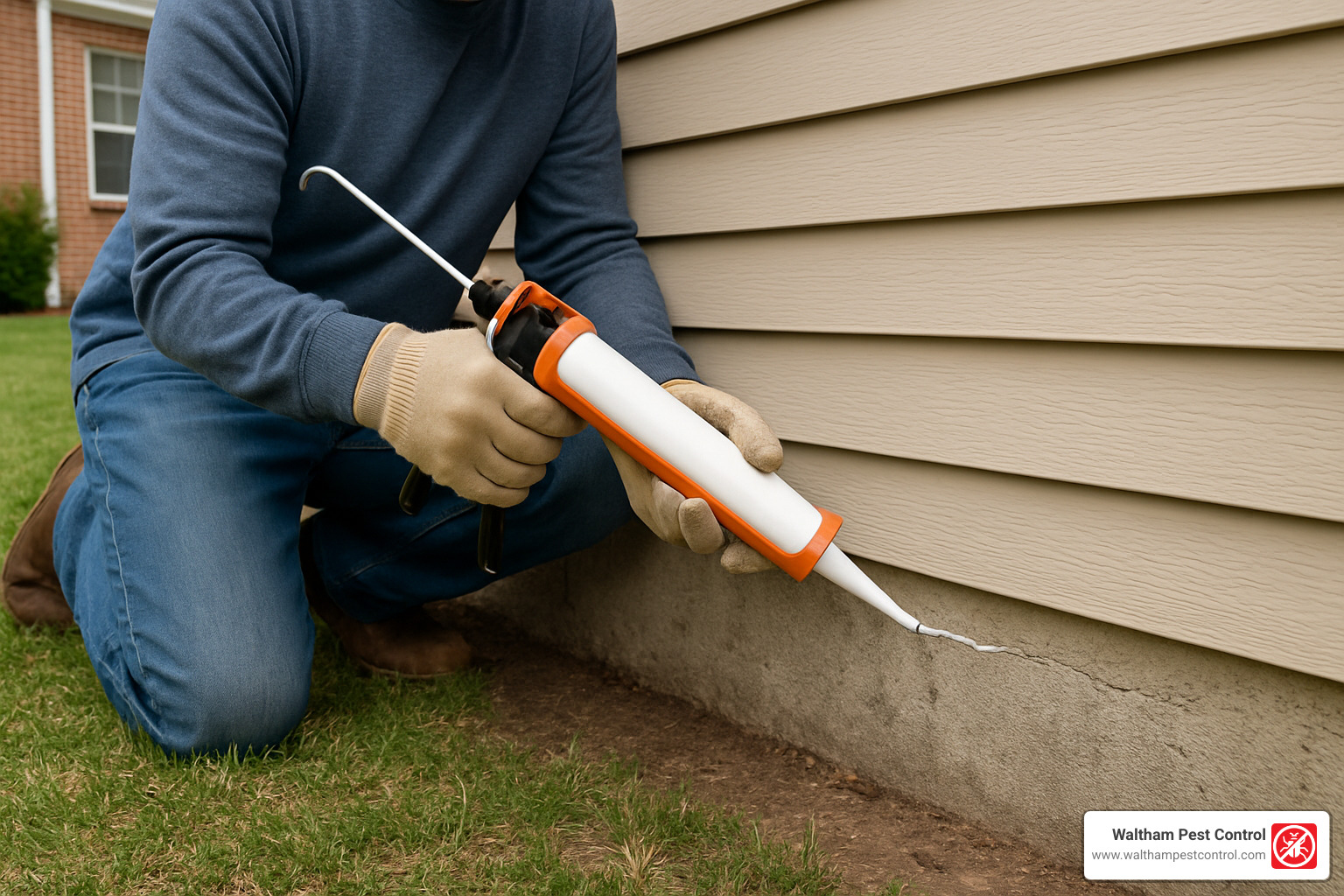
Structural exclusion is your first line of defense. Take a walk around your home’s perimeter and look for potential entry points. Even tiny cracks can be highways for ants. Grab a tube of silicone caulk and seal gaps around windows, doors, pipes, and utility lines. Don’t forget to install door sweeps and repair damaged screens – these simple fixes can make a tremendous difference in keeping ants outdoors where they belong.
Your kitchen is ant paradise if left unchecked. Proper food storage in airtight containers eliminates the buffet that attracts ants in the first place. After dinner, take those extra few minutes to wipe down counters and sweep floors – your future self will thank you! A simple vinegar solution works wonders for removing ant pheromone trails, essentially erasing the road maps that ants leave for their colony members.
Many homeowners don’t realize that their landscaping choices can invite ants indoors. Keep shrubs and tree branches trimmed back at least two feet from your home’s exterior. Consider replacing mulch near your foundation with pea gravel – mulch retains moisture and provides perfect nesting conditions for many ant species. And that firewood stack? Move it away from your house to avoid creating a convenient ant highway.
Moisture control is absolutely critical for ant prevention. Fix leaky pipes promptly, ensure proper drainage around your foundation, and consider using dehumidifiers in damp basements or crawl spaces. Many ant species are drawn to moisture, so eliminating excess water sources makes your home significantly less attractive to them.
For more detailed information about bait options that can be used as part of your prevention strategy, visit our guide on best indoor ant bait.
DIY Prevention Checklist After Professional Treatment
After we’ve eliminated your ant infestation, keeping your home ant-free becomes a partnership between our house ants exterminator team and your ongoing vigilance. I’ve worked with thousands of homeowners over the years, and those who follow these maintenance steps consistently enjoy longer-lasting results.
Your weekly routine should include wiping down kitchen surfaces with a vinegar solution to disrupt pheromone trails. Take a few minutes to check under appliances where food crumbs love to hide. Those forgotten potato chip fragments under the toaster? They’re like a neon “OPEN” sign for ants. Pet owners should be especially diligent about cleaning feeding areas after meals – that tiny kibble piece is a feast for an ant colony.
Monthly maintenance goes a bit deeper. Set aside time to inspect and clean your pantry, checking for any packages that might have tiny openings. Examine the areas under sinks for moisture issues – even minor condensation can attract certain ant species. Walk your home’s perimeter looking for ant activity or new potential entry points.
As seasons change, so should your prevention strategy. Spring is the perfect time to schedule a preventive perimeter treatment before ant activity peaks. During summer, maintain your yard by keeping grass trimmed and removing debris that could house ant colonies. Fall is ideal for cleaning gutters and ensuring proper drainage away from your foundation. Even in winter, stay vigilant by sealing any new cracks you find during colder months.
Annually, consider scheduling a professional inspection even if you don’t see ants. Our technicians can spot early warning signs and address potential issues before they become full-blown infestations. We’ll help you review and update your prevention plan based on any changes to your property or lifestyle.
For more comprehensive information about preventing house ants, visit our detailed guide: House ants – how to prevent them and how to treat them.
Prevention is always less expensive and less stressful than dealing with a full infestation. The small investments of time and attention now can save you significant hassle down the road. At Waltham Pest Control, we’re always here to help with professional perimeter treatments and seasonal maintenance visits to keep your home ant-free year-round.
Frequently Asked Questions about House Ant Control
How long does it take to eliminate a colony?
When it comes to ant control, patience is key. The timeline for complete colony elimination varies based on several important factors:
Ant species plays a significant role in treatment time. Carpenter ants, with their complex nesting habits, typically require 2-4 weeks for elimination, while sugar ants often respond to treatment within 1-2 weeks. The difference stems from their biology and colony structures.
Colony size directly impacts treatment duration. A newly established colony with a single queen might be eliminated quickly, while a mature multi-queen colony with thousands of workers requires more time for the treatment to reach all members.
Nest accessibility is another crucial factor. When we can directly treat a visible nest, results come faster. However, most ant colonies are hidden within walls, under floors, or in your yard, requiring worker ants to carry bait back to these hidden locations.
Treatment method also affects the timeline. Professional baits are designed to work gradually—this is intentional! The slow-acting formulations ensure workers have time to share the treatment throughout the colony before dying, eventually reaching the queen.
Most of our customers see a significant reduction in ant activity within 48 hours after our professional treatment, but complete elimination typically takes 1-4 weeks. For carpenter ants nesting in structural wood, the process may require additional time and follow-up treatments.
Don’t be alarmed if you initially see more ants after bait placement—this is actually a good sign! It means the ants are attracted to the bait and actively carrying it back to the colony, which is exactly what we want to happen.
How often should preventative treatments be scheduled?
In Eastern Massachusetts, ant activity follows seasonal patterns, making regular preventative treatments important for long-term control. Based on our 40+ years of experience, here’s what we recommend:
Quarterly treatments provide the most comprehensive year-round protection against ants and other common pests. This approach addresses seasonal changes in ant behavior and prevents colonies from becoming established.
Bi-annual programs represent our minimum recommendation, with treatments timed strategically in spring (before ant activity peaks) and fall (as ants prepare for winter). This schedule works well for homes with minimal historical pest issues.
Monthly monitoring may be necessary for commercial properties or homes with a history of severe infestations, especially those near wooded areas or water sources.
The ideal frequency for your home depends on several factors, including your property’s infestation history, surrounding environment (wooded areas tend to harbor more ants), construction type and age of your home, and whether you have children, pets, or family members with health concerns.
At Waltham Pest Control, we don’t believe in one-size-fits-all solutions. We’ll customize a maintenance schedule based on your specific situation, property characteristics, and risk factors to ensure your home stays ant-free year-round.
Will ants return after professional service?
This is one of the most common questions we hear from homeowners. Professional ant extermination significantly reduces the risk of reinfestation, but several factors influence whether ants will return to your home.
Our house ants exterminator service focuses on these factors that reduce return risk:
Complete colony elimination is our primary goal, targeting not just the visible workers but the queen(s) who produce new ants. Without eliminating the reproductive members, the colony will simply rebuild.
Exclusion measures are critical—we identify and seal entry points around your home to physically block ants from returning. Even tiny cracks can serve as highways for ants.
Prevention guidance helps you maintain an ant-resistant environment through proper sanitation and moisture control, eliminating the conditions that attract ants in the first place.
Scheduled maintenance provides ongoing protection against new colonies attempting to establish in or around your home.
However, certain factors can increase the risk of ants returning:
Neighboring properties with untreated ant problems can be a constant source of new colonies. Environmental factors like excessive rainfall or flooding often drive ants to seek higher ground, potentially in your home. Structural issues providing easy entry or failure to address food and moisture attractants can also invite new ant activity.
At Waltham Pest Control, we stand behind our work. Our service includes guarantees and free return visits if ants reappear within a specified period after treatment. We’re not satisfied until your ant problem is completely resolved.
With proper maintenance and prevention strategies, most of our customers maintain ant-free environments long-term. However, seasonal changes may trigger new ant activity, making regular inspections an important part of your home maintenance routine.
Conclusion & Next Steps
When it comes to house ants, the difference between temporary relief and lasting resolution often comes down to professional expertise. While store-bought sprays might give you a brief reprieve, a professional house ants exterminator targets what matters most—the colony, queens, and developing larvae that keep the infestation going.
After serving Eastern Massachusetts for over 40 years, we at Waltham Pest Control have seen how proper ant treatment transforms homes from frustrating battlegrounds to peaceful living spaces. Our approach combines scientific knowledge with practical experience, creating customized solutions for each unique situation we encounter.
Choosing the right house ants exterminator shouldn’t be overwhelming. Look for the essentials: proper licensing, comprehensive insurance, transparent pricing, and a willingness to explain their process. A quality provider won’t just spray and leave—they’ll partner with you, offering education and support to prevent future problems.
What sets our team apart is our deep connection to the local area. We understand which ant species thrive in Eastern Massachusetts and how seasonal changes affect their behavior. This regional expertise allows us to anticipate problems before they escalate and implement preventive measures at just the right time.
For homeowners currently dealing with ant invasions, we offer:
– Thorough inspections that identify the true source of your problem
– Species-specific treatment plans that target the entire colony
– Family-friendly options that keep your household safe
– Written guarantees that protect your investment
– Ongoing support to maintain an ant-free home
Don’t let what seems like a small problem grow into a major headache. Ant colonies expand rapidly when left unchecked, potentially causing more damage and becoming harder to eliminate. Taking action now saves you time, money, and frustration in the long run.
Ready to reclaim your home from unwanted six-legged visitors? Our friendly team is just a phone call away, ready to help you develop a comprehensive plan for lasting ant control.
For more detailed information about our approach to ant management, check out our comprehensive guide: House ants – how to prevent them and how to treat them.
When you choose Waltham Pest Control as your house ants exterminator, you’re not just getting a service—you’re gaining a local partner committed to keeping your home pest-free through every New England season.
