

Tick control for yards: Top Safe Solutions
Why Effective Tick Control for Yards is Critical for Massachusetts Families
Tick control for yards is essential for protecting your family and pets from dangerous tick-borne diseases like Lyme disease, which has more than doubled in Massachusetts over the past decade. Here are the most effective yard tick control methods:
Top Tick Control Options:
- Perimeter spray treatments – Target tick entry points along yard edges and wooded borders
- Granular tick control products – Time-release formulas for lawn and garden bed application
- Natural tick repellents – Essential oil-based sprays safe for children and pets
- Tick tubes – Innovative systems that target ticks on mice and other host animals
- Integrated landscaping – Strategic yard maintenance to eliminate tick habitats
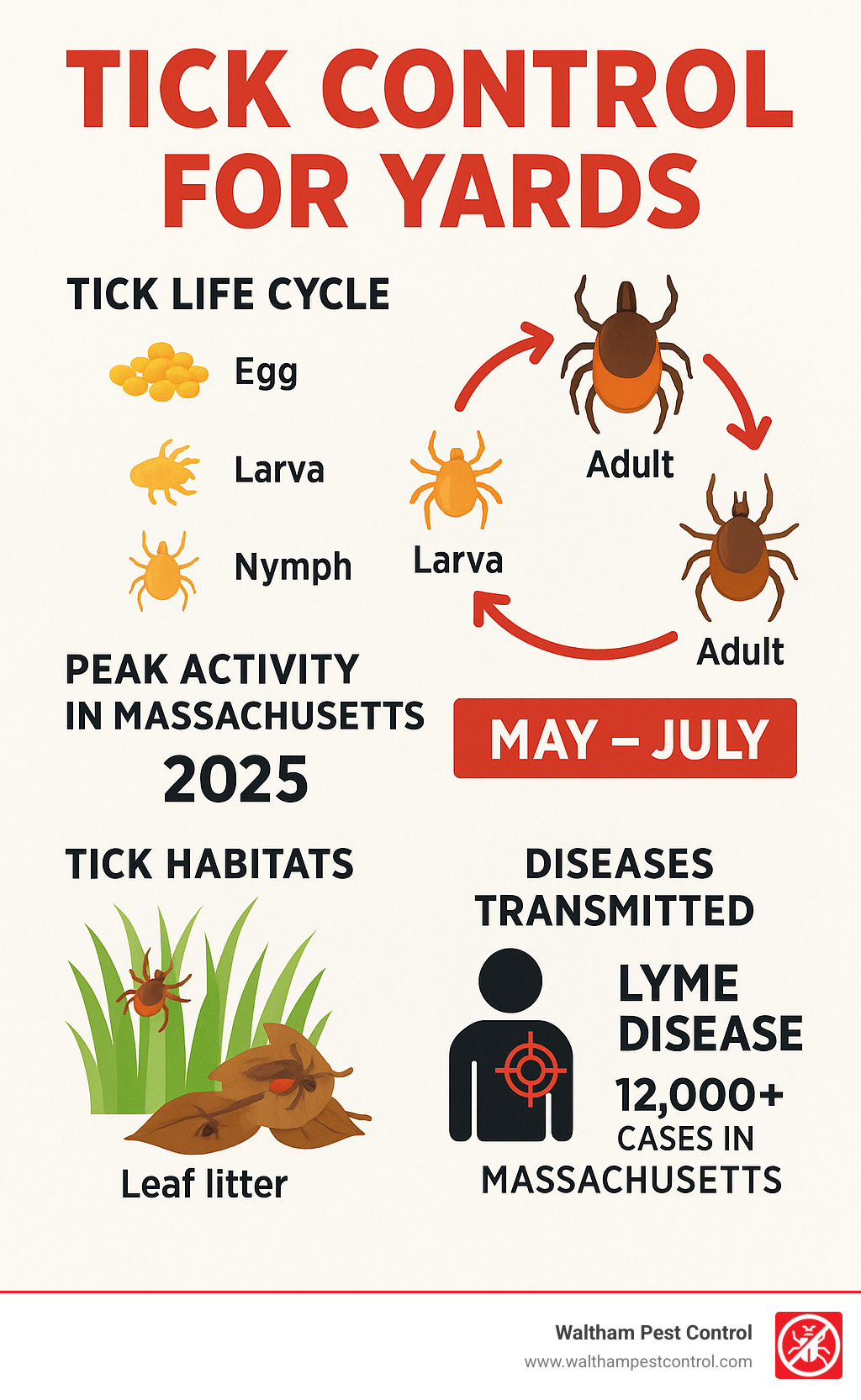
The statistics are sobering. More than 80% of ticks stay within the outer 9 feet of your lawn, and an estimated 75% of tick bites occur during normal home activities like gardening, playing with pets, or entertaining friends. With nymph ticks responsible for approximately 98% of all tick bites and peak activity from May through July, protecting your yard isn’t just about comfort – it’s about preventing serious illness.
Your backyard should be a safe haven, not a health hazard. The reality is that at least one variety of disease-transmitting tick has been found in all of the lower 48 states, and tick populations are rising across the country. From Rocky Mountain spotted fever to anaplasmosis, these tiny arachnids can transmit about a dozen common diseases through their saliva when feeding.
I’m Waltham Pest Control, President & CEO of Waltham Pest Control, and over my 40 years in the pest control industry, I’ve seen how effective tick control for yards can transform families’ ability to safely enjoy their outdoor spaces. Our integrated pest management approach has helped thousands of Eastern Massachusetts homeowners reclaim their yards from these dangerous pests.
Quick tick control for yards terms:
Understanding the Enemy: Tick Hotspots and High-Risk Seasons
To effectively combat ticks in our yards, we first need to understand their behavior. When are these tiny arachnids most active, and where do they prefer to hide? Knowing this helps us target our control efforts precisely.
Ticks are most active when temperatures rise, generally from April through September. However, the real danger period, especially in our region of Eastern Massachusetts, is from May through July. This is when immature, pinhead-sized ticks called “nymphs” are most active. These tiny nymphs are responsible for approximately 98% of all tick bites, making them a critical target for prevention. We also know that tick activity can extend into the milder autumn months, so vigilance is key year-round.
Where do these unwelcome guests lurk in our yards? Ticks are not fans of open, sunny, dry spaces. They prefer cool, humid, and shady environments. This means we’ll typically find them in:
- Tall grass and weeds: Ticks don’t fly or jump; they “quest,” climbing to the tips of grasses and shrubs, waiting to latch onto a passing host. Tall grass provides the perfect perch.
- Leaf litter: Fallen leaves create a moist, sheltered environment that ticks adore. Removing leaf litter is a simple yet effective step.
- Woodpiles: These offer both shade and potential harborage for rodents, which are primary hosts for ticks.
- Overgrown areas and brush: Any dense vegetation provides ideal hiding spots.
- Yard perimeters: Especially where our lawns meet wooded areas, stone walls, or unmaintained properties, ticks are often found in higher concentrations. In fact, over 80% of ticks stay in the lawn’s outer 9 feet, making this a crucial zone for treatment.
The importance of effective tick control for yards cannot be overstated. Ticks are not just a nuisance; they are significant vectors of disease. They transmit a wide variety of pathogens, and the consequences of a tick bite can range from mild irritation to severe, life-altering conditions. In our region, the blacklegged tick (also known as the deer tick) is a major concern, as it’s the primary carrier of Lyme disease. Other diseases that ticks can transmit include:
- Lyme disease: Characterized by symptoms like fever, chills, fatigue, body aches, headache, neck stiffness, and sometimes a distinctive “bullseye” rash. If left untreated, it can lead to neurological problems, joint pain, and heart issues.
- Rocky Mountain spotted fever: A serious bacterial disease that can be fatal if not treated early.
- Anaplasmosis: Causes fever, headache, muscle aches, and fatigue.
- Babesiosis: A parasitic infection that can cause flu-like symptoms and hemolytic anemia.
- Ehrlichiosis: Similar to anaplasmosis, presenting with fever, headache, and muscle aches.
- Powassan virus: A rare but serious tick-borne disease that can cause encephalitis or meningitis.
As we’ve seen, tick populations and the incidence of tick-borne diseases are unfortunately on the rise across the country, making proactive tick control for yards a vital part of protecting our health. We must remember that no U.S. region is free from the threat of these tiny, disease-transmitting arachnids. For more detailed information on tick-borne illnesses, we often refer to The CDC’s guide to Tickborne Diseases.
Identifying a Tick Problem in Your Yard
Here’s the tricky thing about ticks – they’re sneaky little creatures that don’t announce their presence like other pests. You won’t see swarms buzzing around your barbecue or trails marching across your patio. Instead, these tiny arachnids are masters of hide-and-seek, tucking themselves away in dark, humid spots under plant leaves, in shady corners, beneath decks, and around woodpiles.
So how do we know if our yards have become tick territory? The signs are often subtle, but there are reliable ways to detect these unwelcome guests.
Your pets are often your best early warning system. If your dog or cat regularly comes inside with ticks after playing in the yard, that’s a clear red flag. These furry family members love to explore all the places ticks hang out – tall grass, brush piles, and wooded edges. Make it a habit to check their fur after outdoor trips, paying special attention to areas around the ears, neck, and between toes.
The most effective method for homeowners is something called a tick drag test. It sounds fancy, but it’s actually quite simple. You’ll need a white towel or a 5-inch square of white fabric attached to a dowel or 18-inch pole. Slowly drag this setup through suspected tick habitats – tall grass, leaf litter, and especially along those transition zones where your manicured lawn meets wilder areas.
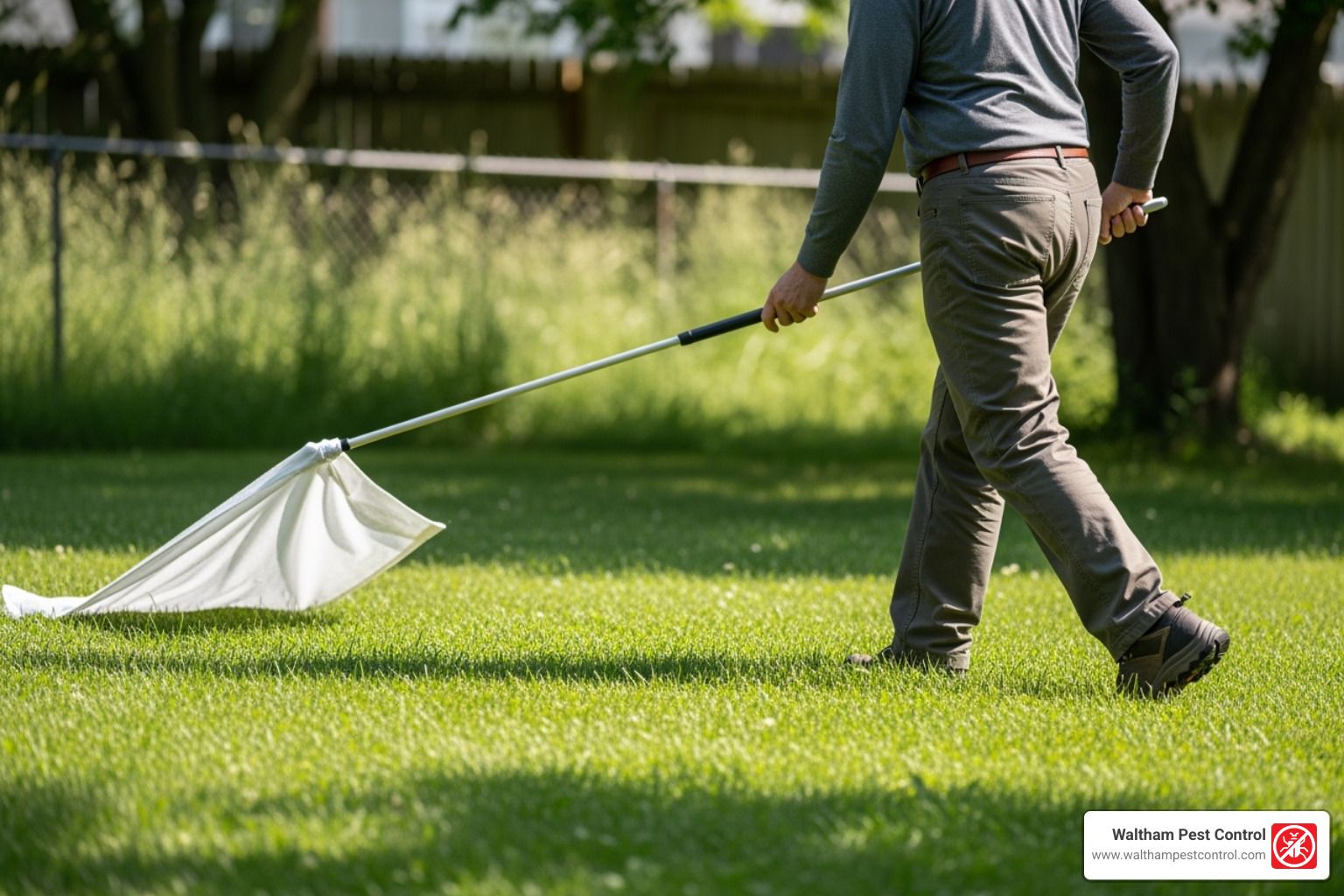
As you drag the fabric, ticks will latch on, mistaking it for a potential host. Stop every few feet to inspect your white cloth for any tiny hitchhikers. This method is particularly effective for finding those nearly invisible nymphs that cause most tick bites.
Visual inspection alone is challenging because ticks are incredibly small and blend seamlessly with their surroundings. Unless they’re already engorged with blood, spotting them with the naked eye is like looking for a needle in a haystack. Even with a flashlight, you’re likely to miss them.
Once you’ve confirmed ticks are present, focus your attention on the high-risk zones where they love to congregate. Wooded edges where your yard meets forest or dense brush are prime real estate for ticks. Stone walls create perfect little crevices and moisture pockets that ticks find irresistible. Dense ornamental plantings and ground covers also provide the cool, humid environment these pests prefer.
Understanding exactly where ticks are hiding helps you implement targeted tick control for yards strategies rather than treating your entire property blindly. This focused approach is not only more effective but also more economical and environmentally conscious.
Top Product Categories for Tick Control for Yards
When it comes to protecting our families from ticks, we have several powerful weapons in our arsenal. The key is understanding which approach works best for your specific situation – and often, the most effective strategy combines multiple methods.
Perimeter Sprays and Barrier Treatments
Think of perimeter sprays as creating an invisible fence around your property. These liquid treatments are one of the most effective methods for tick control for yards, and here’s why they work so well.
The magic happens at your property’s edges – those transition zones where your manicured lawn meets the wild. We apply liquid insecticides to create a protective barrier that targets tick entry points and their favorite hiding spots. Since we know that over 80% of ticks stay within the outer 9 feet of your lawn, this targeted approach makes perfect sense.
Most professional-grade perimeter treatments use active ingredients like bifenthrin or permethrin. These synthetic pyrethroids are designed to be less toxic to mammals while still being deadly effective against ticks. However, there’s an important safety note for cat owners: permethrin can be fatal to cats, so professional application with proper precautions is crucial.
When our licensed technicians apply these treatments, we use high-pressure sprayers to ensure thorough coverage. We get under leaves, around plant bases, and into all those shadowy spots where ticks love to hide. The timing matters too – we typically recommend applications in mid-May and mid-June when nymph activity peaks, plus a fall treatment in mid-October for adult ticks.
The beauty of professional perimeter treatments is their lasting power. One application can provide weeks of protection, creating that tick-free zone where your family can play safely. For more detailed information on our approach, check out our guide on How to Treat Yard for Ticks.
Granular Tick Control Products
If you prefer a more hands-on approach, granular products offer excellent tick control for yards with the convenience of DIY application. These small pellets work like tiny time-release capsules scattered across your lawn.
The process is straightforward – you use a standard broadcast spreader to distribute the granules across your lawn and garden beds. Once applied, water activates the granules, releasing their active ingredients over time. This slow-release formula provides extended protection, making it a popular choice for homeowners who like to maintain their own pest control.
One major advantage of granular products is their precision. Unlike liquid sprays that can drift in the wind, granules stay exactly where you put them. This makes them ideal for treating large areas or for use around sensitive plantings where spray drift might be a concern.
The trade-off is timing – granular products work more slowly than liquid applications. They need time to activate and distribute their protective ingredients, so they’re not the best choice if you need immediate tick knockdown.

Natural and Pet-Friendly Tick Control for Yards
For families seeking gentler alternatives, natural tick control for yards options have come a long way in recent years. These eco-friendly solutions rely on essential oils and naturally occurring substances rather than synthetic chemicals.
Essential oil-based sprays are the stars of this category. Products containing cedarwood oil, peppermint oil, lemongrass, or rosemary create an aromatic barrier that ticks find unbearable. Many of these treatments offer “Spray & Play” convenience – kids and pets can use treated areas immediately after application.
Diatomaceous earth takes a different approach entirely. This fine powder, made from fossilized diatoms, works by physically damaging ticks’ outer shells, leading to dehydration. It’s completely natural and long-lasting, though it does need reapplication after heavy rains.
Neem oil and beneficial nematodes round out the natural options. Neem oil acts as both a repellent and growth disruptor, while these microscopic roundworms hunt down tick larvae in the soil like tiny underground warriors.
The honest truth about natural methods? They typically require more frequent applications – often every two weeks compared to monthly or bi-monthly chemical treatments. Their effectiveness can also vary based on weather conditions and tick pressure in your area. For homeowners interested in environmentally conscious pest management, we offer more info about green pest control services.
Innovative Solutions for Long-Term Tick Control for Yards
Sometimes the most effective solutions are the most creative ones. Tick tubes represent a brilliant approach to tick control for yards that works by outsmarting ticks at their own game.
Here’s the clever science behind tick tubes: these small, biodegradable cardboard tubes are filled with permethrin-treated cotton. Mice – which happen to be the primary hosts for immature blacklegged ticks – collect this cotton for their nests. As they move the treated cotton around, the permethrin transfers to their fur. The insecticide is completely safe for the mice but deadly to the tick larvae and nymphs that try to feed on them.
This method is particularly effective because it disrupts the tick life cycle at its most vulnerable point. Instead of waiting for ticks to mature and threaten our families, we’re eliminating them while they’re still dependent on their rodent hosts. Since mice play a crucial role in Lyme disease transmission, targeting them makes perfect biological sense.
Research from the Connecticut Agricultural Experiment Station on tick management shows that consistent use of tick tubes can lead to statistically significant drops in tick populations over several years. The patience required is worth it – you’re not just treating this season’s tick problem, you’re preventing future generations.
The main consideration with tick tubes is that they’re a long-term strategy rather than a quick fix. You’ll need to replace them annually, and results build over time as the local tick population gradually decreases. But for families committed to sustainable, targeted tick control, they’re an invaluable tool in the fight against these dangerous pests.
Supporting Your Defense: Landscaping and Maintenance Tips
Think of your yard as a fortress, and these landscaping techniques as your first line of defense. The most effective tick control for yards isn’t just about what products you use—it’s about creating an environment where ticks simply don’t want to live. This approach, called Integrated Pest Management (IPM), works with nature rather than against it.
Let’s start with the basics. Regular lawn mowing might seem obvious, but it’s one of your most powerful weapons. Ticks love to climb tall grass, waiting patiently for their next meal to walk by. By keeping your lawn mowed to about 3 inches, you’re essentially removing their hunting grounds. For most properties, mowing every two weeks works well, but if your yard borders heavily wooded areas, you might need to break out the mower more often.
Leaf litter removal is another game-changer that many homeowners overlook. Those beautiful autumn leaves might look picturesque scattered across your garden beds, but they’re essentially rolling out the red carpet for ticks. These piles create the perfect moist, shady environment that ticks crave. A good raking session, especially around garden beds and property edges, eliminates these tick hideouts.
Here’s a clever trick that works surprisingly well: creating mulch barriers. A simple 3-foot-wide strip of wood chips, gravel, or coarse bark mulch between your lawn and wooded areas acts like a moat around a castle. Ticks are surprisingly reluctant to cross these dry, open boundaries. It’s like they hit an invisible wall.
Your gravel pathways serve double duty—they look great and create natural tick barriers throughout your yard. Combined with proper landscaping that discourages deer and rodents, you’re addressing the root of the problem. Deer are like tick taxis, dropping off passengers all around your property. Fencing, deer-resistant plants, and removing food sources can help keep these unwanted visitors away.
The secret weapon in this battle? Sunny play areas. Ticks absolutely hate direct sunlight and dry conditions. When you’re planning where to put playground equipment, decks, or patios, choose the sunniest spots in your yard, away from dense vegetation and yard edges. Your kids get to play safely while ticks stay far away—it’s a win-win.
Don’t forget about the small details that make a big difference. Keeping your yard free of debris, trimming back overgrown shrubs to let sunlight in, and storing firewood properly all contribute to an environment where ticks struggle to survive. Every pile of old furniture or neglected corner becomes potential tick real estate.
This integrated approach works beautifully alongside any product-based treatments you choose. When you combine smart landscaping with targeted tick control products, you’re not just treating the problem—you’re preventing it from coming back. For more comprehensive strategies to protect your outdoor spaces, check out our Essential Tips for a Safe and Enjoyable Summer.
Frequently Asked Questions about Yard Tick Control
Over my four decades in pest control, I’ve heard just about every question homeowners have about tick control for yards. Let me share the most common concerns we address here in Eastern Massachusetts, along with the honest answers you deserve.
How much does professional tick treatment cost?
This is usually the first question on everyone’s mind, and I completely understand why. Your family’s safety is priceless, but you still need to budget wisely.
Professional tick treatment costs vary significantly based on several key factors. According to general internet data, average costs across the U.S. can range from $75 to $300 per treatment, though comprehensive services for larger properties can reach $900 or more per season. These are average costs found online and do not reflect the actual costs for Waltham Pest Control services.
Several factors affect what you’ll actually pay for tick control for yards. Property size is the biggest factor – treating a quarter-acre lot takes much less time and product than protecting a two-acre property with extensive wooded borders. Infestation severity also matters; if your yard is heavily infested, we might recommend more intensive initial treatments to get the population under control.
Treatment frequency plays a role too. Many homeowners choose multiple treatments throughout tick season for continuous protection, which can reduce the per-visit cost through seasonal packages. Your geographic location within Eastern Massachusetts can influence pricing, and the type of treatment you prefer – whether natural or synthetic – may have different cost structures.
The best approach? Contact us directly for a personalized quote based on your specific property and needs. We’ll walk your yard with you and provide an honest assessment of what it will take to keep your family safe.
Are yard tick treatments safe for my children and pets?
This question keeps many parents up at night, and rightfully so. Safety is always our top priority, and I’m happy to report that when applied correctly by licensed professionals, most yard tick treatments are very safe for children and pets.
The key phrase here is “when the treated areas have dried.” Most professional treatments require a drying time – usually just a few hours – before allowing family members and pets back into treated areas. Once the product has dried, it binds to surfaces, dramatically reducing any exposure risk.
Natural options like essential oil-based sprays often allow for immediate re-entry into the treated area. Chemical treatments, while highly effective, do require that drying time. We always explain exactly which active ingredients we’re using and any specific precautions needed.
Here’s something critical for cat owners: permethrin is highly toxic to cats when wet. As professionals, we take extra precautions and provide specific guidance for households with feline family members. This is exactly why professional application matters – we understand these nuances and how to keep everyone safe.
Reading product labels thoroughly is essential, even with professional service. We always review safety protocols with homeowners and answer any concerns before we begin treatment.
How often should I treat my yard for ticks?
The timing and frequency of tick control for yards treatments can make or break your success in protecting your family. In Eastern Massachusetts, our extended tick season means we need to think strategically about when and how often to treat.
Peak tick season runs from spring through fall, but the most critical period is May through July when those tiny, dangerous nymph ticks are most active. These pinhead-sized nymphs are responsible for about 98% of tick bites, making spring and early summer treatments absolutely essential.
Our typical approach includes multiple applications throughout tick season. We often recommend treatments in mid-May and mid-June to target those active nymphs, followed by an additional application in mid-October to handle adult blacklegged ticks that are still active in our New England climate.
High-infestation areas – properties bordering dense woods or with a history of tick problems – might need monthly treatments from spring through the first frost. The good news is that each property is different, and we customize treatment schedules based on your specific situation.
Regional climate impact is real here in Eastern Massachusetts. Our ticks can be active during milder winter thaws, and our humid summers provide ideal conditions for tick populations to thrive. This means consistent treatment throughout the warmer months isn’t just recommended – it’s necessary for effective protection.
The best treatment schedule is one that’s custom to your property, your family’s outdoor activities, and the specific tick pressure in your neighborhood. That’s something we determine together during our initial consultation.
Conclusion: Reclaiming Your Yard with Confidence
Your backyard should be a place of joy, not worry. After dealing with hundreds of tick-infested yards across Eastern Massachusetts over the past four decades, I’ve seen how these tiny pests can rob families of their outdoor peace of mind. The good news? Tick control for yards doesn’t have to be overwhelming when you know what works.
The most successful approach combines multiple strategies working together. Whether you choose perimeter spray treatments to create protective barriers, granular products for extended coverage, or innovative tick tubes that disrupt the life cycle at its source, no single method works in isolation. The magic happens when we pair these treatments with smart landscaping choices – keeping grass trimmed, removing leaf litter, and creating those crucial mulch barriers between your lawn and wooded areas.
Year-round vigilance is key to long-term success. Ticks don’t take vacations, and neither should our prevention efforts. From the spring nymph emergence through fall adult activity, consistent treatment timing makes all the difference. Those tiny nymphs responsible for 98% of tick bites are most active during prime outdoor season – exactly when your family wants to be outside most.
At Waltham Pest Control, we’ve spent over 40 years perfecting our integrated pest management approach for Eastern Massachusetts properties. Our licensed and insured team understands that every yard is different – what works for a sunny suburban lawn won’t be the same strategy needed for a property backing up to dense woods. We’re committed to providing cost-effective solutions that actually work, not just temporary fixes.
Don’t let fear of ticks keep you from enjoying summer barbecues, kids playing in the yard, or peaceful evenings on your deck. With the right combination of professional treatments and maintenance practices, you can transform your outdoor space back into the safe haven it should be.
Ready to take back your yard? Learn more about our Tick and Mosquito Control programs and find how we can help you enjoy your outdoor space with complete confidence.
