

Professional Tick Spray for Yard: 5 Powerful Benefits in 2025
Why Professional Tick Spray for Yard Makes All the Difference
Professional tick spray for yard services provide targeted, long-lasting protection against dangerous tick-borne diseases like Lyme disease, which affects nearly 30,000 Americans annually. Here’s what you need to know:
Key Benefits:
- 4-week residual protection vs. 1-2 weeks for DIY sprays
- Licensed applicators use EPA-approved formulations
- Barrier treatment targets tick hotspots around your property
- Pet and family safe when applied correctly
- Organic options available for eco-conscious homeowners
What It Covers:
- Perimeter spraying around foundations, decks, and play areas
- Tick tubes for natural rodent-based control
- Follow-up treatments during peak tick season (April-October)
Ticks are more than just a nuisance – they’re disease vectors that can transmit serious illnesses to your family and pets. As one Massachusetts homeowner finded after professional treatment, “I couldn’t let my kids play in the backyard until we got our tick problem under control.”
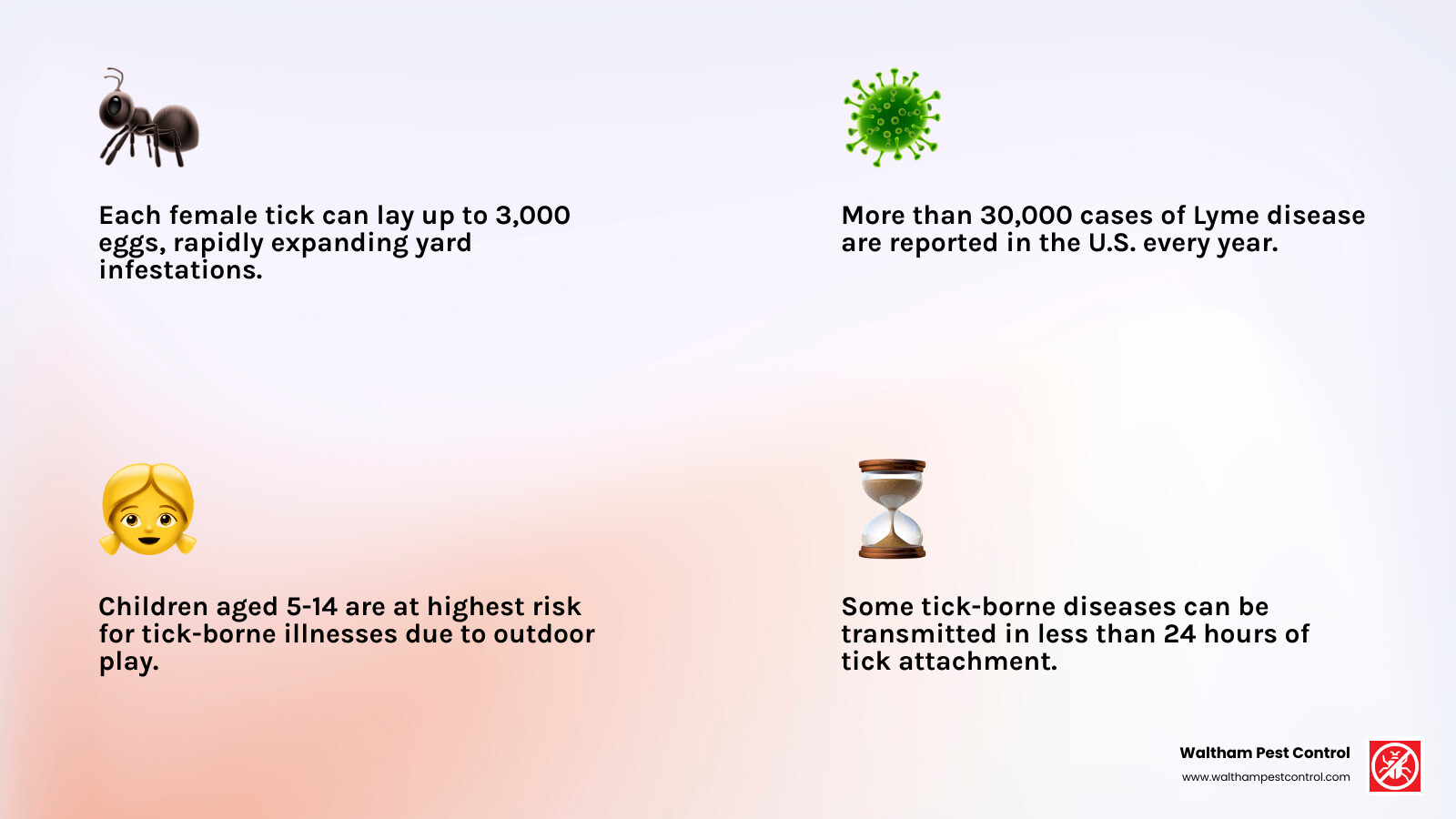
The reality is stark: ticks can lay up to 3,000 eggs in a single clutch, and they’re responsible for transmitting more disease-causing organisms than any other arthropod insect. Professional treatments target these reproduction cycles in ways that store-bought sprays simply can’t match.
I’m Waltham Pest Control, President & CEO of Waltham Pest Control, and I’ve spent over 40 years helping Eastern Massachusetts families reclaim their outdoor spaces through effective professional tick spray for yard programs. Our integrated pest management approach combines the latest EPA-approved treatments with proven yard maintenance strategies to create truly tick-free zones.
Professional tick spray for yard further reading:
Professional Tick Spray for Yard: How It Works & Why It Beats DIY
When we talk about professional tick spray for yard applications, we’re discussing a completely different approach than what you’ll find at your local hardware store. The difference isn’t just in the products – it’s in the science, equipment, and expertise behind every application.
Professional tick control works through multiple mechanisms. First, we use EPA-approved formulations that often feature micro-encapsulation technology. This means the active ingredients are protected in tiny capsules that release slowly over time, providing up to four weeks of residual control compared to the 1-2 weeks you might get from store-bought options.
Our licensed applicators understand tick biology and behavior patterns. We know that ticks don’t randomly distribute themselves across your property – they concentrate in specific microclimates where humidity stays high and hosts are likely to pass through. This knowledge allows us to create strategic barrier zones that intercept ticks before they reach your family’s activity areas.
The equipment we use makes a significant difference too. Professional-grade sprayers deliver consistent pressure and droplet size, ensuring uniform coverage that penetrates vegetation properly. This isn’t something you can achieve with a garden hose attachment from the hardware store.
What Exactly Is a “Professional Tick Spray for Yard”?
A professional tick spray for yard isn’t just a stronger version of what you can buy retail – it’s an entirely different category of pest control product. These are EPA-registered formulations that are only available to licensed applicators who have the training to use them safely and effectively.
The active ingredients in professional treatments often include synthetic pyrethroids like bifenthrin or permethrin, which are designed to provide both immediate knockdown and long-term residual control. Many of these products use micro-encapsulation technology, where the active ingredient is surrounded by a protective coating that breaks down slowly when exposed to moisture, UV light, or physical contact.
We create barrier zones around your property – typically focusing on the transition areas between your maintained lawn and wilder spaces like wooded edges, stone walls, or overgrown areas. These barriers don’t just kill ticks on contact; they create a treated zone that continues working for weeks after application.
Why a Professional Tick Spray for Yard Outperforms Store Sprays
The difference between professional and retail tick control comes down to three key factors: formulation, application technique, and ongoing management.
Professional formulations are simply more sophisticated. While store-bought sprays might contain 0.5% active ingredient, professional products can contain 2-5% or more, delivered through advanced carrier systems that improve penetration and persistence. We also have access to product rotation strategies that prevent tick populations from developing resistance.
Coverage uniformity is another crucial factor. Our calibrated equipment ensures that every square foot of your treatment area receives the correct amount of product. Retail sprayers often create patchy coverage with hot spots and missed areas – exactly what ticks need to survive and reproduce.
Perhaps most importantly, professional service includes ongoing monitoring and adjustment. We don’t just spray and leave – we track tick activity, weather patterns, and seasonal cycles to optimize treatment timing and effectiveness.
Hidden Dangers: Why Tick Control Matters for Homeowners & Pet Parents
The tick situation in Massachusetts has become increasingly serious over the past decade. These tiny parasites aren’t just annoying – they’re vectors for multiple serious diseases that can have lifelong consequences for both humans and pets.
Lyme disease leads the list of concerns, with nearly 30,000 cases reported to the CDC annually. But that’s just the tip of the iceberg. Ticks in our region also transmit anaplasmosis, babesiosis, Rocky Mountain spotted fever, and several other pathogens. What makes this particularly concerning is that many tick-borne illnesses have similar early symptoms – fever, fatigue, and muscle aches – that can be easily mistaken for common viral infections.
For pet owners, the risks are equally serious. Dogs are particularly susceptible to tick-borne diseases, and cats, while less commonly affected, can still contract serious illnesses. The cost of treating tick-borne diseases in pets can run into thousands of dollars, not to mention the emotional toll of watching a beloved family member suffer.
Scientific research on tick-borne illnesses continues to reveal new insights about the complexity and severity of these diseases, emphasizing the importance of prevention.
The population boom we’re seeing isn’t accidental. Climate change has extended tick season, and suburban development has created ideal edge habitats where ticks thrive. Add to this the increasing deer populations in many Massachusetts communities, and you have a perfect storm for tick proliferation.
Diseases & Statistics You Should Know
The numbers around tick-borne disease are sobering. Beyond the 30,000+ Lyme disease cases reported annually, consider that each female tick can lay up to 3,000 eggs in a single clutch. This means that even a small tick population can explode exponentially under the right conditions.
Children are at particular risk due to their outdoor play habits and the fact that they’re closer to the ground where ticks wait on vegetation. Studies show that children aged 5-14 have some of the highest rates of Lyme disease infection, often because tick bites go unnoticed during active play.
What’s particularly concerning is that not all tick-borne diseases require the tick to be attached for 24-48 hours like Lyme disease does. Some pathogens can be transmitted much more quickly, making prompt removal crucial but not always sufficient for prevention.
The economic impact is staggering too. The CDC estimates that Lyme disease alone costs the U.S. healthcare system over $1 billion annually in direct medical costs, not including lost productivity or quality of life impacts.
Health, Safety & Environmental Reassurance
We understand that many homeowners have concerns about using professional pesticides around their families and pets. This is why modern professional tick spray for yard programs emphasize safety at every step of the process.
Re-entry times are typically just 30 minutes after application for most professional treatments. This means your family and pets can return to normal yard activities within half an hour of treatment, once the product has dried. We always provide clear instructions about timing and any specific precautions for your situation.
Environmental responsibility is a core part of our approach. Modern tick control products are designed to break down relatively quickly in the environment while maintaining their effectiveness against target pests. We also offer organic and natural options for families who prefer plant-based treatments.
Pollinator protection is a priority in all our treatments. We time applications to minimize impact on beneficial insects like bees and butterflies, and we use targeted application techniques that focus on areas where ticks live rather than blanket spraying entire properties.
Treatment Menu: Types of Professional Yard Services Explained
Not all professional tick spray for yard services are created equal. We offer several different approaches depending on your property’s specific needs, your family’s preferences, and environmental considerations.
The most common approach is conventional barrier spraying, which creates a treated perimeter around your home and high-use areas. But we also offer natural and organic options, integrated solutions that combine multiple control methods, and specialized treatments for unique situations.
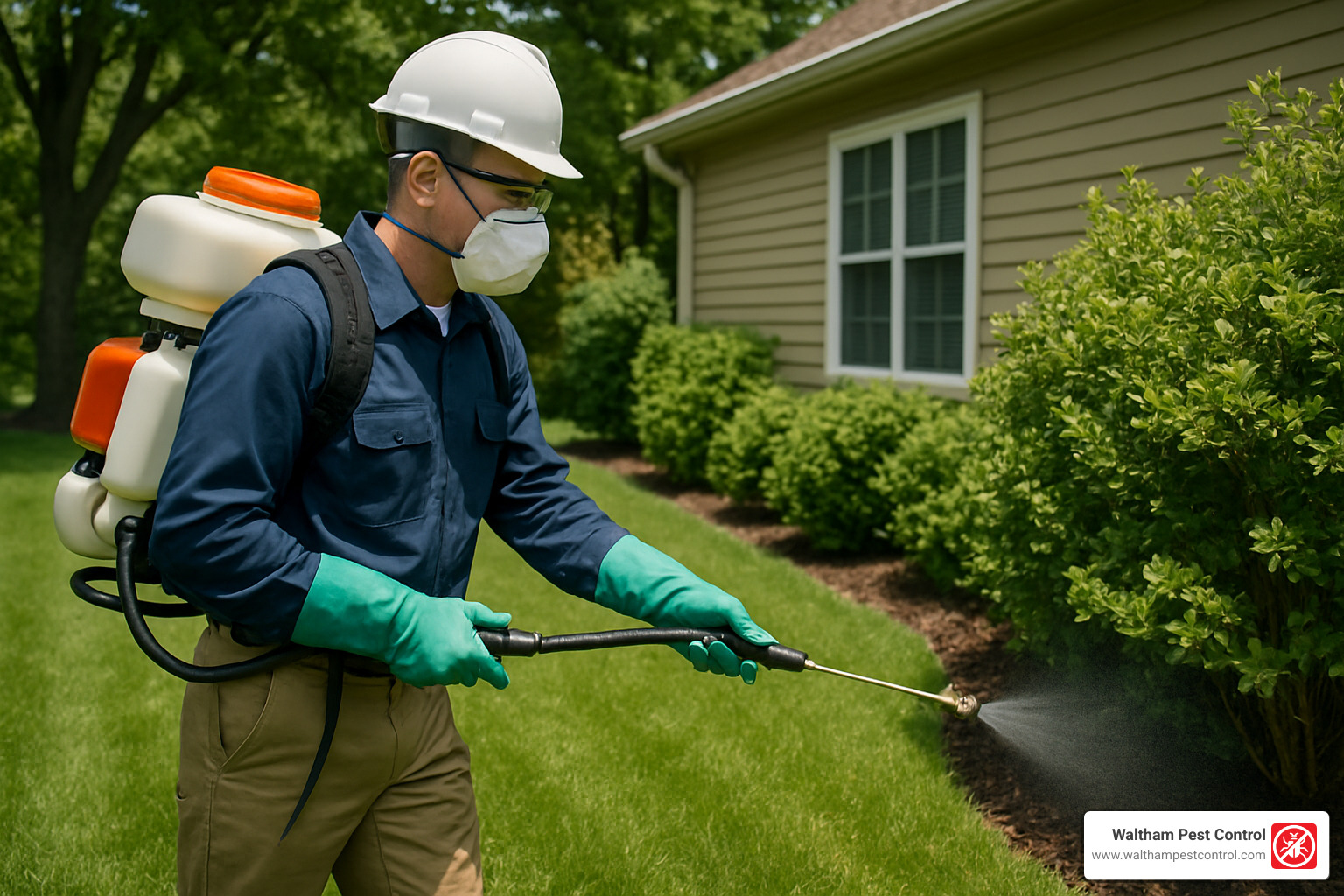
The key is matching the right treatment approach to your specific situation. A family with young children and pets might prioritize organic options, while a property adjacent to heavy woods might need more aggressive conventional treatments. We assess each property individually to recommend the most effective approach.
Conventional Barrier Sprays
Conventional barrier sprays remain the gold standard for tick control effectiveness. These treatments typically use synthetic pyrethroids – insecticides derived from chrysanthemum flowers but manufactured to be more stable and longer-lasting than natural pyrethrins.
The most common active ingredients we use include bifenthrin, permethrin, and lambda-cyhalothrin. These products provide both immediate knockdown of existing ticks and up to four weeks of residual control. They’re also rain-fast, meaning they won’t wash away with normal rainfall once they’ve dried.
Application technique is crucial for conventional sprays. We focus on creating barrier zones in transition areas – the edges between your maintained lawn and wilder spaces where ticks naturally concentrate. This includes areas around stone walls, wood piles, deck perimeters, and the edges of wooded areas.
The timing of conventional treatments is carefully planned around tick lifecycle and seasonal activity patterns. In Massachusetts, we typically recommend treatments beginning in April and continuing through October, with the heaviest focus during peak tick season from May through August.
Natural & Organic Professional Options
For families who prefer natural approaches, we offer several organic professional tick spray for yard options that can be surprisingly effective. These treatments use plant-based active ingredients like clove oil, cedar oil, and other essential oil combinations.
Cedar oil-based products work by disrupting ticks’ pheromone receptors and causing dehydration. While they don’t provide the same residual control as synthetic products, they can be highly effective when applied correctly and reapplied as needed.
Some natural products, like those containing sodium lauryl sulfate (a soap-based compound), work by breaking down the waxy coating on ticks’ exoskeletons. These products are particularly appealing to families with organic gardens or those concerned about chemical exposure.
The trade-off with natural options is typically in duration and consistency of control. While synthetic products might provide 4-6 weeks of protection, natural treatments often need reapplication every 2-3 weeks during peak season.
Integrated Solutions Beyond Sprays
The most comprehensive tick control programs combine spraying with other proven methods. Tick tubes are one of our most popular add-on services. These biodegradable tubes contain cotton treated with permethrin that mice and other small mammals take back to their nests. Since these animals are primary hosts for juvenile ticks, treating their nesting areas can significantly reduce tick populations.
Habitat modification is another crucial component. While we handle the chemical control, we also provide guidance on landscape changes that make your property less attractive to ticks. This might include creating gravel or mulch barriers between lawn and wooded areas, or recommendations for deer-resistant landscaping.
For properties with severe deer pressure, we sometimes recommend physical barriers like fencing or deer-resistant plant selections. While deer aren’t the only tick hosts, they’re certainly the most visible and can transport large numbers of ticks onto your property.
What to Expect From a Service Call—Timelines, Cost & Upkeep
Understanding what to expect from a professional tick spray for yard service helps you prepare properly and get the best results. Our process is thorough but efficient, designed to minimize disruption to your family’s routine while maximizing protection.
The initial service call typically takes 45-90 minutes depending on property size and complexity. This includes inspection time, application, and a brief consultation about ongoing maintenance and prevention strategies.
Based on internet research, average pricing for professional tick control ranges from $100-$400 per treatment for typical residential properties, with high-end services for large acreage potentially reaching $1,200 or more. These are general market estimates and not specific to our services – we provide customized quotes based on your property’s specific needs.
Step-By-Step Process of a Professional Yard Spray
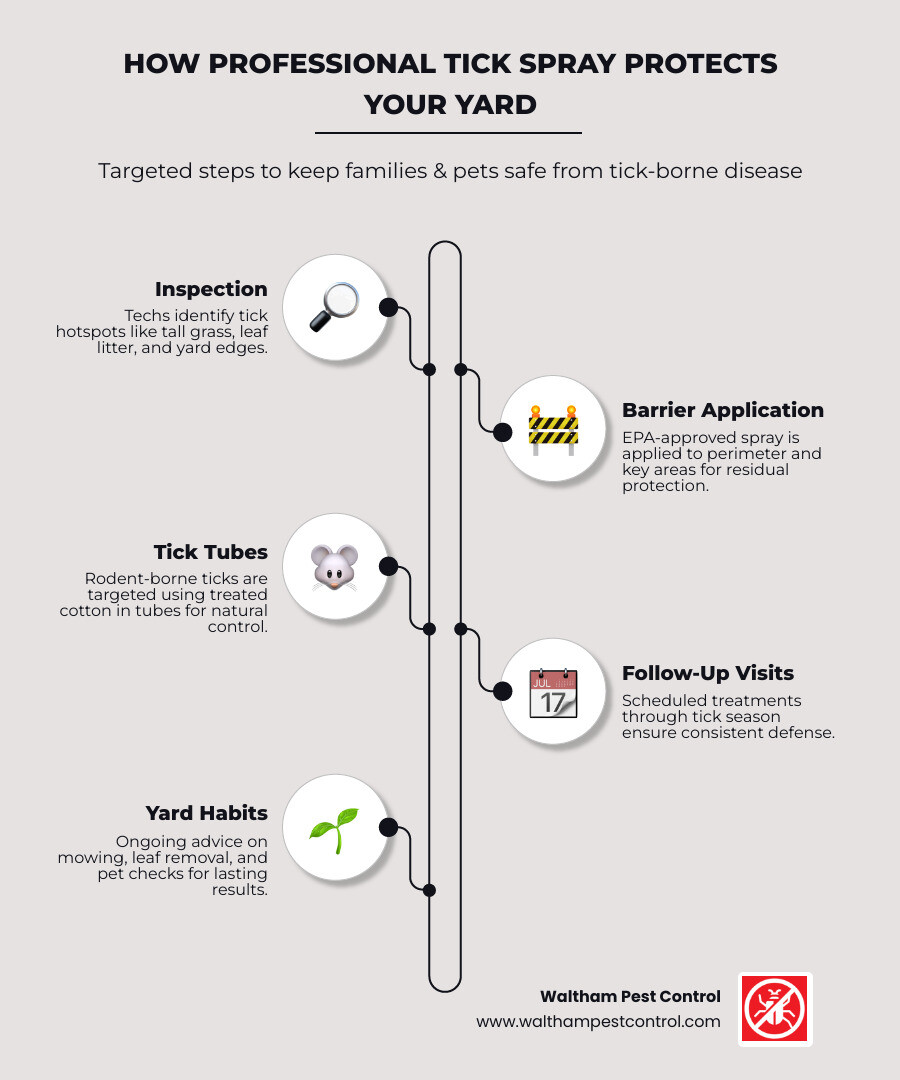
Every professional tick spray for yard service begins with a thorough property assessment. We walk your entire property, identifying tick habitat areas, noting moisture patterns, and discussing your family’s primary outdoor activity zones.
We create a treatment map that shows exactly where we’ll be applying products and why. This isn’t a blanket spray approach – we target specific areas where ticks are most likely to encounter your family and pets.
The actual application process is systematic and thorough. We use calibrated equipment to ensure consistent coverage, paying special attention to transition zones, vegetation edges, and areas around outdoor furniture or play equipment.
After application, there’s typically a 30-minute dry time before the area is safe for re-entry. We provide clear instructions about timing and any specific precautions for your situation. We also schedule follow-up treatments based on your property’s needs and seasonal tick activity patterns.
Budgeting & Frequency
Most effective tick control programs involve multiple treatments throughout the season. We typically recommend 3-4 treatments per year for most Massachusetts properties, timed to coincide with peak tick activity periods.
Many families find that package deals for seasonal service provide better value than individual treatments. These packages often include additional services like tick tubes or habitat modification advice.
When considering the cost, it’s important to think about the return on investment. The peace of mind that comes from knowing your family can enjoy your outdoor spaces safely is invaluable. Plus, the cost of treating tick-borne diseases – both human and veterinary – can far exceed the cost of prevention.
Beyond Chemicals: Yard Habits That Keep Ticks Out
While professional tick spray for yard treatments are highly effective, they work best when combined with good yard maintenance practices. Think of professional treatment as your primary defense, with these practices as important supporting strategies.
The goal isn’t to eliminate every tick from your property – that’s neither possible nor necessary. Instead, we want to create conditions that make it unlikely for ticks to encounter your family and pets during normal outdoor activities.

DIY Yard Practices That Boost Professional Results
Regular mowing is one of the most effective things you can do to reduce tick habitat. Research by the USDA Forest Service found that well-maintained lawns had significantly fewer ticks than overgrown areas. Bi-weekly mowing is typically sufficient for most properties, though areas near woods might benefit from weekly cutting.
Leaf litter removal is crucial, especially in fall. Ticks overwinter in leaf piles and other organic debris, so removing these materials eliminates important habitat. Don’t just rake leaves to the woods – bag them or compost them away from your main activity areas.
Creating physical barriers can be surprisingly effective. A three-foot strip of gravel or wood chips between your lawn and wooded areas creates an environment that ticks avoid. They prefer the high humidity found in vegetation, not the dry conditions of gravel paths.
Host control is another important factor. While we can’t eliminate all the animals that carry ticks, we can make our properties less attractive to them. This might mean removing bird feeders during peak tick season, securing garbage cans, or installing fencing to exclude deer.
Personal protection remains important even with professional treatment. When working in the yard or spending time in areas that might have ticks, wear light-colored clothing that makes ticks easier to spot, tuck pants into socks, and use EPA-approved repellents.
Regular tick checks should become routine for your family and pets. Check for ticks after any outdoor activity, paying special attention to areas where ticks commonly attach – hairlines, behind ears, armpits, and other warm, moist areas.
Frequently Asked Questions about Professional Tick Spray for Yard
How long does a professional tick spray for yard really last?
Professional tick treatments typically provide 3-4 weeks of effective control under normal conditions. However, several factors can affect this timeline. Heavy rainfall shortly after application can reduce effectiveness, while hot, dry conditions might actually extend the treatment’s life.
The key is understanding that “effectiveness” doesn’t mean 100% elimination for the entire period. What it means is significant reduction in tick populations and activity for the stated timeframe. Most professional treatments provide excellent control for 2-3 weeks, with gradually declining effectiveness through week 4.
This is why we recommend scheduling treatments every 3-4 weeks during peak tick season rather than waiting for effectiveness to completely wear off. Consistent, overlapping treatments provide much better protection than sporadic applications.
Are professional tick sprays safe for kids, pets, and pollinators?
Modern professional tick spray for yard products are designed with safety as a primary consideration. When applied correctly by licensed professionals, these products pose minimal risk to children, pets, and beneficial insects.
The key safety factor is the 30-minute re-entry period. Once the product has dried (typically 30 minutes under normal conditions), treated areas are safe for normal family activities. This includes children playing and pets running around.
For pollinators like bees and butterflies, we use targeted application techniques that focus on areas where ticks live rather than flowering plants where pollinators feed. We also time applications to minimize impact on beneficial insects – typically early morning or evening when bee activity is lowest.
Pet safety is excellent with professional applications. The concentrations used and application methods mean that pets would need to consume unrealistic amounts of treated vegetation to experience any adverse effects. Still, we recommend keeping pets inside during the 30-minute drying period as a precaution.
How do I prepare my property before the technician arrives?
Preparation for a professional tick spray for yard treatment is straightforward but important for getting the best results. The main goal is ensuring our technician can access all the areas that need treatment while keeping your family and pets safe during the process.
First, identify and communicate any areas of special concern – places where your children play regularly, pet run areas, or spots where you’ve noticed tick activity. This helps us focus our treatment for maximum effectiveness.
Clear any obstacles from treatment areas if possible. This might mean moving outdoor furniture, toys, or equipment that could interfere with thorough application. We can work around these items, but moving them allows for more complete coverage.
Plan to keep children and pets inside during treatment and for 30 minutes afterward. This isn’t because the process is dangerous, but because it ensures the product can dry properly and provides the best safety margin.
If you have a vegetable garden or areas with edible plants, point these out to your technician. While our products are safe for use around edibles, we may adjust our application technique or product selection in these areas.
Finally, if you have any specific concerns or questions about the treatment, this is the perfect time to discuss them. We want you to feel completely comfortable with the process and confident in the results.
Conclusion
Creating a truly tick-free zone around your home requires more than just hoping for the best or relying on store-bought sprays that provide inconsistent results. Professional tick spray for yard services offer the expertise, equipment, and proven formulations needed to protect your family from the serious health risks that ticks represent.
The investment in professional tick control pays dividends in peace of mind and health protection. When you consider that ticks can lay up to 3,000 eggs in a single clutch and are responsible for transmitting more disease-causing organisms than any other arthropod, the importance of effective control becomes clear.
At Waltham Pest Control, we’ve been protecting Eastern Massachusetts families for over 40 years. Our integrated approach combines the latest EPA-approved treatments with proven yard maintenance strategies to create comprehensive protection that lasts throughout tick season.
Whether you choose conventional barrier sprays for maximum effectiveness, natural options for environmental peace of mind, or integrated solutions that combine multiple control methods, professional treatment provides protection that DIY approaches simply can’t match.
The key to successful tick control is consistency and proper timing. Our seasonal planning approach ensures that treatments are applied when they’ll be most effective, creating overlapping protection throughout the months when ticks are most active.
Don’t let ticks keep your family from enjoying your outdoor spaces. With proper professional treatment and ongoing maintenance, you can reclaim your yard and enjoy the Massachusetts outdoors with confidence.
Ready to create your tick-free zone? More info about tick control services or contact us today to schedule your property assessment and learn how we can protect your family from tick-borne diseases.
