

Mouse traps near me: 4 Effective Options
The Telltale Signs of a Mouse Problem
Mouse traps near me can be found at most hardware stores, big-box retailers like Home Depot and Walmart, grocery stores, and drug stores throughout Massachusetts. For immediate needs, many locations offer same-day pickup or delivery options.
Quick Answer: Where to Buy Mouse Traps Locally
| Store Type | Examples | Availability |
|---|---|---|
| Hardware Stores | Ace Hardware, local shops | In-stock, same-day pickup |
| Big-Box Retailers | Home Depot, Lowe’s, Target | Wide selection, delivery options |
| Grocery Stores | Stop & Shop, Market Basket | Basic traps available |
| Drug Stores | Walgreens, CVS | Limited selection, convenient |
Before you rush out to buy traps, though, it’s important to understand what you’re dealing with. Mice rarely travel alone. If you’ve spotted one mouse, there’s a good chance you have several hiding in your walls, attic, or basement.
Common signs of a mouse problem include:
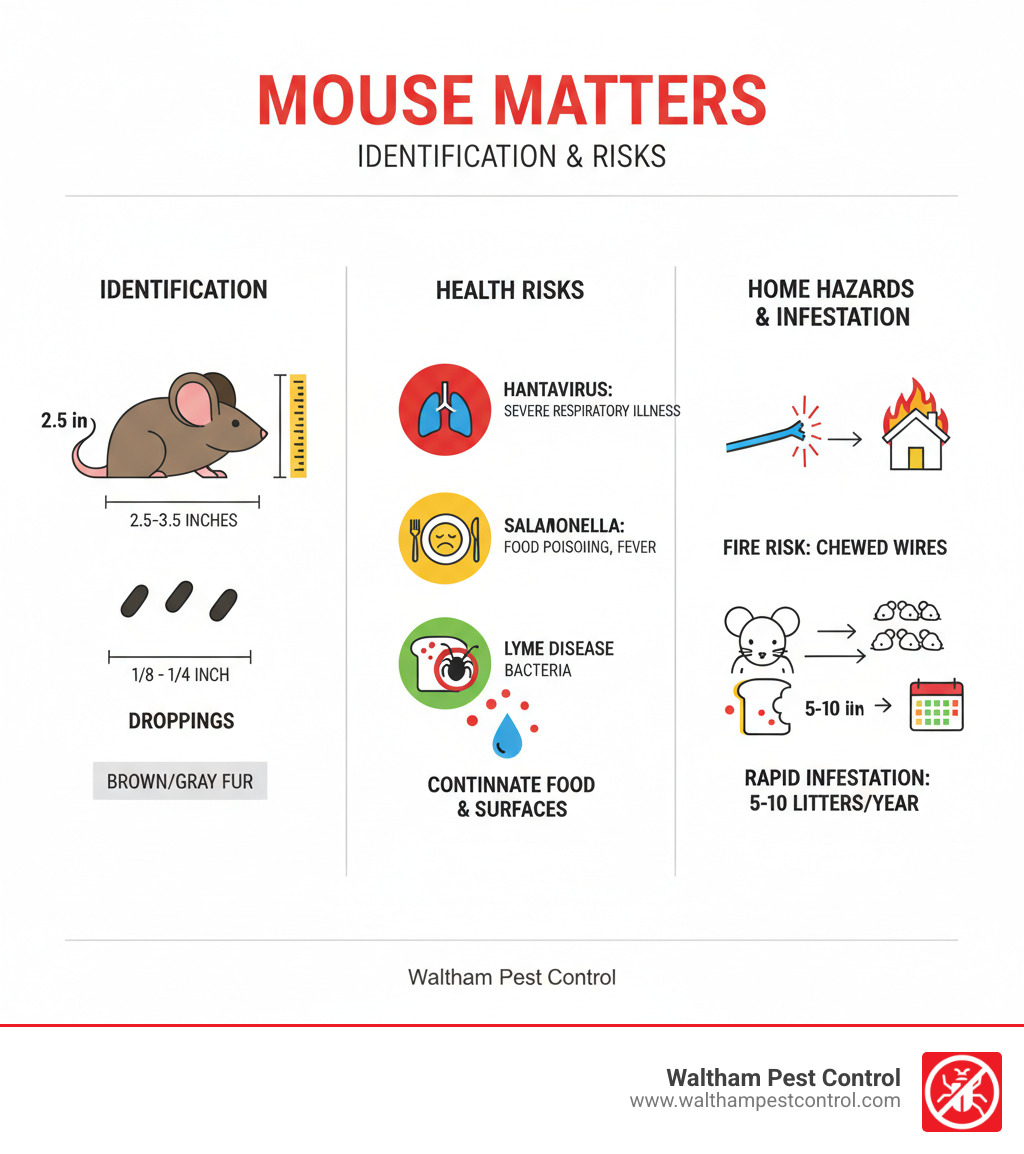
- Small, dark droppings (about 1/8 to 1/4 inch long with pointed ends)
- Gnaw marks on food packaging, wires, or building materials
- Scratching or scurrying sounds inside walls, especially at night
- Shredded paper, fabric, or insulation used for nesting
- A persistent musky odor in enclosed spaces
- Your pets pawing at walls or staring at one spot for extended periods
The global mouse trap market was valued at $3.1 billion in 2022 and is projected to reach $4.8 billion by 2030. That’s a lot of traps—and a lot of mice causing problems in homes and businesses.
But here’s the reality: mice are more than just a nuisance. They gnaw through electrical wiring (causing fires and appliance failures), contaminate food products, and carry diseases like Hantavirus and Salmonella. Their droppings and urine can trigger allergies and asthma, particularly in children.
I’m Waltham Pest Control, President & CEO of Waltham Pest Control, and over the past 40 years, I’ve helped thousands of Massachusetts homeowners and businesses deal with mouse infestations—including finding the right mouse traps near me solutions that actually work. While traps can be effective for small problems, understanding which type to use and how to use it properly makes all the difference between catching one mouse and solving your mouse problem for good.
Common mouse traps near me vocab:
- how does an exterminator get rid of mice
- best way to exterminate mice
- how to exterminate mice in walls
A Guide to the 4 Main Types of Mouse Traps
Walk into any hardware store and you’ll face an entire aisle of mouse traps near me options. It can be overwhelming. After four decades in pest control, I’ve seen homeowners try every type imaginable—some with great success, others with frustrating results.
The truth is, there’s no single “best” trap for everyone. Your choice depends on your comfort level with different kill methods, whether you have curious pets or children in the house, and how quickly you need results. Let me walk you through the four main types you’ll encounter, along with the real-world pros and cons of each.
Snap Traps: The Classic Solution
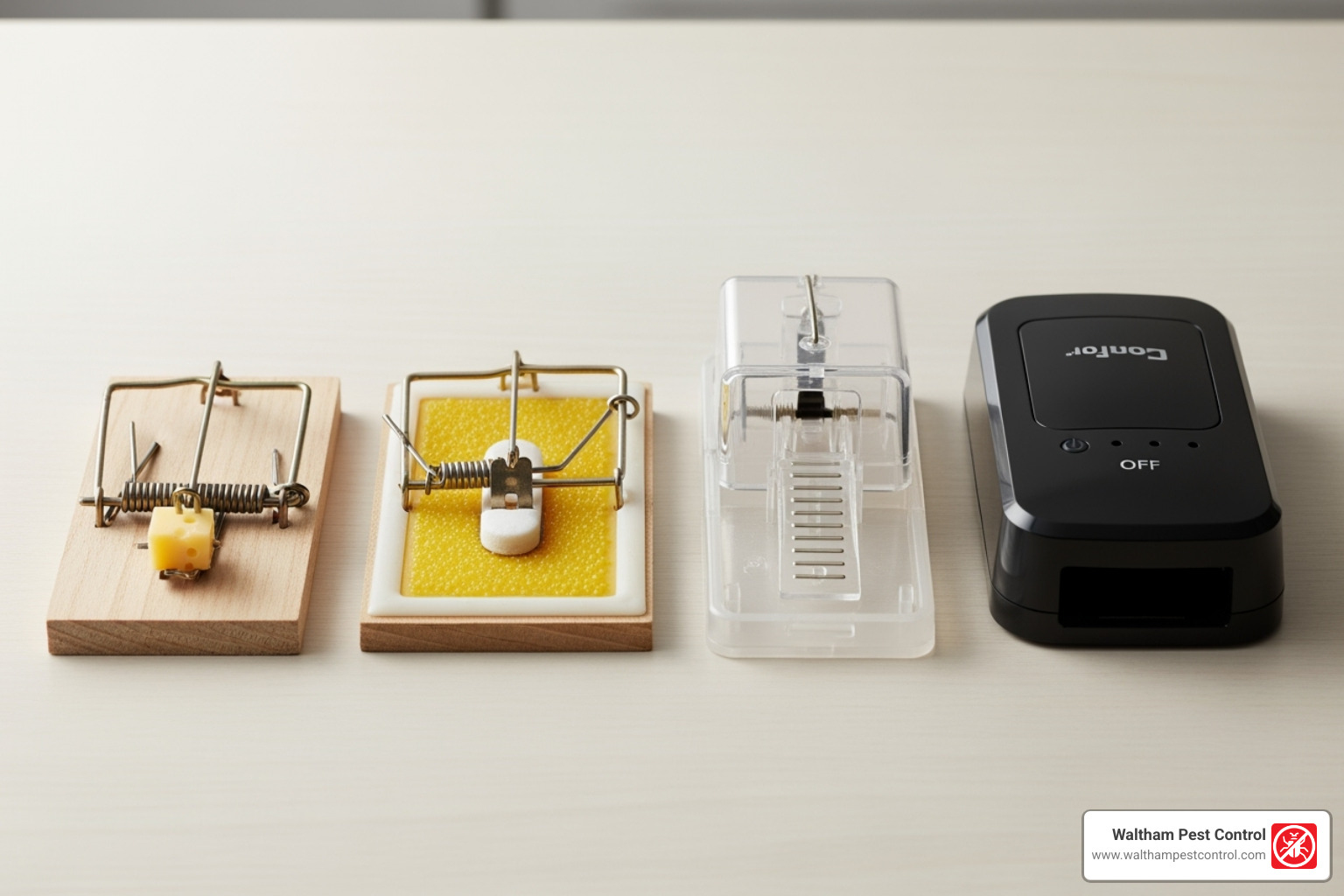
You’ve probably seen these in old cartoons—the classic wooden trap with a spring-loaded metal bar. They’ve been around for over a century because they work. When a mouse goes for the bait, snap—the bar comes down fast.
The biggest advantage? Speed and effectiveness. A properly set snap trap delivers a quick kill, which is far more humane than methods that leave a mouse suffering. They’re also incredibly affordable—often just a few dollars each—and you can reuse them multiple times. You’ll find these mouse traps near me at virtually every hardware store, grocery store, and online retailer.
But let’s be honest about the downsides. Setting these traps requires careful attention because that spring mechanism has enough force to snap your fingers if you’re not careful. And yes, you’ll need to deal with disposing of the dead mouse afterward, which isn’t pleasant for everyone.
Occasionally, the trap doesn’t kill instantly. While this is relatively rare with modern designs, it’s worth knowing that snap traps aren’t 100% foolproof when it comes to a clean, immediate kill.
Electronic Traps: A Modern, Contained Kill
If you want something more high-tech, electronic traps might be your answer. These battery-powered devices deliver a high-voltage shock that kills mice almost instantly—we’re talking just seconds. Many people consider this the most humane kill method available.
The design is brilliant for those who don’t want to see or touch dead mice. The mouse enters a chamber to reach the bait, the trap senses its presence, delivers the shock, and the mouse stays contained inside. You simply empty the chamber into the trash without ever seeing the rodent. It’s sanitary and straightforward.
These traps are reusable—some models can handle up to 100 mice on a single set of batteries. The trade-off? They’re more expensive than traditional snap traps, sometimes costing $20 to $50 or more. They also require periodic battery replacement and work best indoors where the electronic components stay dry and protected.
Live-Catch Traps: A Humane Alternative
For those who can’t stomach the idea of killing anything, live-catch traps offer a no-harm method for dealing with mice. These small cages or boxes have a one-way entry—the mouse walks in for the bait but can’t figure out how to leave.
The appeal is obvious: you’re catching and releasing the mouse alive and unharmed. The traps are reusable, and you never have to directly touch the mouse. For many people, this feels like the most ethical approach.
Here’s where it gets complicated. Live traps require frequent checking—ideally several times a day—to prevent the mouse from suffering stress, dehydration, or starvation while trapped. Once you’ve caught a mouse, you face the challenge of proper relocation. You’ll need to drive at least a mile or two away from your home to release it, or it’ll likely find its way back.
Being confined in a small space is stressful for mice, even temporarily. And releasing a mouse into unfamiliar territory comes with its own concerns about the animal’s survival. Live-catch traps are humane in intent, but they require more time and effort than any other option.
Glue Traps: A Controversial Choice
I need to be direct here: glue traps are widely considered inhumane by pest control professionals, including our team at Waltham Pest Control. These traps consist of a board coated with strong adhesive—mice step onto the surface and become stuck.
Yes, they’re affordable and non-toxic. They don’t have snapping mechanisms that could hurt children or pets. But here’s the problem: mice caught on glue traps suffer tremendously. They struggle desperately to free themselves, sometimes tearing off their own fur or skin. Some even chew off their own limbs trying to escape. Death comes slowly from exhaustion, dehydration, or stress—sometimes taking hours or even days.
Glue traps also pose a risk of catching non-target animals like small birds or even family pets. Dealing with a live, panicked, injured mouse stuck to a board is distressing for everyone involved, and disposal becomes a difficult ethical dilemma.
Despite their availability at most stores, we strongly advise against using glue traps. The level of suffering they cause simply isn’t worth it when more humane options exist. Effective pest control doesn’t have to mean unnecessary cruelty.
Where to Find Mouse Traps Near Me and What to Look For
The good news? Finding mouse traps near me is remarkably easy. Walk into virtually any hardware store in Massachusetts—whether it’s a local shop or a larger chain—and you’ll find an entire section dedicated to rodent control. Big-box retailers like Home Depot and Lowe’s carry extensive selections, with many offering same-day pickup or delivery options. Even your local grocery store or pharmacy likely stocks basic snap traps and glue boards in their household goods aisle.
For online shoppers, retailers like Home Depot provide detailed product listings where you can compare dozens of options from various brands. You can read reviews, check specifications, and often reserve items for pickup within hours.
But here’s the thing: having options doesn’t mean having the right solution. I’ve seen homeowners buy the wrong type of trap for their situation countless times. They grab whatever’s cheapest or most familiar, set it up, and then wonder why they’re still hearing scratching sounds in their walls a week later.
Choosing the right trap requires thinking through your specific circumstances. Let me walk you through what actually matters.
Key Factors for Choosing the Right Trap
Where you’ll place the trap makes a significant difference. Indoor traps can be more delicate, while outdoor placements need weather-resistant construction. Electronic traps work beautifully in dry basements or kitchens, but they’re not designed to sit outside in the rain. Snap traps and live-catch models, on the other hand, can handle both environments depending on their construction.
If you have pets or young children, safety becomes your top priority. I can’t tell you how many times I’ve heard stories of dogs getting their noses snapped or cats getting paws stuck on glue traps. It’s heartbreaking and entirely preventable. Enclosed bait stations offer one layer of protection, though these typically hold poison rather than traps. Electronic traps with covered entry points are safer than exposed snap traps. Live-catch traps generally pose less risk, but they still need to be placed where curious hands and paws can’t accidentally open them.
The size of your problem matters more than most people realize. Spotted one mouse last week? A couple of well-placed snap traps might handle it. But if you’re seeing droppings in multiple rooms, hearing sounds every night, or finding gnawed food packages regularly, you’re dealing with more than a solitary visitor. Small infestations need multiple traps placed strategically. Large infestations often require professional intervention, because traps alone may not be enough to get ahead of their breeding cycle.
Your personal comfort level with killing mice is worth considering honestly. Some people have no problem with quick-kill methods. Others feel strongly about catch-and-release approaches. Neither perspective is wrong—it’s about what you can live with. Just understand the commitment each choice requires. Live-catch means checking traps multiple times daily and driving caught mice at least a mile or two away for release. Kill traps mean dealing with disposal, though electronic models make this considerably less unpleasant.
Are there humane mouse traps near me?
What makes a mouse trap “humane” is a question I get asked frequently, and it’s one worth thinking through carefully.
Live-catch traps are the most obviously humane option since they don’t harm the mouse at all. You capture it alive and release it far from your home. But here’s what many people don’t consider: a mouse left in a live trap for eight hours while you’re at work is experiencing significant stress. It’s confined, frightened, and possibly dehydrated. If you choose this route, you need to commit to checking traps every few hours—morning, lunch, and evening at minimum. You also need to release the mouse in appropriate habitat far enough away that it won’t simply return to your warm house.
Electronic traps offer what many consider a humane kill method. The high-voltage shock is instantaneous—the mouse is gone in milliseconds, with no suffering. The contained design means you never have to see the deceased animal if you don’t want to. For people who want effective control without causing unnecessary pain, these traps represent a good middle ground.
Glue traps, on the other hand, are something we strongly discourage. Yes, you’ll find them on the shelves when searching for mouse traps near me, but that doesn’t mean they’re a good choice. Mice stuck on glue boards can struggle for hours or even days, sometimes injuring themselves severely in panic. They may die from exhaustion, dehydration, or stress. It’s a prolonged, frightening death that we don’t believe is necessary when more humane options exist.
At Waltham Pest Control, we’ve built our reputation on doing things the right way—effectively, but also responsibly. Our green pest control services focus on integrated pest management that prioritizes prevention and exclusion first. We seal entry points, eliminate attractants, and use targeted treatments only where necessary. This approach often means fewer traps overall and a more permanent solution to your mouse problem.
Sometimes the most humane approach isn’t about the trap itself—it’s about preventing mice from entering your home in the first place.
How to Use Mouse Traps for Maximum Effectiveness
Finding the right mouse traps near me is only half the battle. To truly tackle a mouse problem, you need to know how to set them up correctly, what bait to use, and how to safely dispose of your catches. Proper technique dramatically increases your success rate—and in my four decades of pest control experience, I’ve seen countless homeowners struggle simply because they didn’t understand mouse behavior.
Here’s the thing: mice aren’t wandering around your home randomly. They’re following specific pathways, and if you understand those patterns, you’ll catch them much more effectively.

How to effectively set up mouse traps near me
Mice are creatures of habit and prefer to travel along walls and in secluded areas. They’re cautious animals with poor eyesight, so they rely on their whiskers to steer by keeping one side of their body against a vertical surface. This means placement is absolutely critical to your success with any type of trap.
The biggest mistake I see homeowners make is placing traps in the middle of a room or randomly throughout the house. Instead, position your traps perpendicular to the wall, with the trigger mechanism facing the baseboard. This ensures that a mouse running along the wall will step directly onto the trigger as it investigates.
Look for droppings to find high-traffic areas. Those small, dark pellets are like a map showing you exactly where mice are traveling most frequently. Check behind appliances, under sinks, in cabinets, along basement walls, and in attic corners. Concentrate your trapping efforts in these zones rather than spreading traps randomly throughout your home.
Don’t be stingy with your traps, either. Even if you’ve only spotted one mouse, you likely have several. Place traps every 2-3 feet in areas where you’ve seen activity. Think of it like casting a wider net—the more traps you have in strategic locations, the higher your chances of success.
Here’s a pro tip that many people overlook: wear gloves when handling and setting traps. Mice have an excellent sense of smell and can detect human scent on traps, making them wary. By wearing disposable gloves, you avoid transferring your scent and make the traps more appealing to curious rodents.
Beyond Cheese: The Best Baits for Mice
Let’s bust a myth right now: mice don’t actually prefer cheese. That’s a cartoon stereotype that’s led to many disappointed homeowners wondering why their traps aren’t working.
In reality, mice prefer foods that are high in protein or fat. Peanut butter is hands-down the most effective bait I’ve seen in my career. Its sticky texture makes it nearly impossible for mice to lick off without triggering the trap, and they absolutely love it. Just use a small smear—about the size of a pea—firmly pressed onto the trigger mechanism.
Hazelnut spread works equally well, and chocolate is another excellent choice. The key is using something with a strong smell that will attract mice from a distance, combined with a texture that requires them to work at it rather than grabbing and running.
Here’s something most people don’t know: nesting materials can be even more effective than food. Mice are constantly searching for soft materials to build their nests, especially during colder months. A small piece of cotton ball, string, or even dental floss tied to the trigger can be incredibly enticing. When they tug at it to carry it away, they trigger the trap.
The trick is to avoid using large chunks of food that mice can easily steal without setting off the trap. Keep bait amounts small and secure them well to the trigger.
Safe Disposal and Cleanup
This is the part nobody likes to talk about, but it’s crucial for protecting your health. Mice carry diseases like Hantavirus and Salmonella, and their droppings and urine can remain infectious even after the mouse is gone.
Always wear disposable gloves when handling traps, dead mice, or cleaning up any evidence of rodent activity. This simple step protects you from potential pathogens that can cause serious illness.
For kill traps, don’t just toss the mouse in your kitchen trash. Place the entire trap with the mouse into a plastic bag, seal it tightly, and then place it into a second bag. This double-bagging prevents odors and potential contamination. Take it directly to an outdoor trash bin.
After removing a trap and mouse, the work isn’t done. Thoroughly clean and disinfect the area where the trap was placed using a disinfectant spray or a solution of one part bleach to ten parts water. This kills any lingering germs and eliminates mouse scent that could attract other rodents to the same spot.
For live-catch traps, disinfect the trap itself after releasing the mouse, and wash your hands thoroughly even if you wore gloves. The mouse has been urinating and defecating inside that trap.
If you’re dealing with extensive contamination—lots of droppings, urine stains, or nesting materials—it might be time to call in professionals. We have the proper equipment and training to safely clean and sanitize areas that have been heavily impacted by rodent activity.
When Traps Aren’t Enough: Securing Your Home from Mice
Here’s the honest truth about mouse traps near me: while they’re excellent tools for controlling a small mouse problem, they’re often just that—control, not complete elimination. If you’re still finding fresh droppings every morning, hearing scratching sounds in your walls at night, or catching mice week after week despite setting multiple traps, you’re likely dealing with a larger infestation that requires a more comprehensive solution.
I’ve seen this scenario play out hundreds of times across Eastern Massachusetts. A homeowner spots one mouse, sets a few traps, catches it, and breathes a sigh of relief. Two weeks later, there are three more. A month later, they’ve caught a dozen mice and the problem seems worse than when they started. Why? Because traps only address the mice you can catch—they don’t stop new ones from entering, and they don’t account for the rapid reproduction happening behind your walls.
A single female mouse can produce 5-10 litters per year, with 5-6 babies in each litter. Do the math, and you’ll see how quickly a “one mouse” problem becomes a serious infestation. What you’re catching in traps is often just the tip of the iceberg.
Signs that your mouse problem has outgrown a DIY solution include persistent activity despite regular trapping—if you’re emptying traps every few days but still seeing new evidence of mice, your trap strategy can’t keep pace with the population. Significant property damage like extensive gnaw marks on structural wood, chewed electrical wires, or shredded insulation in large quantities indicates a well-established colony. And if you’re seeing multiple mice during daylight hours, that’s a red flag. Mice are naturally nocturnal and avoid humans; daytime sightings usually mean overcrowding is forcing them out of hiding.
This is where professional intervention makes all the difference. At Waltham Pest Control, we don’t just set more traps—we solve the underlying problem. Our comprehensive approach starts with a thorough inspection of your property to identify every potential entry point. Mice can squeeze through openings the size of a dime, and most homes have dozens of these vulnerabilities around utility penetrations, foundation cracks, garage door gaps, and roof vents.
We’ll assess the full extent of your infestation, locating nesting sites and tracking patterns you might not notice. Then we develop a customized treatment plan that combines strategic baiting (in tamper-resistant stations that keep children and pets safe), professional-grade trapping, and—most importantly—exclusion work to seal entry points and prevent future invasions. We also provide expert guidance on eliminating food sources and conditions that attract rodents in the first place.
Our goal isn’t just to catch the mice you have today. It’s to create a lasting solution that keeps them out tomorrow, next month, and next year. With over 40 years of experience serving communities throughout Eastern Massachusetts—including Acton, Bedford, Burlington, Cambridge, Concord, Lexington, Newton, Waltham, Winchester, and dozens more—we’ve seen every type of mouse problem imaginable, and we know how to solve them.
Don’t let a manageable mouse problem turn into a costly infestation. If you’re struggling despite your best efforts with traps, or if you want to prevent mice from becoming a problem in the first place, we’re here to help. Contact us for a professional mouse exterminator in Bedford, MA, and surrounding areas today for a consultation. Let us give you back the peace of mind that comes with a truly mouse-free home.