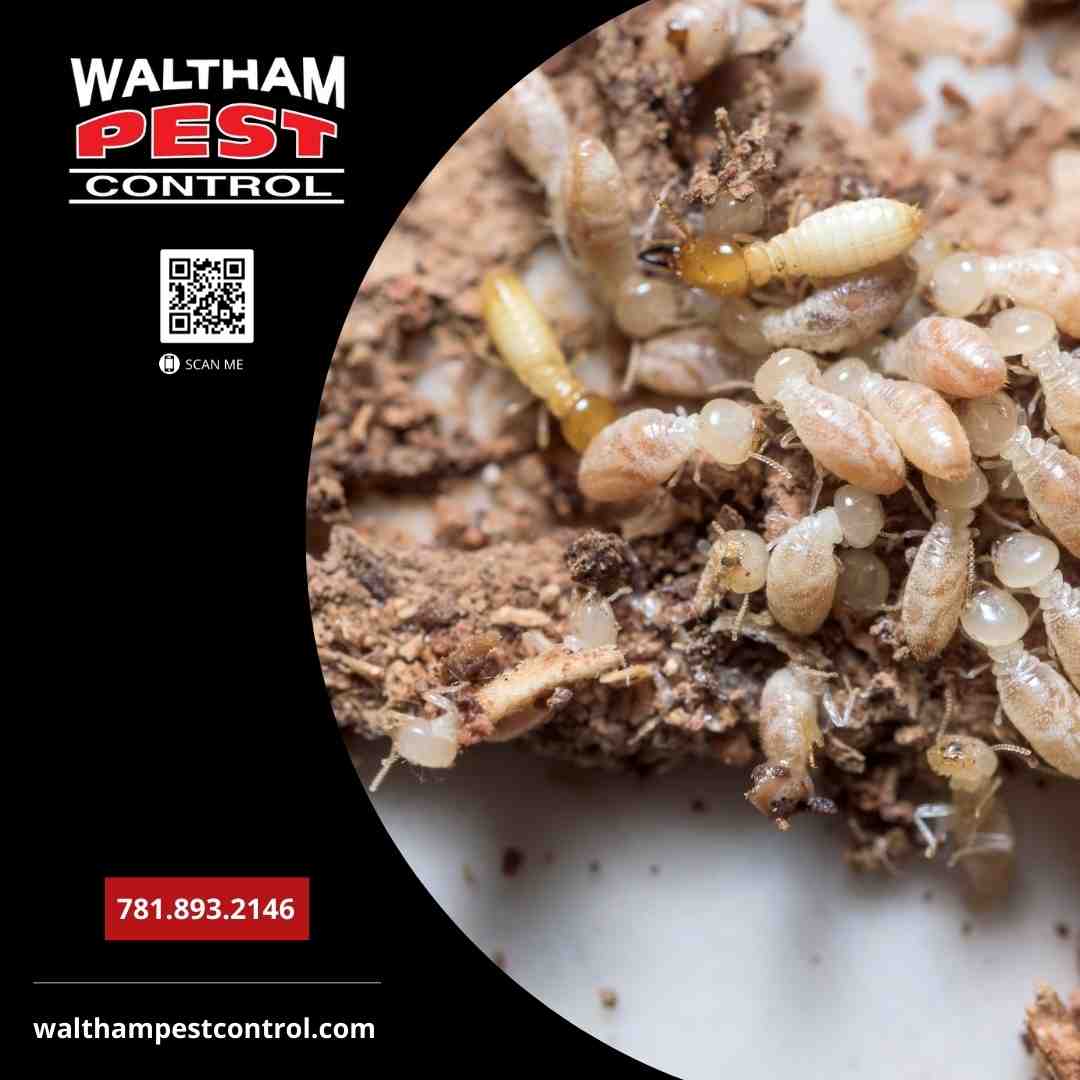

Termite Treatment Companies: Best Guide 2025
Why Professional Termite Treatment Companies Matter
Termite treatment companies provide professional services to eliminate termite infestations and protect your property from structural damage. Here’s what you need to know when choosing a provider:
Key Services Offered:
- Complete inspections – Licensed technicians assess the extent of infestation
- Liquid termiticide treatments – Long-lasting barrier protection around your property
- Ongoing monitoring – Regular check-ups to prevent future infestations
- Eco-friendly options – Safe treatments for homes with children and pets
What to Look For:
- Licensed and insured professionals
- Experience with local termite species (subterranean and drywood)
- Integrated pest management (IPM) approach
- Clear treatment plans and pricing
Termites cause billions of dollars in property damage across the United States every year. Most homeowner insurance policies don’t cover termite damage, making prevention and early treatment critical.
These silent destroyers work 24/7, eating away at the wood structure of your home. By the time you notice visible signs like mud tunnels or discarded wings, the colony may have already caused significant damage.
The good news? Professional termite treatment companies can eliminate active infestations and create protective barriers that last for years.
I’m Waltham Pest Control, President & CEO of Waltham Pest Control, and with over 40 years of experience helping Eastern Massachusetts property owners protect their investments, I’ve seen how the right termite treatment companies can save homeowners thousands in repair costs. In this guide, I’ll walk you through everything you need to know to choose the best termite treatment provider for your needs.
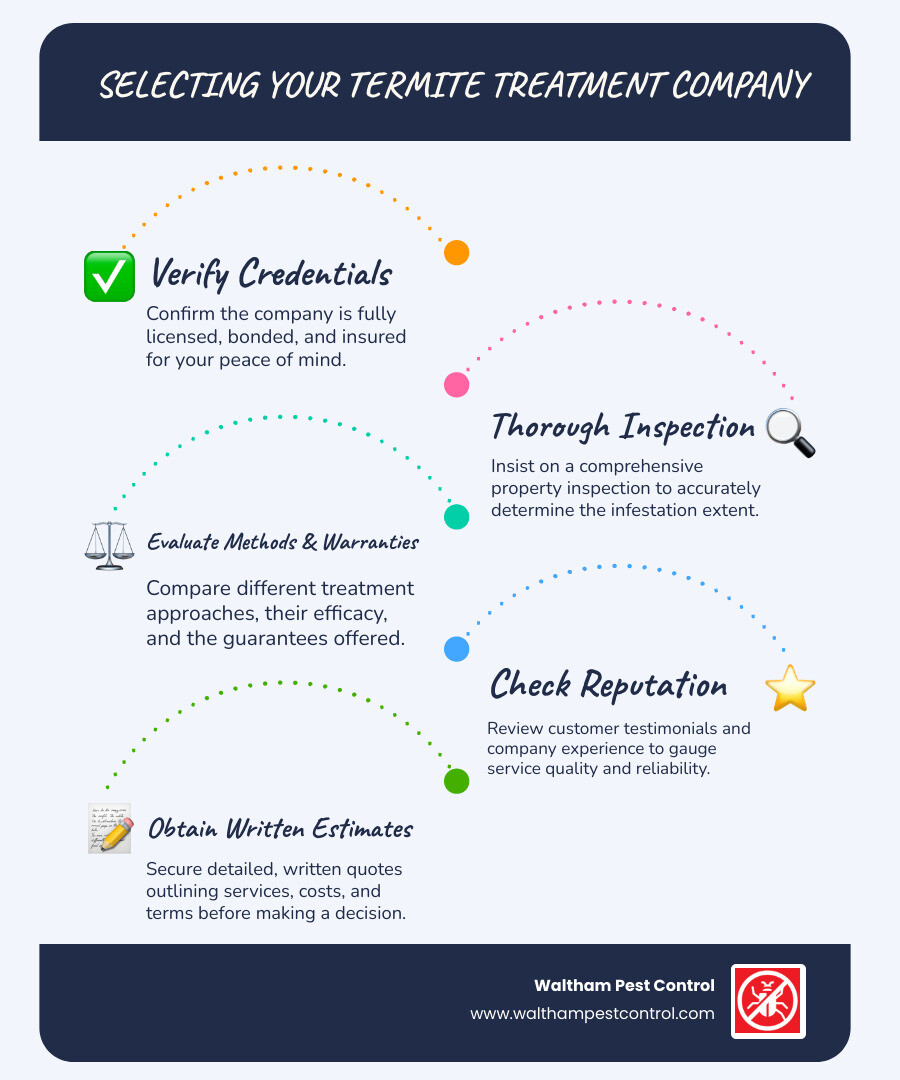
Basic termite treatment companies glossary:
Top Termite Treatment Company
Finding the best termite company isn’t just about picking a name from a Google search. You’re looking for a partner who’ll stand by you through the entire process – from that first nervous phone call to the final inspection years down the road. The right termite treatment companies don’t just show up, spray some chemicals, and disappear. They get to know your property, understand what you’re dealing with, and create a plan that actually works.
What makes a termite control company truly excellent? It starts with local expertise. A company that knows the termite species in your area – whether you’re battling subterranean termites tunneling up from the ground or drywood termites hiding in your attic beams. They understand how these pests behave in your climate, where they’re likely to strike, and what treatments will actually protect your home for years to come.
The best termite exterminators are also honest. They’ll tell you what you need to hear, not what you want to hear. If your home has an active infestation, they’ll explain the extent of the problem clearly. If you just need preventive treatment, they won’t try to upsell you on unnecessary services.
Waltham Pest Control
Here’s where I’m a bit biased – but I think we’ve earned that right. At Waltham Pest Control, we’ve spent over 40 years building our reputation one satisfied customer at a time. Based in Burlington, MA, we’ve become a trusted name across Eastern Massachusetts because we focus on two things: quality and commitment.
Our approach really is straightforward. We provide licensed, insured, and cost-effective solutions that actually solve your termite problems. No gimmicks, no pressure tactics, just honest pest management that works.
What sets our experienced technicians apart? They’re not just following a script or going through the motions. These are professionals who understand termite behavior inside and out. They can spot warning signs most people miss, explain what’s happening in plain English, and develop customized treatment plans based on your specific situation.
We’re also committed to using eco-friendly products whenever possible. Look, we understand – your home is where your kids play, where your pets sleep, where you spend your life. We take that responsibility seriously. Our treatments are designed to be tough on termites but safe for the people and animals you care about.
Whether you’re dealing with an active infestation or want to protect your home before termites become a problem, we’re here to help. That’s not just a tagline – it’s a promise we’ve kept for four decades.
Most Effective Termite Treatments
When you’re dealing with termites, you want to know what actually works. The truth is, termite treatment companies have several powerful tools in their arsenal, and the best approach often depends on your specific situation. We’re talking about everything from proven liquid termiticides to innovative eco-friendly products that protect your home while keeping your family safe.
The key is customization. Every home is different, every infestation is unique, and cookie-cutter solutions just don’t cut it. That’s why professional termite control combines different methods into customized plans that address your property’s specific needs – whether that’s the type of termites you’re facing, the construction of your home, or your personal preferences about treatment methods.
Liquid Termiticides
If you want to know what professional pest control companies rely on most, it’s liquid termiticides. These treatments have been protecting homes for decades, and for good reason – they work.
Here’s how it happens: we apply a liquid treatment to the soil around your home’s foundation, creating an invisible protective barrier. When termites pass through this treated zone (which they will, because they don’t know it’s there), they pick up the termiticide on their bodies. They then carry it back to their colony, where it spreads to other termites through their natural social behaviors. It’s like a chain reaction that takes down the entire colony.
One of the most trusted products in the industry contains the active ingredient fipronil. What makes fipronil so effective is that it’s non-repellent – termites can’t detect it, so they don’t avoid it. They walk right through it, unknowingly sealing their colony’s fate. The beauty of this approach is the long-term protection it provides. We’re not just killing the termites you have now; we’re creating a barrier that can protect your home for years to come.
Eco-Friendly Options
I get it – you want to protect your home, but you also want to protect your kids, your pets, and the environment. That’s not too much to ask, and thankfully, modern pest control has some great solutions.
Eco-friendly products have come a long way. These reduced-risk products use innovative approaches that minimize environmental impact while still delivering real results. Some treatments incorporate essential oils and botanical extracts that termites find lethal but pose minimal risk to mammals. Others use targeted baiting systems that use tiny amounts of active ingredients right where they’re needed.
The real advantage? Safety for kids and pets. You don’t have to worry about your children playing in the yard or your dog digging in the garden after treatment. These methods are designed to target termites specifically while leaving your family and furry friends unharmed.
At Waltham Pest Control, we believe you shouldn’t have to choose between effective termite protection and environmental responsibility. That’s why we offer both traditional and eco-friendly options, and we’ll work with you to find the approach that fits your values and your situation. After all, protecting your home should never mean compromising on what matters most to you.
Signs of a Termite Infestation
Nobody wants to think about termites munching away at their home, but catching them early can be the difference between a minor fix and a major financial headache. The tricky part? These little destroyers are sneaky. They do most of their damage completely out of sight, hidden behind walls or beneath floors. That’s exactly why knowing what to look for – and scheduling regular termite damage inspections – is so important for prevention.
Think of yourself as a detective looking for clues. Termites leave evidence of their presence, and once you know what to watch for, you’ll be much better equipped to protect your home. If anything seems suspicious, don’t hesitate to reach out to experienced termite treatment companies for a professional assessment. We’ve seen it all, and we can help you figure out what’s really going on.
Common Indicators
Termites aren’t great at covering their tracks. They leave behind several telltale signs that something’s amiss. During your regular home maintenance checks, keep your eyes open for these common indicators:
Discarded wings are often the first clue homeowners notice. After reproductive termites swarm to find mates and start new colonies, they shed their wings – they literally don’t need them anymore. You might spot small piles of these translucent, almost paper-thin wings near windowsills, doorways, or around light fixtures. Finding these is like finding footprints at a crime scene – it means a termite swarm happened nearby, and there’s likely an active colony in the area.
Hollowed-out wood is exactly what it sounds like, and it’s unsettling. Termites are clever eaters – they consume wood from the inside out, leaving just a thin outer shell of wood or paint that looks perfectly normal. Try tapping on wooden structures around your home. If they sound hollow or feel soft, that’s a red flag. You might also notice wood that’s buckling, floors that seem swollen, ceilings that sag, or even maze-like patterns visible in furniture or walls when you look closely.
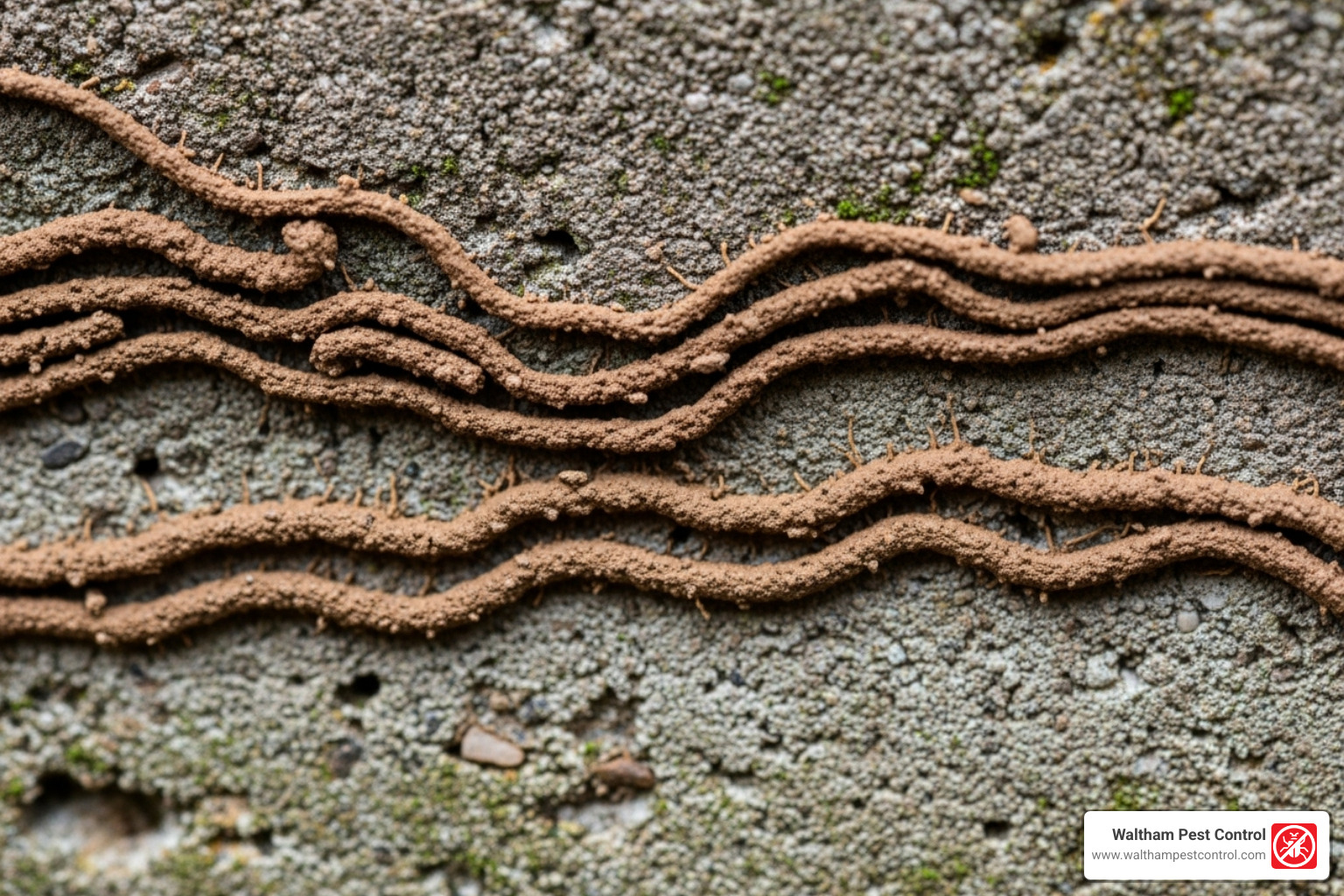
Mud tunnels (sometimes called mud tubes) are the signature calling card of subterranean termites. These fascinating but frustrating structures are about as wide as a pencil and made from a mixture of soil, wood particles, and termite saliva. They’re essentially protected highways that let termites travel safely between their underground colony and their food source – your home. Check your foundation walls, crawl spaces, and wooden beams regularly for these pencil-width tubes running up from the ground.
If you’re dealing with drywood termites, watch for frass – those tiny, wood-colored fecal pellets that drywood termites push out of their tunnels as they eat. These often collect in small piles that look like sawdust or coffee grounds, usually found below infested wood.
Types of Termites
Not all termites are created equal, and understanding the types that cause structural damage in our area helps us tackle them more effectively. Here in Eastern Massachusetts, we primarily deal with two troublemakers:
Subterranean termites are the heavyweight champions of destruction. These are the most damaging termite species in North America, responsible for the vast majority of termite-related damage. They live in underground colonies that can house millions of individuals, and they build those distinctive mud tubes to reach food sources above ground. These termites need moisture to survive, which is why they’re constantly foraging for cellulose – the main component in wood. Your home’s wooden structures are like an all-you-can-eat buffet to them.
Drywood termites take a different approach. Unlike their underground cousins, drywood termites set up shop entirely within the wood they’re eating. They don’t need soil contact or even much moisture – they can survive in dry, sound wood like structural timbers, furniture, and hardwood floors. Their colonies are smaller than subterranean colonies, but don’t let that fool you. Given enough time, they can still cause serious damage. The frass they leave behind is often your first clue that they’ve moved in.
Early detection really is your best friend when it comes to termite damage. The sooner you spot the signs, the less damage these pests can do, and the more affordable treatment becomes. If you notice any of these warning signs around your home, reach out to us right away. A thorough inspection by experienced termite treatment companies like Waltham Pest Control can give you clarity and peace of mind – and help you protect your biggest investment.
Cost of Termite Treatment
Let’s talk about what you can expect to invest in termite treatment – and yes, it really is an investment in your home’s financial security. While I can’t share specific pricing for Waltham Pest Control (every home is unique, after all), I can give you a realistic picture of average costs based on internet data and what influences those numbers.
Here’s the thing: termite treatment costs vary wildly depending on factors like your home’s size, the severity of the infestation, the type of termites you’re dealing with, and the treatment method used. A small localized problem will cost significantly less than treating an entire home with an extensive colony. And remember, most homeowner insurance policies won’t cover termite damage, so prevention and early treatment with professional termite treatment companies can save you thousands down the road.
One-Time Visit
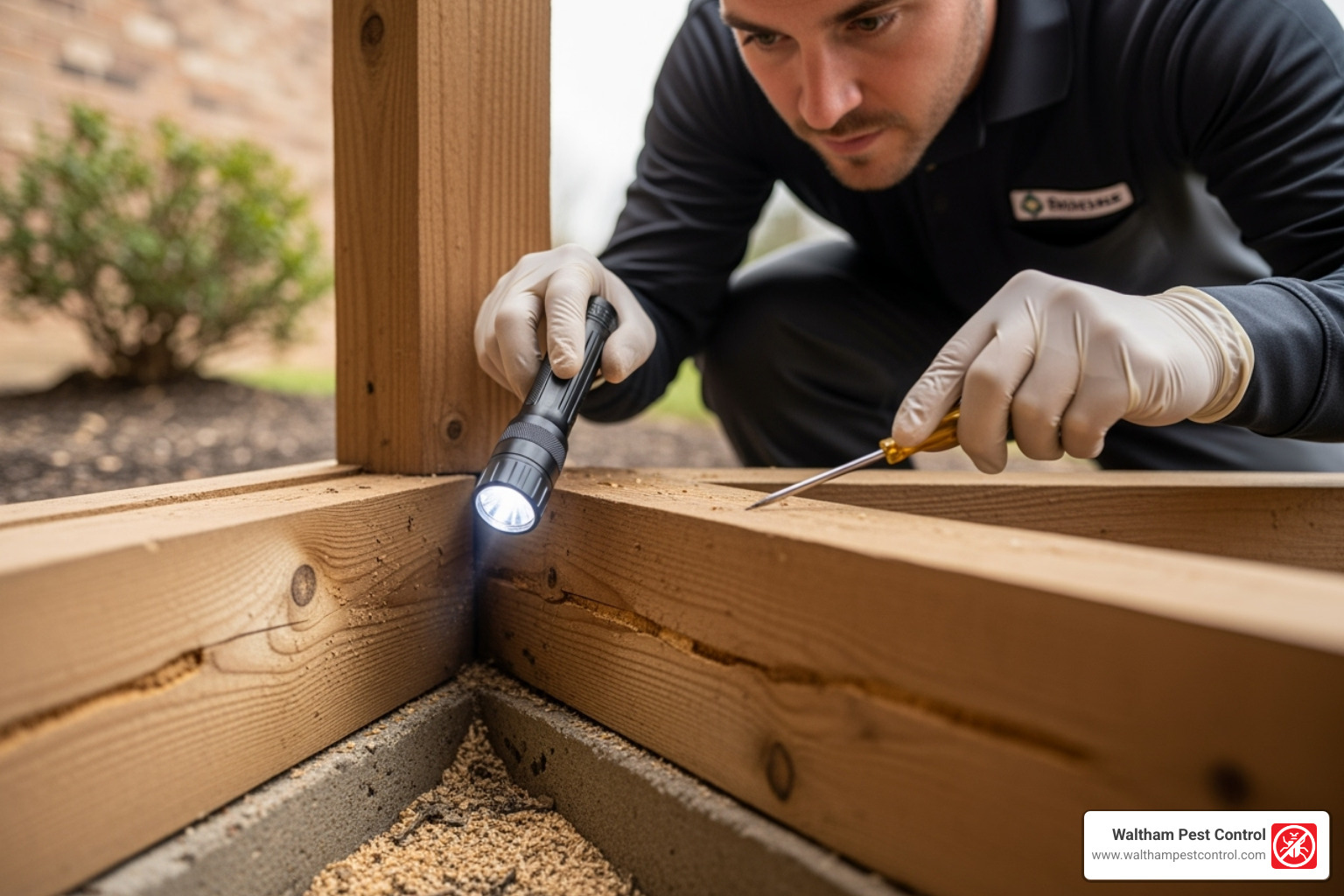
A one-time visit typically starts with a comprehensive inspection where a licensed technician assesses your property, identifies the type of termites present, and determines the extent of the infestation. Then comes the diagnosis and treatment plan custom to your specific situation.
Based on internet data, the average cost for a one-time termite treatment can range anywhere from $250 to $2,500 or more. That’s quite a range, I know. A smaller spot treatment might fall on the lower end, while treating an entire home’s perimeter with liquid termiticides or installing a comprehensive baiting system could push toward the higher end or beyond.
The treatment method makes a big difference too. Creating a complete liquid barrier around your foundation requires more product and labor than treating a single infested area. Your home’s size, accessibility, and even the type of construction all factor into the final cost.
Monthly Service
Monthly service plans are less common for termites specifically, but some termite treatment companies do offer them, particularly if you’re dealing with a severe infestation or want to bundle termite protection with other pest control services. These plans typically include an initial visit for intensive treatment, followed by regular monthly check-ups and preventative applications.
The initial visit cost is usually higher to address the active infestation, while the recurring monthly fee covers ongoing monitoring and immediate response if new termite activity pops up. Most effective termite treatments, especially professional liquid termiticides, offer protection that lasts years rather than months, which is why annual plans are more typical for termites alone.
That said, if you’re already dealing with multiple pest issues, a monthly comprehensive pest control plan that includes termite monitoring might make sense for your situation.
Annual Service
Annual service plans are the sweet spot for most homeowners seeking long-term termite protection. These plans give you peace of mind without breaking the bank, and they’re designed around the fact that quality termite treatments provide lasting protection.
Here’s how they typically work: you get an initial intensive treatment to eliminate any active infestation and create a protective barrier around your property. Then, you receive annual inspections where a technician checks for any signs of new termite activity, inspects bait stations if you have them, and applies booster treatments if needed.
The beauty of an annual plan is that it catches new threats early, before they can cause significant structural damage. Regular monitoring means we’re not just reacting to problems – we’re preventing them. And the cost of that annual service? It’s typically a fraction of what you’d pay for the initial treatment, making it an affordable way to protect one of your biggest investments.
At Waltham Pest Control, we believe in transparent pricing and customized solutions. Every home is different, so we’ll conduct a thorough inspection and provide you with a detailed estimate based on your specific needs. No surprises, no hidden fees – just honest, effective termite protection.
Frequently Asked Questions about Termite Treatment Companies
You’ve got questions – we’ve got answers. After four decades in the business, we’ve heard just about every concern homeowners have when it comes to choosing among termite treatment companies. Let’s tackle the big ones together.
Are Termite Contracts Worth It?
Here’s the honest truth: termite contracts are almost always worth every penny. Think of them as insurance for your home’s foundation – literally.
Termites cause billions of dollars in damage across the United States every single year, and here’s the kicker: most homeowner insurance policies won’t cover a cent of it. They consider termite damage preventable, which means you’re on the hook for repairs that can run into tens of thousands of dollars.
A termite contract, typically structured as an annual service agreement, gives you something priceless: financial security and peace of mind. These agreements usually include regular inspections by trained technicians who know exactly what to look for. Even better, many contracts come with warranties that cover re-treatment if termites dare to return, and some even cover repairs for new damage that occurs during the contract period.
Given that termites work silently, often for years before you notice anything wrong, having professional eyes on your property regularly is invaluable. It’s not just about treating current problems – it’s about catching potential damage before it becomes a financial nightmare. A contract with reputable termite treatment companies is a proactive investment in your home’s structural integrity and your wallet’s well-being.
What is the Most Effective Treatment for Termites?
After working in pest control for over 40 years, I can tell you that liquid termiticides – particularly those containing fipronil – are the gold standard for treating subterranean termites, which cause the vast majority of termite damage in our area.
What makes these products so effective is their sneaky approach. Fipronil is non-repellent, meaning termites can’t detect it. They unknowingly walk through the treated zone, pick up the product on their bodies, and carry it back to their colony. Through their natural social behaviors – grooming each other, feeding each other – they spread the termiticide throughout the entire colony. It’s like a domino effect that provides long-term protection for your home, often lasting years.
Now, for drywood termites, the approach is different. Whole-house fumigation works well for widespread drywood infestations, while spot treatments can handle smaller, isolated problems. The truth is, there’s no one-size-fits-all answer. The “most effective” treatment depends on what type of termites you’re dealing with, how extensive the infestation is, and the unique characteristics of your property.
That’s exactly why a thorough inspection by experienced professionals is the crucial first step. We need to understand your specific situation before we can recommend the treatment that will work best for you.
How Much Does Termite Treatment Cost?
This is probably the question we hear most often, and I wish I could give you a simple answer. The reality is that termite treatment costs vary quite a bit based on your specific situation.
Based on general internet data, you might see prices ranging anywhere from approximately $250 for very small, localized treatments or preventative measures, all the way up to $2,500 or even $7,500 or more for extensive infestations across large properties. These are average costs based on internet research, not actual costs for Waltham Pest Control.
Several pricing factors influence what you’ll actually pay. The type of termite matters – subterranean and drywood termites require different approaches. The size of the infestation plays a huge role; a small problem caught early costs far less than years of unchecked damage. Your home’s size and construction affect the amount of materials and labor needed. The treatment method itself – whether it’s liquid barriers, bait systems, or fumigation – comes with different cost structures.
Geographic location can shift prices, and the service frequency you choose makes a difference too. A one-time treatment has a different price point than an ongoing annual service plan, though that annual plan often provides better long-term value and protection.
Here’s what I always tell homeowners: the real cost isn’t just the treatment itself. It’s weighing that against the potential cost of structural repairs if termites go unchecked. We’ve seen homes with damage in the tens of thousands of dollars that could have been prevented with timely treatment.
At Waltham Pest Control, we believe in transparency. We’ll always provide a detailed assessment of your specific situation and a clear plan before any work begins. No surprises, no hidden fees – just honest solutions custom to your home’s needs and your budget.
Conclusion
Your home is more than just a building – it’s your family’s shelter, your financial investment, and the place where life happens. Protecting it from termites isn’t something to put off or take lightly. These silent destroyers work around the clock, and by the time you spot the damage, they may have already cost you thousands in repairs that insurance won’t cover.
That’s where choosing the right termite treatment companies makes all the difference. You need more than just someone to spray some chemicals and disappear. You need a partner who understands local termite behavior, uses proven treatment methods, and stands behind their work with real commitment.
At Waltham Pest Control, we’ve been protecting homes and businesses across Eastern Massachusetts for over 40 years. We’ve seen it all – from minor infestations caught early to major structural damage that could have been prevented. Our quality and commitment aren’t just marketing words; they’re the foundation of how we operate every single day. Our licensed and insured technicians bring decades of combined experience to your property, and we pride ourselves on offering cost-effective solutions that actually work.
We serve communities throughout Middlesex, Essex, and Norfolk Counties – from Acton to Woburn, Cambridge to Framingham, and everywhere in between. We know the termite challenges specific to our region, and we know how to solve them effectively.
Don’t wait until you see mud tubes on your foundation or find piles of discarded wings on your windowsills. By then, termites may have already caused serious damage. Reach out to us today for a thorough inspection and a customized treatment plan that gives you real peace of mind. Your home deserves the best defense against termites, and we’re here to provide it.