
Commercial Ant Control: 2024’s Ultimate Guide
The Importance of Commercial Ant Control
Commercial ant control is essential for maintaining a clean and safe environment in business spaces. If you’ve spotted ants in your commercial building, here’s what you need to know right away:
- Commercial Ant Control: Effective pest management strategies custom for businesses.
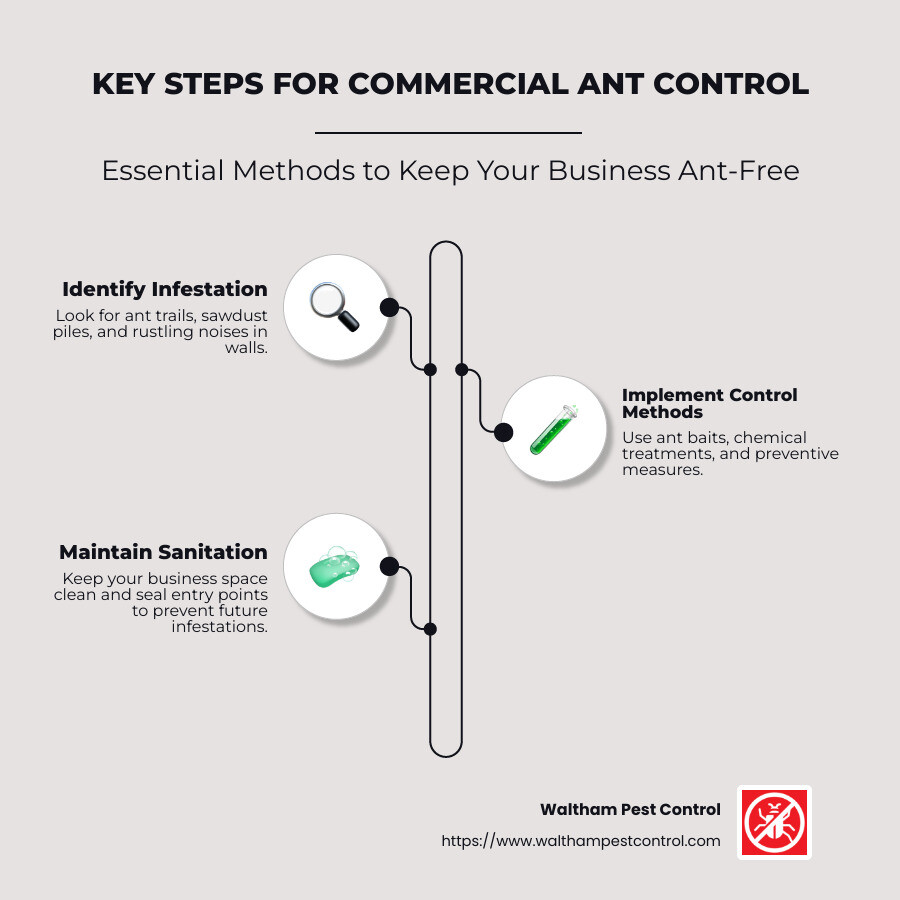
- Infestation Signs: Ant trails, sawdust piles, rustling noises in walls.
- Key Methods: Ant baits, chemical treatments, preventive measures.
- Why It Matters: Prevents damage, ensures sanitary conditions, protects reputation.
Ant infestations can cause significant disruptions in commercial spaces. Businesses such as restaurants, retail stores, and offices can suffer from contaminated food, compromised structural integrity, and tarnished reputations. Being proactive with commercial ant control not only keeps these pesky invaders at bay but also ensures your business operates smoothly.
For over 40 years, I, Waltham Pest Control, have led Waltham Pest Control, specializing in commercial ant control and other pest management solutions across Eastern Massachusetts. With expert techniques and years of experience, we ensure your business remains pest-free.
Next, we’ll dig into understanding ant behavior to improve your commercial ant control efforts.
Understanding Ant Behavior
To tackle any ant problem effectively, you need to understand their behavior. Let’s break down the basics of ant species, colony structure, and foraging habits.
Ant Species
There are many types of ants, but not all invade commercial spaces. Some common culprits include:
- Carpenter Ants: Known for damaging wood structures.
- Fire Ants: Aggressive and can cause painful stings.
- Black House Ants: Often found in kitchens and pantries.
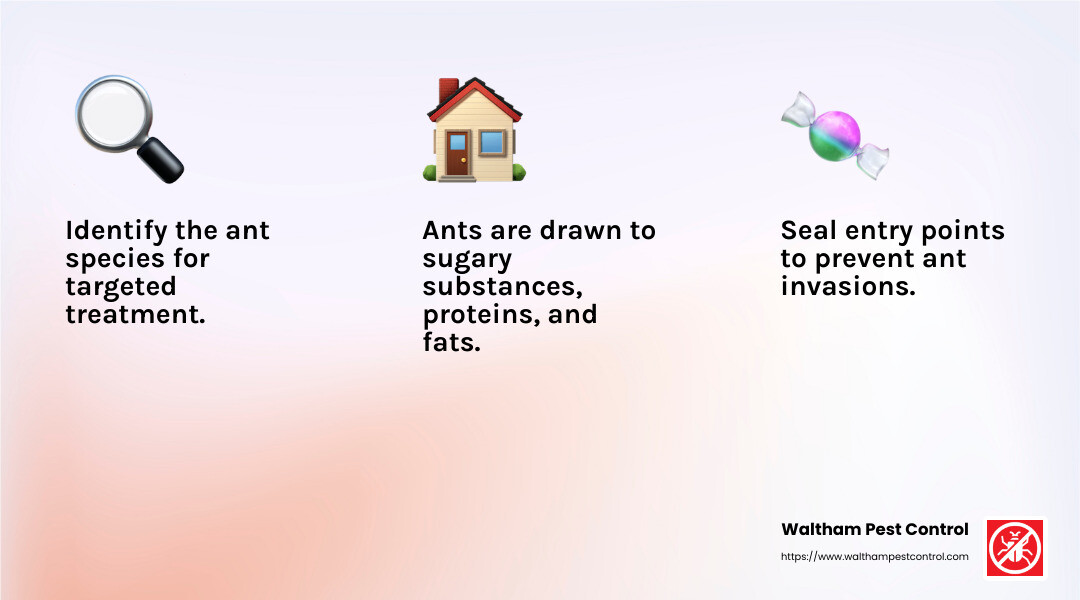
Each species has unique behaviors and preferences, which is why identifying the type of ant is the first step in control.
Colony Structure
Ants are social insects with a highly organized colony structure. A typical colony includes:
- Queen(s): The reproductive center of the colony. Killing the queen is crucial for eliminating the colony.
- Workers: These ants forage for food and bring it back to the colony.
- Soldiers: They protect the colony from threats.
- Brood: The eggs, larvae, and pupae that will become future ants.
Understanding this structure helps in targeting treatments effectively. For instance, using ant baits allows workers to carry poison back to the nest, ultimately reaching the queen and the brood.
Foraging Habits
Ants forage for food to sustain their colony. They follow pheromone trails laid down by other ants, which is why you often see them in lines. Here’s what you should know:
- Food Sources: Ants are attracted to sugary substances, proteins, and fats.
- Pheromone Trails: These chemical trails guide other ants to food sources. Disrupting these trails can help in controlling the infestation.
- Entry Points: Ants enter buildings through cracks, gaps, and other small openings. Sealing these entry points can prevent future invasions.
By understanding these habits, you can better implement commercial ant control strategies. For example, placing bait stations along foraging trails ensures that workers carry the poison back to the colony.
Next, we’ll explore the methods for identifying ant problems in your commercial space.
Identifying the Ant Problem
Before you can effectively control ants in your commercial space, you need to identify the problem. This involves a thorough inspection, recognizing signs of infestation, following ant trails, and identifying entry points.
Inspection
Start with a detailed inspection of your commercial property. Look for areas where ants are most likely to be found, such as kitchens, storage areas, and break rooms. Pay attention to:
- Visible Ants: Note where you see ants most frequently.
- Food Sources: Check areas where food is stored or consumed.
- Moisture: Ants are attracted to moisture, so inspect bathrooms, kitchens, and areas with leaks.
Signs of Infestation
Recognizing the signs of an ant infestation can help you pinpoint the severity and location of the problem. Common indicators include:
- Ant Trails: Lines of ants moving to and from food sources.
- Nests: Look for ant hills or mounds outside and sawdust piles indoors, especially for carpenter ants.
- Discarded Wings: Swarming ants often leave behind wings, indicating a nearby nest.
Ant Trails
Ants follow pheromone trails to food sources, which can help you trace back to their nest. Here’s how to use these trails to your advantage:
- Follow the Line: Carefully follow the ant trail to see where they are coming from and going to.
- Bait Placement: Place ant baits along these trails to ensure worker ants carry the poison back to the colony.
Entry Points
Identifying how ants are entering your commercial space is crucial for long-term control. Common entry points include:
- Cracks and Gaps: Inspect walls, windows, and doors for small openings.
- Utility Lines: Ants can enter through gaps around pipes and electrical lines.
- Foundations: Check the building’s foundation for any breaches.
Seal these entry points with caulk or other appropriate materials to prevent future infestations.
By conducting a thorough inspection, recognizing signs of infestation, following ant trails, and identifying entry points, you can take the first steps in effective commercial ant control.
Next, we’ll explore effective commercial ant control methods.
Effective Commercial Ant Control Methods
When it comes to commercial ant control, using the right methods can make all the difference. Here, we’ll cover three main approaches: baiting techniques, chemical treatments, and natural remedies.
Baiting Techniques
Ant baits are one of the most effective ways to eliminate entire ant colonies. The key is to use non-repellent baits that ants can’t detect. Here’s a step-by-step guide to using baits:
- Choose the Right Bait: Select a bait that targets the specific ant species in your commercial space. Products like MAXFORCE FC Professional Ant Killer Stations are excellent choices. They contain Fipronil, which worker ants carry back to the colony, effectively killing the queen and other ants.
- Placement: Place baits along ant trails and near entry points. This ensures that foraging worker ants find the bait and carry it back to the nest.
- Monitor and Replenish: Check bait stations regularly and replenish them as needed. The goal is to maintain a constant supply of fresh bait until the colony is eliminated.
Chemical Treatments
Chemical treatments can offer quick and effective ant control, especially for large infestations. Here are the main types:
- Liquid Treatments: These are applied to the soil around your building’s foundation. Products like Termidor are highly effective as they are non-repellent, meaning ants pass through them without detecting the chemical. This leads to the eventual elimination of the entire colony.
- Foam Applications: These are useful for treating hard-to-reach areas such as wall voids and cracks. The foam expands to fill spaces, ensuring thorough coverage.
- Insect Growth Regulators (IGRs): These chemicals, like those found in Extinguish® Professional Fire Ant Bait, disrupt the reproductive cycle of ants. They are particularly effective against fire ants, preventing the queen from laying eggs and reducing colony size over time.
Natural Remedies
For those looking for more natural solutions, there are several effective options:
- Borax Mixtures: Create a bait using borax and sugar. The sugar attracts the ants, and the borax acts as a poison. Place the mixture in areas where ants are active.
- Diatomaceous Earth: This natural powder can be sprinkled around entry points and along ant trails. It dehydrates and kills ants on contact.
- Boiling Water: For outdoor nests, pouring boiling water directly into the mound can destroy the colony. Be cautious and ensure safety when using this method.
By combining these methods—baiting, chemical treatments, and natural remedies—you can effectively control ant infestations in commercial spaces. Next, we’ll discuss some of the top commercial ant control products available.
Top Commercial Ant Control Products
When it comes to commercial ant control, choosing the right products can significantly impact the effectiveness of your efforts. Below, we highlight two top products: Extinguish® Professional Fire Ant Bait and MAXFORCE FC Professional Ant Killer Stations.
Extinguish® Professional Fire Ant Bait
Extinguish® Professional Fire Ant Bait is designed to target fire ants specifically. Its active ingredient, (S)-Methoprene, is an insect growth regulator (IGR). This means it disrupts the reproductive abilities of the fire ant queen, preventing her from laying eggs and effectively reducing the colony size over time.
Key Benefits:
– Prevents New Mounds: By affecting the queen’s reproductive abilities, this bait stops new mounds from forming.
– Long-Term Control: Expect a reduction in colony size in about 3 weeks and complete elimination within 8-10 weeks.
– Large Coverage: A single bag treats up to 25 acres, making it ideal for extensive commercial properties like golf courses, parks, and sports fields.
MAXFORCE FC Professional Ant Killer Stations
MAXFORCE FC Professional Ant Killer Stations are versatile and effective for a wide range of ant species, including Pharaoh ants, Argentine ants, and Crazy ants. The active ingredient, Fipronil, is a powerful non-repellent insecticide. Worker ants carry the bait back to the colony, where it eliminates the queen and other ants.
Key Benefits:
– Child-Resistant: The bait stations are designed to be safe around children.
– Non-Repellent: Ants do not detect Fipronil, ensuring they carry the bait back to the nest.
– Comprehensive Colony Elimination: Kills both adult and larval ants, ensuring the entire colony is eradicated.
– Versatile Use: Suitable for various commercial environments including hospitals, schools, food service areas, and transportation facilities.
Using these top commercial ant control products can help ensure a thorough and long-lasting solution to your ant problems. By targeting the colony at its source, both Extinguish® and MAXFORCE FC offer reliable and efficient ant control for commercial spaces.
Next, we’ll explore the pros and cons of DIY ant control versus hiring professional services.
DIY vs. Professional Ant Control
When it comes to commercial ant control, deciding between DIY methods and hiring professionals can be tricky. Let’s break it down.
Cost Comparison
DIY Ant Control:
– Initial Cost: DIY products like ant baits and sprays generally cost between $20 and $50.
– Long-Term Cost: If the infestation persists, repeated purchases might be needed, adding up over time.
Professional Ant Control:
– Initial Cost: Professional services can range from $250 to $550 for a one-time treatment.
– Long-Term Cost: Often includes follow-up visits and guarantees, potentially saving money in the long run by addressing the root problem.
Effectiveness
DIY Ant Control:
– Short-Term: DIY solutions can be effective for minor infestations or as a preventive measure.
– Long-Term: May only address visible ants, not the entire colony, leading to recurring problems.
Professional Ant Control:
– Short-Term: Professionals use advanced techniques like non-repellent insecticides and baiting systems that target the whole colony.
– Long-Term: More likely to provide a complete and lasting solution, eliminating the colony and preventing future infestations.
Safety
DIY Ant Control:
– Risks: DIY products can contain harsh chemicals. Incorrect usage can pose risks to humans and pets.
– Precautions: Always read and follow product instructions carefully.
Professional Ant Control:
– Safety Measures: Professionals are trained to handle and apply chemicals safely, reducing risks.
– Health Concerns: They can choose products that are safer for specific environments, such as schools or hospitals.
Professional Advice
DIY Ant Control:
– Limited Guidance: Most DIY products come with basic instructions but lack personalized advice.
– Trial and Error: You might need to try different products to find what works best.
Professional Ant Control:
– Expert Knowledge: Professionals can identify the exact type of ant and the best treatment method.
– Customized Plans: They provide custom solutions based on the specific needs of your commercial space.
In summary, while DIY methods can be a cost-effective and convenient initial step, professional services offer a comprehensive and safer approach to commercial ant control. If you’re dealing with a persistent or large-scale infestation, hiring a professional might be the best option.
Frequently Asked Questions about Commercial Ant Control
What do professionals use for ant control?
Professionals use a range of methods to ensure effective commercial ant control. Here are some of the most common techniques:
- Liquid Treatments: These are non-repellent insecticides like Termidor that ants cannot detect. They walk through the treated area and carry the poison back to the colony, effectively killing it from the inside out.
- Foam Applications: Foam treatments are ideal for penetrating hard-to-reach areas like wall voids. They expand to fill the space, ensuring thorough coverage.
- Non-Repellent Insecticides: Products like Demand® CS and Tandem® insecticides are commonly used. They are undetectable by ants, allowing the pests to spread the poison throughout the colony.
These methods are highly effective because they target the entire colony, not just the ants you see.
What can I use to permanently get rid of ants?
For those looking to tackle an ant problem themselves, several options are available:
- Borax Mixtures: A homemade solution of borax and sugar water can be a highly effective bait. The sugar attracts the ants, and the borax kills them.
- Diatomaceous Earth: This natural powder dehydrates ants when they come into contact with it. It’s safe for humans and pets but deadly for ants.
- Boiling Water: Pouring boiling water directly into ant mounds can kill a significant number of ants on contact. However, it may not reach the queen or the deeper parts of the colony.
For a more permanent solution, combining these methods with professional advice and treatments is often the best approach. Professionals can identify the specific ant species and recommend the most effective treatment plan.
What is the most effective ant killer?
Several products are known for their effectiveness in commercial ant control:
- Terro T300 Liquid Ant Baits: These are popular for their simplicity and effectiveness. The liquid bait attracts ants, which then carry it back to the colony.
- Syngenta Advion Ant Gel: This gel is highly effective due to its attractive formulation and ease of application. It can be used in cracks and crevices where ants are likely to travel.
- Extinguish® Professional Fire Ant Bait: This product uses (S)-Methoprene to disrupt the reproductive abilities of the queen, leading to the colony’s eventual collapse.
- MAXFORCE FC Professional Ant Killer Stations: These bait stations contain Fipronil, a non-repellent that ants carry back to the colony. The stations are also child-resistant, making them a safe option for various environments.
Each of these products targets the entire colony, ensuring long-term control and prevention of future infestations.
By understanding and utilizing these methods and products, you can achieve effective and lasting commercial ant control. For persistent or large-scale infestations, professional services remain the most reliable option.
Next, we’ll explore the Conclusion and summarize the key points to keep your commercial space ant-free.
Conclusion
Effectively managing ants in commercial spaces can be challenging, but it’s crucial for maintaining a clean and safe environment. From identifying the ant problem to implementing the right control methods, a comprehensive approach is essential.
Summary
We’ve covered various methods for commercial ant control, including baiting techniques, chemical treatments, and natural remedies. Products like Extinguish® Professional Fire Ant Bait and MAXFORCE FC Professional Ant Killer Stations have proven effective in targeting entire colonies, ensuring long-term results.
Long-Term Solutions
For sustained ant control, it’s important to:
- Regularly inspect and monitor ant activity.
- Implement preventive measures like sealing entry points and maintaining cleanliness.
- Use a combination of baiting, chemical treatments, and natural remedies as needed.
Waltham Pest Control: Your Professional Partner
At Waltham Pest Control, we bring over 40 years of experience in providing top-notch pest management solutions. Based in Burlington, MA, we serve Eastern Massachusetts with licensed, insured, and cost-effective services. Our commitment to quality ensures that your commercial space remains ant-free.
Whether you’re dealing with a minor infestation or a large-scale problem, our team of experts is here to help. We offer personalized treatment plans custom to your specific needs, ensuring effective and long-lasting results.
For more information, visit our Commercial Pest Control page.
By partnering with Waltham Pest Control, you can trust that your commercial ant control needs will be met with professionalism and expertise. Say goodbye to ants and hello to a pest-free environment!
